

Plagiarism detection and AI writing detection answer two fundamentally different technical questions, operate on incompatible mathematical models, and fail in opposite ways ([1], verified October 4, 2026; [2], 2026)[1]. Plagiarism checkers (Turnitin, iThenticate, Copyscape, and Grammarly's similarity engine) execute deterministic string-matching queries against indexed databases of existing text to answer: "Does this sequence of words appear elsewhere?"[1]. AI detectors (Pangram, Originality.ai, GPTZero, and Turnitin's AI Writing Report) run probabilistic statistical classifiers over token predictability (perplexity) and sentence-rhythm variance (burstiness) to answer: "How closely does this prose resemble the statistical distribution of a large language model?" ([3], 2026; [4], October 31, 2026)[2]. A 100% original human-written novel can score 0% for plagiarism while triggering a 78% to 100% AI-generation flag simply because polished, edited human prose follows the exact linguistic conventions language models were trained to imitate ([5], May 26, 2026)[5].
For solo working writers in 2026, tool selection depends strictly on which corpus and failure mode apply to a submission ([6], August 27, 2026)[6]. Turnitin sells no individual license at any price ([7], verified November 2026)[6]; its official self-serve route for solo authors is iThenticate ($125 for one manuscript up to 25,000 words; $300 for up to three manuscripts or one up to 75,000 words, with AI detection explicitly excluded from individual packages) ([8], verified November 14, 2026; [9], verified November 2026)[8]. Copyscape Premium ($0.03 for the first 200 words plus $0.01 per additional 100 words) is the lowest-cost web-duplication check ($9.01 for a 90,000-word novel, $0.16 for a 1,500-word pitch) ([10], verified November 14, 2026), but it is blind to academic databases and paywalled journals[10]. Grammarly Pro ($12/month billed annually or $30/month billed monthly) ([11], verified November 9, 2026) scans 16 billion web pages and ProQuest academic databases inside the editor, catching 82% of plagiarized passages in third-party testing ([12], 2026; 99% on verbatim copy-paste, but only 3%–5% on paraphrased text in August–October 2026 tests), while its bundled AI detector was rated the least reliable tool tested in a University of Chicago Academic Technology Solutions evaluation ([13], March 2026)[14]. When screening for AI flags specifically, Pangram led a June 2026 International Journal for Educational Integrity benchmark—correctly identifying 37 of 40 mixed-text papers and 37 of 40 human-rewritten AI papers ([15], June 2026)6—yet even Pangram's probability scores have fueled major publishing cancellations and prize disputes, making a timestamped provenance file the only non-probabilistic defense for human authorship ([16], July 1, 2026)[17].
1. Tool Specifications and Production Layer Dossier
1A. Master Structured Data Comparison: Similarity Checkers and AI Detectors
| Field | Turnitin (Feedback Studio / Originality) | iThenticate (Individual Credits) | Copyscape Premium | Grammarly Pro (Plagiarism + AI) | Pangram (Pangram 4 / 4.1) | Originality.ai (Model 5.0 / Pro) | GPTZero (Essential / Premium / Pro) |
|---|---|---|---|---|---|---|---|
| Pricing | Institutional only; no individual license sold at any price[6]. Public benchmark: ~$6.70/FTE/yr (min 1,000 licenses = $6,700/yr)[18]. | One-time credits: Single $125 (1 MS up to 25,000 words); Multiple $300 (up to 3 MS or 1 MS up to 75,000 words)[8]. Valid 12 mos; includes 5 free revisions[8]. | Pay-per-search: 3¢ ($0.03) for first 200 words + 1¢ ($0.01) per additional 100 words (or part thereof)[10]. Free tier: URL-only, max 10 results[10]. Copysentry: $4.95–$19.95/mo[10]. | Subscription: $12/month billed annually ($144/yr), $20/mo quarterly ($60/3 mos), or $30/month monthly[11]. Plagiarism check excluded from Free tier (yes/no flag only)[13]. | Freemium / Sub / API: Free: 20 credits/day (~2,000 words/day)[19]. Individual: $20/mo ($15/mo annual) for 300k words/mo[19]. Pro: $65/mo ($45/mo annual, 1.5M words)[19]. API: $0.05/100 words[20]. | Freemium / Sub / PAYG: Free: 100 one-time credits + 60/day[21]. Pro: $14.95/mo ($12.95/mo annual, $155.40/yr) for 2,000 credits[6]. PAYG: $30 for 3,000 credits (2-yr validity)[21]. 1 credit = 100 words (AI or Plag); 2 credits = 100 words (both)[21]. | Freemium / Subscription: Free: $0 (10,000 words/mo, 10k chars/scan)[22]. Essential: $14.99/mo ($8.33/mo annual, 150k words)[22]. Premium: $23.99/mo ($12.99/mo annual, 300k words)[22]. Pro: $45.99/mo ($24.99/mo annual, 500k words)[22]. |
| What It Checks Against | 1.9B+ student papers, 178M+ subscription journal articles, Crossref publications, ProQuest dissertations, and billions of archived/live web pages[23]. | 244M subscription sources, 85,000+ journals (1,500+ Crossref publishers incl. IEEE, Springer Nature, Wiley), ProQuest theses, 200M+ open-access items, 54B web pages across 170 languages[24]. | Publicly indexed open web pages (blogs, news sites, corporate pages, online publications) plus optional user-populated Private Index ($0.01/1,000 words)[25]. | Over 16 billion public web pages and ProQuest academic databases (incl. PubMed, arXiv, ScienceDirect, Springer, SAGE, PLOS One, Frontiers, DOAJ, Elsevier)[1]. | Statistical token embeddings trained on 1M+ human documents and 26 frontier LLMs (GPT-5/6, Claude 5/5.5, Gemini 3/4, DeepSeek V4, Llama 3.3); paid plans bundle web similarity check[20]. | Proprietary ML classifiers (Models 5.0, Turbo 3.0.2, Lite 1.0.2, Academic) for AI generation, plus public web index for plagiarism and fact/hallucination checking[6]. | 7-component statistical classifier (perplexity, burstiness, AI vocabulary, model fingerprints across GPT, Claude, Gemini, Llama) plus web plagiarism check on paid tiers[26]. |
| What It Does Not Check (The Gap) | Cannot be accessed by solo writers outside an institution; submitting via unauthorized third-party brokers risks depositing your manuscript into a school's private repository[6]. | Excludes Turnitin's 1.9B student paper repository on individual packages, excludes AI detection on individual credits, and caps single files at 75,000 words on the $300 tier[6]. | Does not check academic databases, paywalled journals, student paper repositories, unpublished documents, or ideogram scripts (Chinese, Japanese, Korean)[25]. | Does not check Turnitin's student paper repository, non-ProQuest Crossref publisher full text, or unpublished files; caps single scans at 100,000 characters (~15k–20k words)[1]. | Does not check paywalled academic databases or student repositories; declares texts under 50 words, code, math notation, machine translations, and bibliographies out of scope[27]. | Does not check Turnitin's student repository or paywalled journal full text (Crossref/iThenticate corpus)[6]. | Free tier does not include plagiarism checking; paid plagiarism check does not index Turnitin's student repository or paywalled publisher archives; free scans cap at 10,000 characters[22]. |
| AI Detection Included? | Yes (institutional add-on via Turnitin Originality)[18]. Visible only to instructors/admins; requires 300+ words; hides scores 1%–19% as *%[28]. | No on individual credits (explicitly excluded; requires buyer acknowledgment at checkout)[8]. Available only on custom Organization plans[8]. | Not in standard plagiarism search (fresh AI text returns 0 matches)[25]. Separate Copyscape Premium AI Detector and Enterprise AI support offered[25]. | Yes (bundled in Grammarly Pro, plus standalone basic web detector and Grammarly Authorship process tracking)[11]. | Yes (primary function). Classifies text into Human, AI-Assisted, Mixed, or AI-Generated across 24 languages[27]. | Yes (primary function alongside web plagiarism). Costs 1 credit/100 words for AI alone, or 2 credits/100 words for combined AI + Plagiarism[21]. | Yes (primary function). Includes AI Detector, Writing Replay (process verification), and Hallucination Detector[22]. |
| Report Format | Color-coded Similarity Score (%) with source links + separate cyan/purple AI Writing Report (%) for LLM-generated and AI-paraphrased text[29]. | Interactive Similarity Report with Match Groups, source comparison, exclusion filters (quotes, bibliography, small matches), and screen-reader PDF export[24]. | Matched web URLs, word-count overlap, percentage of your text matched, highlighted duplicate snippets, and separate red-highlighted AI probability score (up to 99%)[25]. | Overall Originality Score (% matching external sources), sidebar source links, auto-formatted APA/MLA/Chicago citations, and % "Resembles AI text"[30]. | 4-tier classification, AI fraction/likelihood %, segment-level passage highlighting, and 245ms API response[31]. | Confidence score (% Original vs. % Likely AI), sentence-level color highlighting, readability score, and shareable/downloadable PDF reports[21]. | Document AI probability %, 3-tier classification (Human, Mixed, AI), sentence-level highlights, AI Vocabulary flags, and Writing Replay video[22]. |
| False-Positive Behaviour (Vendor vs. Independent) | Vendor: <1% document FPR (at 20%+ threshold), ~4% sentence FPR[32]. Independent: 0.61 macro-average accuracy in Hadra et al. (2026)[33]; 61.22% aggregate detector FPR on non-native TOEFL essays (Liang et al., 2023)[3]. | Similarity only: Matches legitimate quotes, bibliographies, and standard terminology unless filters are toggled; Turnitin notes ~50% edge-case common-phrase flags in small-sample Washington Post review[23]. | Similarity only: Zero false positives on unindexed text, but flags syndicated quotes or common boilerplate on the public web[25]. Separate AI detector warns against use as proof[25]. | Vendor: Claims 99% AI accuracy on RAID[34]. Independent: UChicago ATS rated its AI detector "least reliable" (false positives on human text + missed 8 of 16 AI texts in Oct 2026 test)[14]; 0%–9% FPR on Authors Guild pre-2022 articles[5]. | Vendor: 0.01% target FPR (0.0090% on Pangram 4.1 across 781,981 English docs; 0.000% on 10,495 creative writing samples; 0.078% on poetry)[35]. Independent: 0% FPR on Authors Guild (10 articles)[5] and VUB study (40 ESL papers)[27], but 14.9% FPR on 2023–2025 human abstracts (26.6% in theology) in Notre Dame study[27], plus high-profile disputes (Shy Girl, Commonwealth Prize, Goncourt)[36]. | Vendor: 99%+ accuracy, 0.5%–1.5% FPR[37]. Independent: 92% accuracy / 5.7% FPR (CyberNews 2026)[38]; 0.69 macro-average accuracy (Hadra et al., 2026)[33]; 76% accuracy / 14%–28% FPR (Scribbr/Axis)[13]; 0%–1% FPR on Authors Guild test[5]. | Vendor: ~99% accuracy, ~1% FPR (0.05% on Booth rerun)[39]. Independent: 0.24% FPR on Chicago Booth benchmark[40], 6%–8% FPR in academic benchmarks, and 15% FPR in real-world 200+ university essay test[40]; missed 39 of 40 humanized AI papers in VUB study[41]. |
| Best For (Writer Profile) | University-affiliated researchers, instructors, and students submitting via institutional LMS[42]. | Academic-adjacent nonfiction authors and scholars submitting to university presses or journals that run Crossref/Turnitin[6]. | Novelists, KDP self-publishers, and freelance writers running low-cost web-duplication checks on drafts or pitches[25]. | Working writers and freelancers wanting integrated grammar editing, citation formatting, Authorship tracking, and verbatim web/ProQuest checks[30]. | Fiction writers, essayists, and small presses wanting the lowest-FPR AI sanity check on creative prose[27]. | SEO publishers, content agencies, and freelance editors screening bulk web articles for raw or paraphrased AI and web duplication[13]. | Students, educators, and writers wanting a generous free AI check (10k words/mo) and Chrome Writing Replay verification[22]. |
| Key Limitation (One Sentence, Sourced) | Turnitin refuses to sell individual licenses at any price[7], and its AI detector achieved only 0.61 macro-average accuracy in peer-reviewed testing (Hadra et al., 2026)[7]. | Individual iThenticate packages cost $125–$300, cap single manuscripts at 75,000 words, and explicitly exclude AI writing detection[8]. | Copyscape scans only the public web—missing all academic databases, paywalled journals, and paraphrased text[10][25]. | Grammarly's plagiarism checker misses 95%–97% of paraphrased copying, and its AI detector was rated the least reliable tool tested in a University of Chicago evaluation[30]. | Despite leading academic benchmarks, Pangram drops in accuracy on short texts (<100 words), missed 96.6%–98.5% of Undetectable AI-humanized abstracts in a 2026 Notre Dame study, and flagged human-claimed literary prize winners at 88%–100% AI[27]. | Independent accuracy figures diverge sharply from vendor claims—dropping to 0.69 macro-average accuracy in Hadra et al. (2026) and 92% accuracy with a 5.7% false-positive rate in CyberNews's 2026 evaluation[33]. | GPTZero failed to detect 40 of 40 hybrid papers and 39 of 40 humanized AI papers in the June 2026 Vrije Universiteit Brussel study, while flagging 6%–15% of human essays in independent university testing[19]. |
| Last Verified Date | November 2026 (guides.turnitin.com, turnitin.com/blog, Hadra et al. Feb 2026)[7]. | November 14, 2026 (ithenticate.com, helpcenter.turnitin.com)[8]. | November 14, 2026 (copyscape.com/faqs.php, copyscape.com/enterprise.php)[10]. | November 9, 2026 (support.grammarly.com, grammarly.com/plagiarism-checker)[11]. | November 14, 2026 (pangram.com/research/model-card/pangram-4-1, Oct 19, 2026)[35]. | November 1, 2026 (originality.ai/pricing, plagiarismcheckerplus.com)[21]. | November 8, 2026 (gptzero.me/pricing, support.gptzero.me Oct 19, 2026)[43]. |
Scroll sideways to see all columns →
1B. The Production Layer: Summary of Rules Governing Originality Checks in 2026
| Production Rule | Core Operational Principle | Primary Evidence / Industry Standard (2026) | Action Required from the Working Writer |
|---|---|---|---|
| Plagiarism vs. AI Detection | Plagiarism matches character strings against an external corpus; AI detection calculates internal token predictability (perplexity) and sentence uniformity (burstiness)[1]. | A text can be 100% original and score 100% AI (e.g., Mary Shelley's Frankenstein on Decopy AI)[44]; conversely, verbatim copied human text scores 0% AI[2]. | Never buy a similarity-only package (like individual iThenticate) expecting an AI score[9], and never treat an AI probability score as evidence of copying[1]. |
| The False-Positive Problem | LLMs are trained on clean, edited human prose; therefore, polished, conventional human writing exhibits low perplexity and triggers false positives[5]. | Authors Guild (May 26, 2026) found consumer detectors flagged pre-2022 human articles up to 100% AI[5]. | Do not degrade your prose or insert intentional typos to appease detectors[4]; rely on process documentation rather than chasing a 0% detector score[45]. |
| The "Prove You Wrote It" Protocol | Probabilistic detector scores cannot be refuted by running a second probabilistic detector; they can only be refuted by documented process provenance[45]. | Commonwealth Foundation cleared Jamir Nazir's "The Serpent in the Grove" (flagged 100% AI by Pangram) in July 2026 after inspecting 6–7 timestamped drafts, outlines, and notes[16]. | Maintain a dedicated Provenance Folder containing cloud version history (Google Docs/Word/Scrivener), dated milestone files (YYYY-MM-DD_Title_Draft01.docx), research notes, and editorial emails[45]. |
| KDP & Publisher AI Disclosure | Platforms police undisclosed AI generation, not AI-assisted editing or brainstorming, but authors bear strict contractual liability for undisclosed third-party editor AI use[45]. | Amazon KDP[46] mandates disclosure of AI-generated text/images/translations (even if heavily edited afterward) but exempts AI-assisted brainstorming and editing[46]. | Disclose any prompt-generated prose or cover art per KDP and publisher guidelines, and add an explicit no-AI warranty clause to contracts with freelance editors and ghostwriters[17]. |
Scroll sideways to see all columns →
2. The Pairing Matrix: Head-to-Head Verdict Guide
Because no single tool indexes both private academic repositories and the open web while maintaining zero AI false positives at an individual price point, the right tool changes by pairing and writer task ([6], August 27, 2026)[23].
Master Pairing Summary Table
| Pairing | Winner by Writer Task | Decisive Factor |
|---|---|---|
| 1. Turnitin vs. iThenticate | iThenticate for solo authors and independent researchers; Turnitin for university-affiliated students/faculty. | Access channel: Turnitin sells zero individual licenses; iThenticate is the official self-serve route to Turnitin's scholarly database[6]. |
| 2. Turnitin vs. Copyscape | Copyscape for solo web writers and novelists; Turnitin for institutional academic integrity. | Corpus vs. availability: Turnitin checks student papers and journals for institutions; Copyscape checks the live web for pennies per search[23]. |
| 3. iThenticate vs. Copyscape | iThenticate for academic-adjacent nonfiction; Copyscape for fiction, journalism, and freelance copy. | Database scope vs. price: $300 for 244M academic subscription sources vs. $9.01 for a 90,000-word public web duplication scan[8]. |
| 4. Grammarly vs. Copyscape | Copyscape for pure, low-cost web duplication; Grammarly Pro for integrated editing + verbatim ProQuest/web checks. | Workflow integration vs. per-search economics: $0.16 per 1,500-word pitch on Copyscape vs. $12–$30/month for an all-in-one writing assistant[25]. |
| 5. Grammarly vs. Turnitin | Turnitin (or iThenticate) for scholarly/paraphrased rigor; Grammarly Pro for everyday drafting and citation hygiene. | Paraphrase sensitivity and student archive: Grammarly catches 80%–99% of verbatim copy-paste but only 3%–5% of paraphrased text[30]. |
| 6. Copyscape vs. Grammarly for Fiction | Copyscape for full-manuscript pre-query checks; Grammarly Pro only if you use Grammarly Authorship without accepting heavy AI rewrites. | Scan limits and AI false-positive contamination: Grammarly caps scans at 100k characters and heavy Grammarly rewrites trigger AI detectors[13]. |
| 7. Pangram vs. Originality.ai | Pangram for creative writing and literary prose; Originality.ai for bulk SEO/web publishing workflows. | False-positive control vs. cost per word: Pangram reports a 0.000% creative-writing FPR in internal tests and led the 2026 VUB study (37/40)[27]. |
| 8. Pangram vs. Turnitin AI Detection | Pangram for individual author self-checks and humanized-AI detection; Turnitin for institutional compliance. | Accuracy and access: Turnitin AI is locked to institutions and scored 0.61 in Hadra et al. (2026), while Pangram is open to individuals and beat Turnitin in the 2026 VUB study[9]. |
| 9. Plagiarism Checker vs. AI Detector | Plagiarism Checker to verify source attribution; AI Detector to preview algorithmic predictability. | Category separation: Database string-matching (similarity) vs. probabilistic LLM token prediction (generation)[1]. |
| 10. Free Tool vs. Paid Tool | Free tools (GPTZero Free, Pangram Free) for short AI spot-checks; Paid tools (Copyscape Premium, iThenticate) for unpublished manuscripts. | Unpublished draft capability: Free Copyscape requires a live URL, and free Grammarly hides all matched passages and source links[10]. |
| 11. Before Submission vs. Before Publication | Before submission for academic citations and provenance logging; Before publication for web-scraping and third-party editor audits. | Risk vector: Pre-submission protects against accidental source overlap; pre-publication catches freelance editor AI insertion (Shy Girl scenario)[1]. |
Scroll sideways to see all columns →
2.1 Turnitin vs. iThenticate
Verdict: iThenticate wins by default for any solo author or independent researcher because Turnitin does not sell individual licenses at any price, making iThenticate the only official self-serve gateway to Turnitin's scholarly publication database ([6], August 27, 2026)[6].
| Dimension | Turnitin (Feedback Studio / Originality) | iThenticate (Individual Credits) |
|---|---|---|
| Corpus Coverage | 1.9B+ student papers, 178M+ subscription journal articles, Crossref, ProQuest, and 54B+ web pages[23]. | 244M subscription sources, 85,000+ journals (1,500+ Crossref publishers), ProQuest, and 54B web pages; excludes the student paper repository on individual credits[6]. |
| AI Detection | Included for institutions licensing Turnitin Originality (hidden from students; 300-word minimum; 1%–19% scores masked as *%)[18]. | Explicitly excluded from $125 Single and $300 Multiple individual credit packages[8]. |
| Price & Access | Quote-based institutional procurement only (e.g., ~$6.70/FTE benchmark); $0 to enrolled students/faculty[6]. | Self-serve credit checkout: $125 (1 MS ≤25,000 words) or $300 (up to 3 MS or 1 MS ≤75,000 words), valid 12 months with 5 revisions[8]. |
| Repository Storage & Privacy | Standard institutional assignments store submissions in Turnitin's database by default unless configured to "no repository"[13]. | Individual submissions are never added to a shared searchable repository; authors can permanently delete files via the trash folder[24]. |
Scroll sideways to see all columns →
Choose Turnitin if you hold an active university affiliation (faculty, staff, or student) and can run your draft through an instructor-enabled "no-repository" sandbox or Turnitin Draft Coach at zero personal cost[42]. Choose iThenticate if you are an independent nonfiction author, medical writer, or scholar submitting to a trade or university press (or a journal using Crossref Similarity Check) and need to audit your manuscript against paywalled scholarly journals without risking repository self-matching[6]. 2025–2026 Changes: Turnitin reinforced its checkout policy on iThenticate requiring individual buyers to explicitly acknowledge before payment that AI Writing Detection is excluded from $125 and $300 credit packages ([9], verified November 2026)[9]. Meanwhile, institutional iThenticate 2.0 expanded its AI detection limit to 30,000 words in April 2026 and added Japanese (April 2026) and Arabic (August 18, 2026) AI detection[29][18].
2.2 Turnitin vs. Copyscape
Verdict: Copyscape wins for solo authors, novelists, and freelance journalists who need an immediate, affordable public-web duplication check, whereas Turnitin is exclusively an institutional academic tool ([47], April 11, 2026)[6].
| Dimension | Turnitin | Copyscape Premium |
|---|---|---|
| Corpus Coverage | Academic journals, ProQuest dissertations, 1.9B student papers, and the web[23]. | Publicly indexed open web pages only (blogs, news, websites); zero academic or paywalled databases[25]. |
| AI Detection | Institutional AI Writing Report (cyan for LLM generation, purple for AI paraphrasing)[29]. | Standard search checks web duplication only; separate Copyscape Premium AI Detector outputs a probability score (up to 99%) and Copyscape Enterprise supports AI checks[25]. |
| Price | Institutional contract (tens of thousands of dollars annually for universities)[13]. | $0.03 for first 200 words + $0.01 per additional 100 words ($0.16 per 1,500-word article; $9.01 per 90,000-word novel)[25]. |
| Report Usefulness | Granular academic audit trail with filterable bibliography/quotation exclusions[29]. | Instant list of matching live URLs with side-by-side highlighted verbatim overlap[25]. |
Scroll sideways to see all columns →
Choose Turnitin if you are grading or submitting coursework inside an accredited university LMS where prior student papers and academic journals are the primary plagiarism source[23]. Choose Copyscape if you are a freelance writer, blogger, or novelist verifying that your draft—or content delivered by a subcontractor—has not been scraped from or leaked onto the open internet[25]. 2025–2026 Changes: In 2026 evaluations ([25], 2026; [48], July 2026), Copyscape caught 100% of verbatim web copies in seconds (including July 2026 BBC News, Yahoo Finance, and Sage platform articles)[25], but missed 100% of QuillBot paraphrases and ChatGPT rewrites in its standard search, while offering a separate probabilistic AI Detector inside Premium and Enterprise accounts ([10], verified November 14, 2026)[25].
2.3 iThenticate vs. Copyscape
Verdict: iThenticate wins for academic-adjacent nonfiction authors whose manuscripts cite paywalled scholarly literature, while Copyscape wins for novelists and general freelance writers at roughly one-thirtieth the cost ([8][10], verified November 14, 2026)[8].
| Dimension | iThenticate (Individual Credits) | Copyscape Premium |
|---|---|---|
| Corpus Coverage | 244M subscription sources, 85,000+ journals (Crossref, IEEE, Springer, Wiley), ProQuest, and 54B web pages[24]. | Open, publicly indexed web pages only[25]. |
| Cost for a 70,000-Word Book | $300.00 (Multiple package covers 1 manuscript up to 75,000 words, including 5 revisions)[8]. | $7.01 ($0.03 for first 200 words + 698 blocks × $0.01) for a single scan[10]. |
| AI Detection | None on individual credits[9]. | None in standard search; separate AI Detector included inside Copyscape Premium (probability score up to 99%) and Enterprise[25]. |
| Revision Economics | 5 free re-scans included per document credit within 12 months[8]. | Every re-scan of a 70,000-word manuscript costs another $7.01 ($35.05 total for initial + 4 revisions)[10]. |
Scroll sideways to see all columns →
Choose iThenticate if your nonfiction manuscript synthesizes peer-reviewed studies, medical literature, or academic monographs, or your publisher uses Crossref Similarity Check (which runs on the iThenticate 2.0 engine)[6]. Choose Copyscape if you write fiction, memoir, or commercial web nonfiction where paywalled academic journals are irrelevant and you only need to confirm no web passages were accidentally echoed[25]. 2025–2026 Changes: iThenticate 2.0 introduced redesigned screen-reader-accessible PDF reports and granular repository exclusion toggles in its April 2026 release notes[29], while maintaining its strict 75,000-word ceiling on the $300 individual package[8].
2.4 Grammarly vs. Copyscape
Verdict: Copyscape wins on per-search cost and full-manuscript capacity for web duplication checks, while Grammarly Pro wins for writers who want real-time grammar coaching, citation formatting, and ProQuest + web similarity checks inside a single editor ([49][10], verified November 2026)[25].
| Dimension | Grammarly Pro | Copyscape Premium |
|---|---|---|
| Corpus Coverage | 16B+ web pages plus ProQuest academic databases (PubMed, ScienceDirect, Springer, Elsevier, arXiv)[1]. | Publicly indexed web pages only (no ProQuest or academic databases)[25]. |
| Price Structure | Flat subscription: $12/month billed annually ($144/yr) or $30/month billed monthly for unlimited checks[11]. | Pay-as-you-go: $0.03 first 200 words + $0.01 per additional 100 words ($0.16 per 1,500-word article)[10]. |
| Paraphrase & Verbatim Accuracy | Caught 82% of plagiarized passages in AI Tools Breakdown testing (99% verbatim Wikipedia copy, 92% Python docs, but only 3%–5% on paraphrased text)[14]. | Catches ~89%–100% of verbatim web copies in seconds, but 0% of QuillBot-paraphrased or ChatGPT-rewritten text[23]. |
| Workflow & Input Limits | Integrated into Google Docs, Word, Apple Pages, and browser; capped at 100,000 characters (~15k–20k words) per scan[11]. | Web dashboard or API paste/upload; no hard character cap on long-form text[25]. |
Scroll sideways to see all columns →
Choose Grammarly Pro if you already want a daily editing assistant, write articles or book chapters under 15,000 words, need automatic APA/MLA/Chicago citation generation, and want Grammarly Authorship to log your typing history[30]. Choose Copyscape if you do not want a monthly subscription, need to scan a 90,000-word manuscript in one pass, or only check occasional freelance pitches ($0.80 for five 1,500-word pieces)[25]. 2025–2026 Changes: Grammarly consolidated its former Premium and Business tiers into Grammarly Pro ($12/month annual, $30/month monthly) under the Superhuman corporate umbrella ([11], verified November 9, 2026)[11], adding AI agents in August 2025 and expanding Grammarly Authorship across Google Docs and Word[11].
2.5 Grammarly vs. Turnitin
Verdict: Turnitin (accessed individually via iThenticate) wins for high-stakes academic and scholarly publishing because its corpus is vastly deeper, whereas Grammarly Pro is a convenience safety net for catching accidental copy-paste errors during drafting ([1], October 4, 2026)[1].
| Dimension | Grammarly Pro | Turnitin (and iThenticate) |
|---|---|---|
| Corpus Depth | 16B web pages + ProQuest academic databases; no student paper archive and no non-ProQuest Crossref full text[1]. | 54B web pages + 244M subscription sources + 85,000+ Crossref journals + ProQuest + (on Turnitin) 1.9B student papers[23]. |
| False-Positive / Trivial Match Rate | In a peer-reviewed study of 27 essays (IJEDICT, 2023), 49% of Grammarly's matches were harmless everyday phrases and only 20% (9 of 45) were potentially problematic[50]. | ~94% text-matching accuracy with granular filters to exclude quotes, bibliographies, and small word-count matches[23]. |
| AI Detection Reliability | Rated "least reliable" in a University of Chicago ATS study[13]; missed 8 of 16 AI texts in an Oct 2026 test and was fooled 4/4 times by Grammarly's own Humanizer[14]. | Turnitin AI scored 0.61 macro-average accuracy in Hadra et al. (2026) and missed 76% of pure AI samples at a 50% threshold in Originality.ai's comparative test[51]. |
| Who Sees the Report | Private to the writer; Grammarly guarantees user text never appears in shared searchable databases[30]. | Institutional Turnitin reports directly to instructors/editors and stores papers by default; individual iThenticate stays private[30]. |
Scroll sideways to see all columns →
Choose Grammarly Pro if you are drafting in Google Docs or Word and want a fast, private check to ensure you did not accidentally leave an unquoted sentence from Wikipedia or a ProQuest paper in your notes[1]. Choose Turnitin / iThenticate if your manuscript is going to an academic journal or university press that screens via Crossref Similarity Check, where a clean Grammarly score cannot predict what the editor's deeper repository will flag[1]. 2025–2026 Changes: Third-party testing in October and November 2026 ([14], October 31, 2026; [30], 2026) confirmed that while Grammarly improved verbatim web detection from 80% (June 2026) to 99% (August–October 2026), its detection of lightly reworded, patchwork, or translated plagiarism remained between 2% and 9%[14].
2.6 Copyscape vs. Grammarly for Fiction
Verdict: Copyscape wins for fiction authors checking a completed novel before querying or self-publishing because it scans 90,000 words for $9.01 without altering your prose, whereas Grammarly Pro's full-sentence rewrite suggestions can inadvertently make human fiction trigger AI detectors ([10], November 14, 2026; [52], 2026)[10].
| Dimension | Copyscape Premium | Grammarly Pro |
|---|---|---|
| Relevance of Corpus to Fiction | High for self-publishers/novelists: checks if your prose, blurb, or ghostwritten chapters match existing web fiction or scraped sites[25]. | ProQuest academic journals are irrelevant for fiction; web check is useful but requires splitting a 90,000-word novel into 5–6 chunks due to the 100k-character limit[13]. |
| Cost for One 90,000-Word Novel | $9.01 one-time prepaid search[10]. | $30.00 for a single month (or $144/year at $12/month)[11]. |
| AI Contamination Risk | Zero risk of altering your voice; Copyscape is a passive read-only scanner[25]. | High risk if you accept "Full-Sentence Rewrites" or "Fluency/Clarity" suggestions: controlled tests show light typo fixes keep text human, but heavy Grammarly rephrasing spikes AI detector flags[52]. |
| Process Provenance | None (external web form)[25]. | Includes Grammarly Authorship, which logs keystrokes vs. pasted text in Google Docs/Word[49]. |
Scroll sideways to see all columns →
Choose Copyscape if you have finished a novel—or hired a developmental editor, co-author, or ghostwriter—and want a $9.01 check against the open internet without subscribing to software[25]. Choose Grammarly Pro if you use Grammarly strictly for typo catching and Grammarly Authorship keystroke logging, while rejecting its generative AI rewrites to preserve your natural syntactic burstiness[49]. 2025–2026 Changes: In 2026 tests[52], Originality.ai and independent testers evaluated human essays under two Grammarly conditions: accepting only grammar/spelling fixes left texts classified as human, whereas accepting heavier Grammarly rephrasing caused AI detectors to flag the human work as machine-generated[52].
2.7 Pangram vs. Originality.ai
Verdict: Pangram wins for creative writers, literary prize judges, and book editors who need the lowest documented false-positive rate on long-form prose, while Originality.ai wins for digital publishers and content agencies screening bulk freelance web articles at a lower per-word API cost ([27], October 2026; [38], 2026)[27].
| Dimension | Pangram (Pangram 4 / 4.1) | Originality.ai (Model 5.0 / Pro) |
|---|---|---|
| Creative & General False-Positive Rate | Vendor: 0.000% FPR on 10,495 creative writing samples and 0.0090% overall on 781,981 English docs (pangram.com/research/model-card/pangram-4-1)[35]. Independent: 0% FPR on Authors Guild test[5] and 0.5% FPR on UChicago product reviews[53]. | Vendor: 0.5%–1.5% FPR[37]. Independent: 5.7% FPR (92% accuracy) in CyberNews 2026 evaluation[38], 14%–28% FPR in Scribbr/Axis tests[13], 0%–1% FPR on Authors Guild test[5], and 0.11%–0.27% on UChicago everyday prose[54]. |
| Mixed & Humanized AI Catch Rate | Flagged 37 of 40 mixed human/AI papers and 37 of 40 human-rewritten AI papers in the June 2026 IJEI (VUB) study[4]; caught 99.3% of humanized nonfiction in ACL 2025[27]. | Scored 0.69 macro-average accuracy in Hadra et al. (IJEI, Feb 2026) with near-zero recall on 50/50 hybrid texts[37], though strong (96.7%) on RAID paraphrased AI[38]. |
| Pricing & Scan Limits | Free: ~2,000 words/day[20]. Individual: $20/mo ($15/mo annual) for 300k words/mo (50 to 18,725 words/scan)[19]. API: $0.05 per 100 words[20]. | Free: 100 credits + 60/day[21]. Pro: $14.95/mo ($12.95/mo annual) for 200k words (AI or Plag) or 100k words (combined)[21]. PAYG: $30 for 300k words[21]. |
| Plagiarism Integration | Includes basic web similarity checker on paid plans ($15–$20/mo)[20]. | Deep web plagiarism checker, readability score, and fact/hallucination checker built into the same scan (at 2 credits/100 words)[13]. |
Scroll sideways to see all columns →
Choose Pangram if you are a novelist, short-story writer, or trade editor testing creative prose or mixed-authorship drafts where Originality.ai's 5.7%+ independent false-positive rate is unacceptably high[27]. Choose Originality.ai if you manage an SEO content team or freelance writing business and want one dashboard that combines AI detection, web plagiarism scanning, readability grading, and Google Docs writing replay for $12.95–$14.95/month (or $30 PAYG)[21]. 2025–2026 Changes: Pangram released Pangram 4 and Pangram 4.1 in October 2026 ([55], October 19, 2026), adding 4-tier classification (Human, AI-Assisted, Mixed, AI-Generated) and retraining on 13 commercial humanizers after an August 2026 Notre Dame preprint showed Pangram 3.2 missed 96.6%–98.5% of abstracts rewritten with Undetectable AI[27]. Originality.ai launched Models 5.0 and 5.0 Max in October 2026 ([37], November 1, 2026) after earlier versions scored 0.69 on hybrid academic texts in Hadra et al. (February 2026) and dropped to 31.7% accuracy on GPT-5 text in one third-party review[37].
2.8 Pangram vs. Turnitin AI Detection
Verdict: Pangram wins on both accessibility and independent detection accuracy—catching 92.5% (37/40) of hybrid and humanized papers in the June 2026 Vrije Universiteit Brussel study—whereas Turnitin AI Detection is locked behind institutional contracts and scored 0.61 macro-average accuracy in Hadra et al. (2026) ([27], October 2026; [33], February 2026)[9].
| Dimension | Pangram (Pangram 4 / 4.1) | Turnitin AI Detection (Originality Add-On) |
|---|---|---|
| Individual Availability | Open to anyone: Free tier (2,000 words/day) or $15–$20/month Individual plan[19]. | Unavailable to individuals; excluded even from paid $125/$300 iThenticate individual credits[9]. |
| Independent Study Performance (2026) | Only tool among four (Pangram, Turnitin, GPTZero, Copyleaks) to perform reliably in the June 2026 IJEI VUB study (37/40 mixed, 37/40 humanized, 0/40 ESL false positives)[15]. | Scored 0.61 macro-average accuracy (0.51 recall) in Hadra et al. (IJEI, Feb 2026)[33]; flagged only 24 of 100 pure AI samples above a 50% threshold in Originality.ai's 300-document study[51]. |
| False-Positive Calibration | Vendor target FPR of 0.01% (1 in 10,000); 0.019% FPR (~1 in 5,000) on 62,971 academic documents[35]. | Vendor claims <1% document FPR (1 in 100) for documents with ≥20% AI and ~4% sentence-level FPR; suppresses scores 1%–19% as *%[51]. |
| Minimum Word Count | 50 words minimum (up to 18,725 words per dashboard scan)[19]. | 300 words of qualifying prose minimum (up to 30,000 words as of April 2026)[34]. |
Scroll sideways to see all columns →
Choose Pangram if you are an individual author, researcher, or publisher who wants to audit a manuscript for AI signals directly, or you need to detect AI text that has been heavily edited by a human[27]. Choose Turnitin AI Detection if you are a university administrator or faculty member operating inside Canvas, Blackboard, or Moodle where institutional policy mandates Turnitin's integrated LMS audit trail[6]. 2025–2026 Changes: In January 2026, Curtin University (Australia) joined institutions such as Vanderbilt, Yale, Waterloo, and Penn State in disabling or restricting Turnitin's AI detector due to reliability and ESL bias concerns ([56], 2026; [3], 2026)[3]. Conversely, Substack integrated Pangram-powered reader scanning in July 2026 ([57], 2026)[57].
2.9 Plagiarism Checker vs. AI Detector (Category-Level Distinction)
Verdict: Use a plagiarism checker (Copyscape, iThenticate, Grammarly) when you need verifiable evidence that your sentences do not duplicate existing published text, and use an AI detector (Pangram, Originality.ai, GPTZero) only as a non-binding preview of whether your prose rhythms mimic a language model ([1], October 4, 2026; [2], 2026)[1].
| Dimension | Plagiarism / Similarity Checker | AI Writing Detector |
|---|---|---|
| Underlying Mathematical Mechanism | Deterministic string matching (e.g., Rabin-Karp and Knuth-Morris-Pratt algorithms) against an external database of indexed documents[1]. | Probabilistic neural classification measuring internal token predictability (perplexity), sentence-length variation (burstiness), and embedding similarity to LLM outputs[2]. |
| Nature of the Evidence | Verifiable source artifact: Produces a URL, DOI, or student paper match that a human editor can open and read side-by-side[1]. | Unverifiable statistical estimate: Produces a probability or fraction score with no source document behind it[1]. |
| Primary Failure Mode | False negatives via corpus gaps or paraphrasing: Misses paywalled sources (Copyscape) or synonym-swapped paraphrasing (Grammarly/Copyscape)[25]. | False positives on clean human writing: Flags polished, conventional, or non-native human prose as machine-generated[3]. |
| Cross-Category Blindness | Fresh, unedited ChatGPT text scores 0% plagiarism on Copyscape and Turnitin because the word sequence was generated anew, not copied verbatim[23]. | A paragraph copied word-for-word from Charles Darwin's On the Origin of Species (1859) or a human blog post scores 0%–11% AI (Human) because a human wrote the original source[2]. |
Scroll sideways to see all columns →
Choose a Plagiarism Checker if you compiled research notes from dozens of articles or books and want to verify that no unquoted phrases or forgotten citations slipped into your draft[1]. Choose an AI Detector if you hired a freelance writer, ghostwriter, or copy editor and want to triage whether they secretly ran your manuscript through an LLM (the Shy Girl risk)[17]. 2025–2026 Changes: In 2025–2026, major platforms (Grammarly Pro, GPTZero Essential/Premium, Originality.ai, Pangram Individual, and Copyscape Premium) bundled both tools into shared interfaces[25], causing widespread confusion among writers and editors who mistake an AI probability percentage for a plagiarism match[1].
2.10 Free Tool vs. Paid Tool
Verdict: Free tools (GPTZero Free at 10,000 words/month and Pangram Free at ~2,000 words/day) are sufficient for spot-checking short drafts for AI flags, but paid tools (Copyscape Premium at $0.16–$9.01 or iThenticate at $125–$300) are mandatory for checking unpublished manuscripts for plagiarism ([10], November 14, 2026; [58], 2026; [20], August 2026)[10].
| Dimension | Free Tier Tools (Copyscape Free, Grammarly Free, GPTZero Free, Pangram Free, ZeroGPT) | Paid Tier Tools (Copyscape Premium, Grammarly Pro, iThenticate, Pangram/Originality Paid) |
|---|---|---|
| Unpublished Draft Plagiarism Scanning | Unusable for actionable review: Copyscape Free requires a live public URL (cannot paste offline drafts)[25]; Grammarly Free gives only a binary yes/no alert without showing matched sentences or URLs[13]. | Full support: Paste raw text or upload .docx manuscripts privately before publication, with exact passage highlights and source URLs[10]. |
| AI Detection Accuracy & False Positives | Highly polarized: Pangram Free (2,000 words/day) and GPTZero Free (10,000 words/mo) use modern models[20], whereas free ad-supported detectors like ZeroGPT (20.5% average FPR; up to 76.3% on Authors Guild pre-2022 articles) and Scribbr Free (trained on GPT-2/3.5; missed 3/3 Claude 3.7 samples) perform poorly in third-party tests[5]. | Unlocks full-document context windows (up to 18,725 words/scan on Pangram, 50,000+ words on GPTZero Premium/Pro, 75,000 words on iThenticate), reducing short-excerpt false positives[8]. |
| Data Privacy & Training Risk | Many free web detectors lack SOC 2 compliance or transparent data-retention policies, creating a risk of feeding unpublished work into third-party training pipelines[59]. | Enterprise/paid tools (iThenticate, Grammarly Pro, Pangram SOC 2 Type 2, Copyscape Premium) explicitly state submitted text is not shared or used to train public LLMs[47]. |
Scroll sideways to see all columns →
Choose a Free Tool if you are a freelancer or student running an occasional AI sanity check on an essay or chapter under 2,000 words using Pangram's free daily allowance or GPTZero's 10,000-word monthly free tier, or using Grammarly Authorship (free) in Google Docs to record your writing process[20]. Choose a Paid Tool if you are checking an unpublished manuscript for plagiarism (where $0.16 on Copyscape Premium or $12/month on Grammarly Pro unlocks actual source links) or scanning a full-length book[25]. 2025–2026 Changes: The Authors Guild's May 26, 2026 test[5] and Pangram Labs' 2026 model benchmark[56] documented a three-order-of-magnitude reliability gap between free consumer detectors (Sidekicker.ai flagging 100% of pre-2022 human articles; ZeroGPT flagging up to 76.3%; Scribbr Free missing 100% of Claude 3.7 Sonnet text) and modern commercial classifiers[5].
2.11 Checking Before Submission vs. Checking Before Publication
Verdict: Check before submission (when querying agents, pitching editors, or submitting to journals) to catch accidental research overlap and lock in your provenance trail, and check before publication (after external copy editing or ghostwriting) to verify that no third-party contractor injected undisclosed AI prose into your manuscript ([1], October 4, 2026; [60], March 29, 2026)[1].
| Dimension | Checking Before Submission (Query / Pitch / Journal Upload) | Checking Before Publication (Post-Edit / Galley / KDP Upload) |
|---|---|---|
| Primary Threat Mitigated | Accidental "cryptomnesia" (reproducing a sentence from research notes), missing quotation marks, or self-plagiarism from your own prior articles[1]. | Third-party AI contamination (a freelance developmental editor, proofreader, or co-author using an LLM to rewrite your chapters without your knowledge)[1]. |
| Who Runs the Counter-Check | Literary agents, acquisition editors, magazine editors (e.g., Clarkesworld), and journal peer-review systems (Crossref Similarity Check)[4]. | Self-publishing platform gates (Amazon KDP, Kobo Writing Life—which rejected ~45% of submissions in 2025, ~80% for suspected AI), book critics, and social media sleuths scanning DRM-free ebooks[17]. |
| Optimal Tool Stack | iThenticate ($125/$300) for academic nonfiction; Copyscape ($0.16–$9.01) for freelance pitches/fiction; Provenance Folder assembly[6]. | Diff-comparison of your pre-edit draft against the editor's returned .docx Track Changes, plus a full-text Pangram scan on any heavily rewritten chapters[17]. |
Scroll sideways to see all columns →
Check Before Submission if you are sending a nonfiction proposal, academic paper, or freelance article where an editor will immediately screen for source attribution or query-letter AI prompts[1]. Check Before Publication if you are an indie/KDP author or traditionally published novelist whose manuscript has passed through outside hands (freelance editors, beta readers, or ghostwriters) and you are signing a warranty of sole human authorship or KDP's AI disclosure form[17]. 2025–2026 Changes: Mia Ballard's Shy Girl cancellation by Hachette in March–April 2026 ([61], March 20, 2026) highlighted a major contractual vulnerability: Ballard denied using AI herself and stated that a freelance editor may have introduced AI rewrites into the self-published version before Hachette acquired it[17]. Because publishing contracts hold the author strictly liable for non-disclosure, auditing external editorial changes before final publication is now essential risk management[62].
3. Cost Mathematics: Worked Calculations for Three Writer Profiles
To eliminate guesswork from subscription versus pay-per-search pricing, the table and worked profile analyses below apply verified November 2026 pricing formulas across every tool ([8][10][11][21][63], verified November 2026)[8].
3.1 Master Cost and Capacity Matrix Across Writer Profiles
| Tool & Pricing Model (Verified Nov 2026) | Profile A: Debut Novelist (One 90,000-Word Manuscript) | Profile B: Academic-Adjacent Nonfiction (One 70,000-Word Manuscript) | Profile C: Freelance Writer (Five 1,500-Word Pitches = 7,500 Words) | High-Volume Benchmark (100 Articles × 1,000 Words = 100,000 Words) | Single-Scan Word Cap & Corpus Checked |
|---|---|---|---|---|---|
| Copyscape Premium ($0.03 first 200w + $0.01 per additional 100w or part thereof)[10] | $9.01 ($0.03 + 898 blocks × $0.01 = $8.98) | $7.01 ($0.03 + 698 blocks × $0.01 = $6.98) | $0.80 ($0.16 per 1,500-word pitch × 5)[10] | $11.00 ($0.11 per 1,000-word article × 100)[10] | No hard word cap; checks publicly indexed open web only (no academic or paywalled sources)[10]. |
| iThenticate Individual (Single $125 ≤25k words; Multiple $300 ≤3 MS or 1 MS ≤75k words)[8] | $300.00 (split into 3 files) or $425.00 ($300 + $125); exceeds 75,000-word single-file cap on $300 tier[8] | $300.00 (Multiple plan fits 70,000 words in 1 upload + 5 free revisions)[8] | $125.00 (Single plan if combined, or $300+$125+$125 =$550 as 5 separate files)[8] | Impractical ($125 per file credit)[6] | 25,000 words (Single) / 75,000 words (Multiple); checks 244M academic sources, 85k+ journals, ProQuest, 54B web pages; NO AI detection[8]. |
| Grammarly Pro ($12/mo billed annually[$144/yr] or $30/mo billed monthly)[11] | $12.00/mo (annual) or $30.00 (one-off month); must split into 5–6 chunks[11] | $12.00/mo (annual) or $30.00 (one-off month); must split into 4–5 chunks[11] | $12.00/mo (annual) or $30.00 (one-off month)[11] | $12.00/mo (annual) or $30.00 (one-off month)[11] | 100,000 characters (~15k–20k words) per scan; checks 16B web pages + ProQuest + unreliable AI check[13]. |
| Turnitin (Feedback Studio / Originality) (Institutional only)[7] | Not Purchasable ($0 only if affiliated with a subscribing university)[6] | Not Purchasable ($0 only if affiliated with a subscribing university)[6] | Not Purchasable[6] | Not Purchasable[6] | 30,000 words for AI report (min 300 words); checks 1.9B student papers + 178M journals + web + AI[23]. |
| Pangram (Free: ~2,000w/day; Individual: $20/mo or $15/mo annual [300k w/mo]; API: $0.05/100w)[19] | $20.00 (1-mo Individual) or $15.00/mo (annual); $45.00 via PAYG API[20] | $20.00 (1-mo Individual) or $15.00/mo (annual); $35.00 via PAYG API[20] | $0.00 (Free tier at 1 pitch/day ≤2,000w/day) or $20.00 (Individual)[19] | $20.00 (1-mo Individual covers up to 300,000 words)[20] | 50 to 18,725 words per dashboard scan; AI detection + web similarity on paid tiers[19]. |
| Originality.ai (Free: 100 credits + 60/day; Pro: $14.95/mo or $12.95/mo annual [2,000 credits]; PAYG: $30 [3,000 credits])[21] | $14.95 (1-mo Pro: uses 900 credits AI-only or 1,800 credits AI+Plag; equals $9–$18 of a $30 PAYG pack) | $14.95 (1-mo Pro: uses 700 credits AI-only or 1,400 credits AI+Plag; equals $7–$14 of a $30 PAYG pack) | $0.00 (Free tier: uses 75 credits AI-only or 150 credits AI+Plag across 3 days) or $0.75–$1.50 credit value | $14.95 (1-mo Pro for AI-only = 1,000 credits; or 2,000 credits for combined AI+Plag) | 1 credit = 100w (AI or Plag); 2 credits = 100w (combined); AI detection + public web plagiarism[6]. |
| GPTZero (Free: 10,000w/mo; Essential: $14.99/mo or $8.33/mo annual [150k w/mo]; Premium: $23.99/mo or $12.99/mo annual [300k w/mo])[22] | $14.99 (1-mo Essential) or $8.33/mo (annual); $23.99/$12.99 on Premium[22] | $14.99 (1-mo Essential) or $8.33/mo (annual)[22] | $0.00 (Fits inside 10,000-word/mo Free tier, 10k chars/scan)[22] | $14.99 (1-mo Essential covers up to 150,000 words)[22] | Free: 10,000 chars/scan; Paid: 50,000+ words/scan + 250-file batch; AI detection + web plagiarism on paid tiers[22]. |
Scroll sideways to see all columns →
3.2 Worked Profile Analysis and Verdicts
Profile A (Debut Novelist Checking One 90,000-Word Manuscript Before Querying): Under Copyscape Premium's formula ($0.03 for the first 200 words plus $0.01 per additional 100 words), a 90,000-word manuscript consists of the initial 200-word block ($0.03) plus 89,800 remaining words divided by 100 (898 blocks × $0.01 = $8.98), totaling $9.01[10]. However, Copyscape does not check academic databases or paywalled sources, making it strictly an open-web duplication check[25]. Grammarly Pro costs $12/month billed annually ($144/year) or $30 for a single month[11] and includes ProQuest + web similarity and AI detection, but its 100,000-character scan limit requires splitting the novel into 5–6 segments and its AI detector was rated the least reliable tested[11]. iThenticate's $300 Multiple package covers up to 3 manuscripts or one manuscript up to 75,000 words[8]—which is not enough to scan a 90,000-word novel as a single file, forcing the novelist to split the book across all three 25,000–30,000-word credits on the $300 tier (or pay $300 + $125 = $425) while getting zero AI detection[8]. Verdict for Profile A: Copyscape is the cheap web check (~$9.01), Grammarly Pro is the all-in-one editing option ($12–$30), and iThenticate ($300+) is the academic-grade check capped at 75,000 words per file. Because the academic journal corpus is irrelevant for fiction, novelists do not need iThenticate unless a publisher specifically requires it (add 1 month of Pangram Individual at $20 if an AI self-check is desired)[8].
Profile B (Academic-Adjacent Nonfiction Author Checking a 70,000-Word Manuscript Before Submission): Turnitin is institutional-only and unavailable to the individual author at any price[7][6]. iThenticate's $300 Multiple package covers one manuscript up to 75,000 words[8]—fitting a 70,000-word nonfiction book in a single upload, including 5 free revisions over 12 months (420,000 total words of scanning capacity across the initial check and 5 revisions, or ~$0.0007/word), with no AI detection[8]. Copyscape costs $7.01 ($0.03 for the first 200 words + 698 additional 100-word blocks × $0.01 = $6.98), but its web-only index misses the 244 million subscription sources and 85,000+ academic journals that matter for scholarly nonfiction[10]. Grammarly Pro costs $12–$30, scanning ProQuest and 16 billion web pages across 4–5 split chunks, but misses non-ProQuest Crossref publisher full text, catches only 3%–5% of paraphrased material, and has unreliable AI detection[1]. Verdict for Profile B: iThenticate Multiple ($300) is the correct tool for academic-adjacent nonfiction because scholarly corpus parity with the publisher's Crossref/Turnitin check is decisive; if the publisher also screens for AI, pair iThenticate with a separate AI check such as one month of Pangram Individual ($20) or Originality.ai Pro ($14.95)[6].
Profile C (Freelance Writer Checking Five 1,500-Word Pitches Before Sending): Under Copyscape Premium's pricing, each 1,500-word pitch costs $0.16 ($0.03 for the first 200 words + 13 additional 100-word blocks × $0.01 = $0.13), so five pitches (7,500 words total) cost $0.80—fast, cheap, and web-only[10]. Grammarly Pro costs $12/month billed annually ($30 monthly), providing editor-integrated plagiarism checking against ProQuest and the web alongside grammar editing, though its AI detector is unreliable[11]. iThenticate Single costs $125 for one manuscript up to 25,000 words, which is severe financial overkill for five short web pitches[8]. For AI spot-checking on 7,500 total words, Pangram Free ($0 for up to 2,000 words/day), GPTZero Free ($0 for up to 10,000 words/month), and Originality.ai Free ($0 for 100 initial credits + 60/day) all cover the five pitches at $0.00. Verdict for Profile C: Copyscape at $0.80 is the right tool for short-form web duplication checks, while Grammarly Pro at $12/month is the right tool if the freelancer wants the plagiarism check inside the editor alongside daily grammar coaching[47].
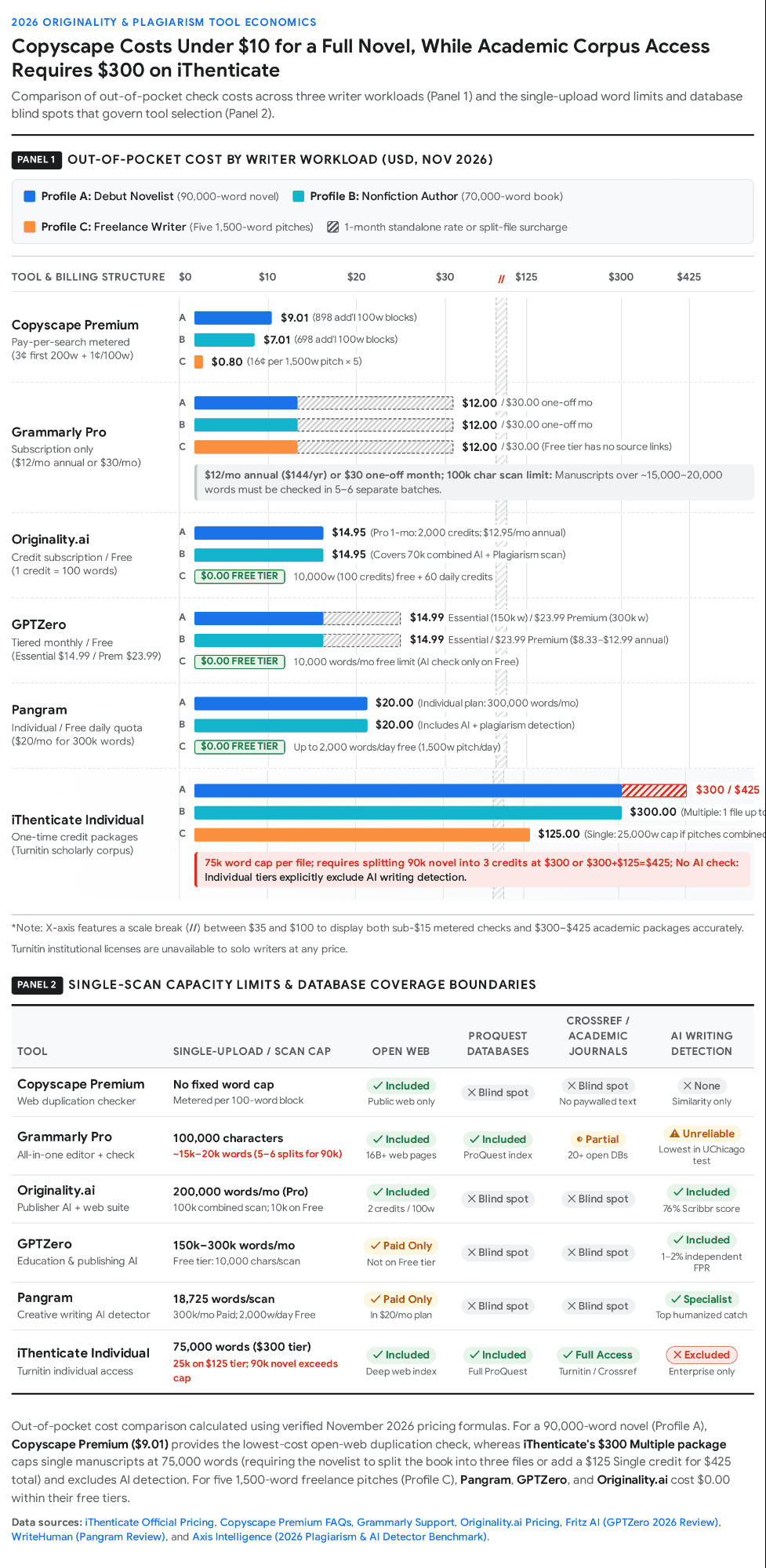
3.3 Tool Grouping by Corpus and Break-Even Reasoning
Grouping the tools by what they actually verify reveals clear financial break-even rules for working writers:
- Open-Web Duplication Checkers (Copyscape Premium): Checks whether exact text strings appear on the public web[25]. At $0.03 + $0.01/100 words, Copyscape is cheaper than Grammarly Pro ($12/month annual) for any writer scanning fewer than ~110,000 words per month (or fewer than 75 pitches of 1,500 words/month). At ~$9.01 for a 90,000-word novel, Copyscape is the cheapest web-duplication check and the proportionate first step for fiction[10].
- Editor-Integrated Hybrid Checkers (Grammarly Pro): Checks 16 billion web pages plus ProQuest academic databases while providing real-time editing and Authorship keystroke tracking[50]. The $12/month Grammarly Pro subscription ($144/year) pays for itself immediately if catching an accidental unquoted sentence saves even a single pitched freelance article from a plagiarism accusation or client rejection[30].
- Academic & Paywalled Corpus Checkers (iThenticate / Turnitin): Checks 244 million subscription sources, 85,000+ Crossref journals, ProQuest, and 54 billion web pages (plus 1.9B student papers on institutional Turnitin)[23]. The $300 iThenticate Multiple package is worth paying only if the academic corpus matters—specifically for academic-adjacent nonfiction, medical/scientific writing, or submitting to a publisher or journal that runs Crossref Similarity Check or Turnitin[6].
- Statistical AI Generation Classifiers (Pangram, Originality.ai, GPTZero): Predicts whether prose exhibits LLM token patterns[2]. Because Pangram (2,000 words/day) and GPTZero (10,000 words/month) offer functional free tiers, the break-even spend for occasional short-form AI sanity checks is $0.00, rising to $14.95–$20.00 for a single month only when auditing a full-length book manuscript after external editing[17].
4. Plagiarism Detection vs. AI Detection: The Core Decision Architecture
Most commercial marketing collapses "originality checking" into a single score, obscuring the fact that a plagiarism checker and an AI detector run independent algorithms with unrelated error rates ([1], October 4, 2026; [64], 2026)[1].
4.1 Decision-Oriented Comparison Table
| Question / Category | What It Asks | Which Tools Answer It | What It Cannot Tell You |
|---|---|---|---|
| Plagiarism Detection | Does this text appear elsewhere in an existing indexed corpus?[1] | Turnitin / iThenticate (academic journals + web + student papers on Turnitin)[24], Copyscape (public web)[10], Grammarly Pro (ProQuest + public web)[1]. | Whether the text was generated by AI (because freshly generated LLM text is statistically novel and matches zero existing web pages or journals)[23]. |
| AI Detection | Was this text statistically likely to have been generated by a language model?[2] | Pangram[31], Originality.ai[21], GPTZero[63], Turnitin AI Detection (institutional only)[9], Grammarly AI Detection[34], Copyscape Premium AI Detector[25]. | Whether the text is plagiarized, or whether a human wrote it and was flagged by mistake due to clean, predictable prose[2]. |
Scroll sideways to see all columns →
4.2 The Overlap, the Fiction Problem, and the Pre-AI Book Tests
Because similarity matching and AI prediction operate on orthogonal dimensions, a text can be both plagiarized and AI-generated (e.g., an AI-paraphrased passage of an unattributed source), or it can be neither and still be flagged as AI[2]. Conversely, copying a human author's paragraph word-for-word will trigger a 99%–100% plagiarism match on Copyscape or Grammarly while scoring 0%–11% AI (Human) on an AI detector—as demonstrated in October 2026 tests where verbatim excerpts from Charles Darwin's On the Origin of Species (1859) and Lewis Carroll's Alice's Adventures in Wonderland (1865) received overall Human verdicts on Phrasly Model 7.0 ([65], October 9, 2026)[2]. Any "plagiarism checker" that also reports an AI score (such as Grammarly Pro, Originality.ai, or Turnitin Originality) is actually running two separate models with two separate error rates, and their percentage outputs do not even share a standardized definition: Originality.ai defines "40% AI" as a 40% model confidence estimate across the document, whereas Pangram 4 and Turnitin define it as the fraction of text segments or sentences exhibiting AI-like patterns ([52], 2026; [66], 2026)[67].
Fiction and narrative nonfiction are acutely exposed to AI false positives because polished, edited prose by experienced human writers shares the exact statistical characteristics of AI output ([5], May 26, 2026; [39], July 20, 2026)[5]. The cleaner, more rhythmically consistent, and more conventional the prose, the more likely an AI classifier is to flag it—inverting a writer's natural assumption by making good writing the false-positive profile[5]. Furthermore, as University of Pennsylvania computer science professor Chris Callison-Burch explained to NPR/GPB ([4], October 31, 2026), AI detectors ask a language model how predictable a passage is, and "the catch is that the language models also tend to find text from their training data unusually predictable"[4].
The "Frankenstein" and pre-AI book tests provide empirical demonstrations that AI detectors measure statistical predictability and training-data familiarity rather than machine authorship. When the opening paragraph of Mary Shelley's Frankenstein (1818) was tested on Decopy AI (a tool claiming 99% accuracy), it came back 100% AI-generated ([44], 2026)[44], and a 203-word passage from Chapter 5 of Frankenstein pulled from Project Gutenberg was flagged at 99% AI-generated in March 2026 while six other detectors scored the identical passage 98%–100% human ([68], August 24, 2026)[68]. Similarly, alongside widely cited industry anecdotes of a 2008 book returning 68% AI (mirrored in documented tests where a pre-AI undergraduate essay on the Book of Daniel scored 68% AI-written on a detector and human academic papers scored 42%–68% AI on Turnitin; [69], 2026; [70], 2026)[69], science author Janelle Shane tested excerpts from her 2019 human-written book You Look Like a Thing and I Love You and received a 98.7% AI confidence flag because the book had been swept into LLM training corpora ([4], October 31, 2026)[4]. Likewise, a 2026 block-scan experiment on Herman Melville's Moby-Dick (1851) placed 44% of the tested material on the AI side on Pangram[52], and the opening page of Leo Tolstoy's War and Peace (1867) scored 35%–40% AI on ZeroGPT[71].
4.3 Verdict: "Can a Plagiarism Checker Tell If I Used AI?"
Verdict: Not reliably. Plagiarism checkers answer the external similarity question and cannot detect fresh AI prose at all; AI detectors answer the statistical generation question; and neither category is accurate enough to serve as the sole basis for an adverse disciplinary, editorial, or contract decision—a limitation that Turnitin, Grammarly, Originality.ai, and Pangram explicitly state in their own documentation[32][37][72].
5. The False-Positive Problem for Fiction
5.1 The Mechanism: How Predictability Penalizes Craft
AI detectors break text into tokens and compute the probability that a language model would select each succeeding word (perplexity) alongside the regularity of sentence lengths (burstiness) ([3], 2026; [73])[2]. Because commercial LLMs were trained on millions of edited books, articles, and literary works, human prose that is clean, tightly line-edited, and structurally conventional follows the exact probability curves the model learned ([5], May 26, 2026)[5]. In addition, detectors weight specific rhetorical and punctuation patterns across a manuscript—including frequent em dashes, lists of three, "not X, but Y" negative parallelisms, opening sentences with adverbs like "notably" or "crucially," rhetorical questions paired with immediate answers, and words such as "delve" or "hums" ([4], October 31, 2026; [74], May 21, 2026)[4]. As the Authors Guild concluded in its May 26, 2026 report[5] and October 13, 2026 publisher guidelines[59], clean, polished writing is the false-positive profile, with disproportionate false-positive rates hitting experienced human stylists, genre fiction writers following established conventions, non-native English writers, neurodivergent writers, and authors working in Caribbean or African oral storytelling traditions that use rhythmic repetition[3].
5.2 Documented Cases: Pre-AI Literature, Publishing Cancellations, and Prize Controversies
| Case / Work Tested | Date of Incident / Test | Tool(s) Used & Score Reported | Provenance & Context | Real-World Outcome / Consequence | Primary Source & Verification Date |
|---|---|---|---|---|---|
| Mary Shelley, Frankenstein (1818) | March–August 2026 | 100% AI (Decopy AI on opening paragraph)[44]; 99% AI on 203-word Ch. 5 Gutenberg excerpt (while 6 rival tools scored it 98%–100% Human)[68]. | Written in 1816–1818; canonical public-domain novel used heavily in LLM training datasets[44]. | Demonstrated that detectors measure training-data predictability rather than authorship[44]. | Startup Fortune (startupfortune.com, Aug 24, 2026)[68]; YouTube/Decopy test[44]. |
| Janelle Shane, You Look Like a Thing and I Love You (2019) & Pre-AI 2008 Book / Essay Tests | Late 2022 / Reported Oct 31, 2026 | 98.7% AI confidence on Shane's 2019 book[4]; 68% AI on pre-AI 2008 book anecdote / pre-AI undergrad Book of Daniel essay and Turnitin 42%–68% human flags[69]. | Written and published years before ChatGPT existed; Shane's book was included in LLM training data[4]. | Shane called it "a clear, glaring, blinking-light false positive" caused by training-data memorization[4]. | GPB / NPR (gpb.org/news/2026/10/31/..., Oct 31, 2026)[4]; Medium (writeswells, 2026)[69]. |
| Human Novelist / Fiction Drafts in Grammarly & Moby-Dick (1851) | 2025–2026 | 40% AI-written (novelist second-novel anecdote & Grammarly 40%–64% flags on human drafts)[34]; 44% AI on Moby-Dick block scan and 100% AI on a new fictional passage after light Grammarly typo fixes[52]. | Moby-Dick published 1851; contemporary novelists and nonfiction writers running human drafts through Grammarly[52]. | Showed that document chunking and basic grammar-checker edits can flip human fiction into 40%–100% AI scores[52]. | Medium (markus_brinsa, 2026)[52]; Reddit r/Grammarly / supwriter.com (2026)[34]. |
| Authors Guild Pre-2022 Article Benchmark (10 Articles) | May 26, 2026 | Sidekicker.ai: 71%–100% AI on all 10 (two at 100%); ZeroGPT: 5.3%–76.3% AI (66% on Joan Didion obituary; 76.3% on Louise Erdrich Pulitzer note); Grammarly: 0%–9% AI; Originality.ai: 0%–1% AI; Pangram: 0% AI[5]. | 10 articles written and published by the Authors Guild in 2020–2022, predating ChatGPT[5]. | Authors Guild warned publishers that cancelling a contract based on detector scores alone is a material breach of contract[5]. | The Authors Guild (authorsguild.org/news/can-ai-detectors-be-trusted/, May 26, 2026)[5]. |
| Mia Ballard, Shy Girl (Hachette / Wildfire / Orbit) | March–April 2026 | 78% / 78.4% AI-generated on Pangram (confirmed by Pangram CEO Max Spero; Hachette also checked Originality.ai and ZeroGPT)[17]. | Self-published horror novel acquired by Hachette (published UK Nov 2025; slated for US April 2026). Ballard denied using AI, stating a freelance editor she hired may have introduced AI changes[17]. | Hachette cancelled the US release, discontinued the UK edition, and pulled the book from retailers; Ballard stated the scandal ruined her career[60]. | The Guardian (Mar 20 & 29, 2026)[60]; CBC News (Apr 12, 2026)[75]; Poynter (May 1, 2026)[76]. |
| Jamir Nazir, "The Serpent in the Grove" & Chanel Sutherland, "Descend" (Commonwealth Short Story Prize) | May–July 2026 | 100% AI-generated on Pangram for Nazir (2026 Caribbean & Overall Winner) and 88% AI fraction for Sutherland (2025 Overall Winner), plus 2 other 2026 regional winners flagged by Pangram (pangram.com/blog/ai-is-writing-prize-winning-fiction)[16]. | Nazir dictated 6–7 drafts on his phone using speech-to-text (viewing 3–4 lines at a time) due to chronic health conditions; Sutherland drew on Vincentian oral storytelling rhythms[16]. | Granta found the AI evidence inconclusive and ended its publishing partnership in May 2026; the Commonwealth Foundation cleared Nazir in July 2026 after inspecting working drafts, timestamps, and notes, though online doubt became the public verdict for critics[16]. | The Guardian (Jul 1, 2026)[16]; The Walrus (Sep 29, 2026)[77]; Pangram Blog (May 21, 2026)[74]. |
| Thélyson Orélien, C'était ça ou mourir (Prix Goncourt / Prix du roman Fnac) | September–October 2026 | 100% AI probability on Pangram (triggered by anonymous X account "Balance ton Claude" on Sep 21, 2026, the day it won the Prix du roman Fnac)[77]. | Haitian-Canadian debut novel; Orélien cited Haitian/Caribbean poetic rhythm and oral tradition (and later said he used AI tools "here and there" while admitting to separate 2012–2013 journalism plagiarism)[77]. | Removed from the Académie Goncourt longlist (Sep 26, 2026); Canadian publisher Boréal initially defended the book but cut ties on Oct 21, 2026 after Orélien gave up compiling a provenance record of his creative process[77]. | CBC News (Sep 24 & Oct 21, 2026)[78]; The Walrus (Sep 29, 2026)[77]. |
| Sally McGraw (Nonfiction Ghostwriter / Book Proposal Sample) | Reported October 31, 2026 | Flagged as machine-generated by multiple AI detectors screened by a prospective book-proposal client[4]. | 20-year veteran nonfiction writer who wrote the sample 100% herself without AI[4]. | Lost the full book-proposal opportunity; McGraw reported dropping her longtime journalistic em dashes and deliberately omitting commas to avoid future false flags[4]. | GPB / NPR (gpb.org/news/2026/10/31/your-writing-was-flagged-ai-what-does-actually-mean, Oct 31, 2026)[4]. |
Scroll sideways to see all columns →
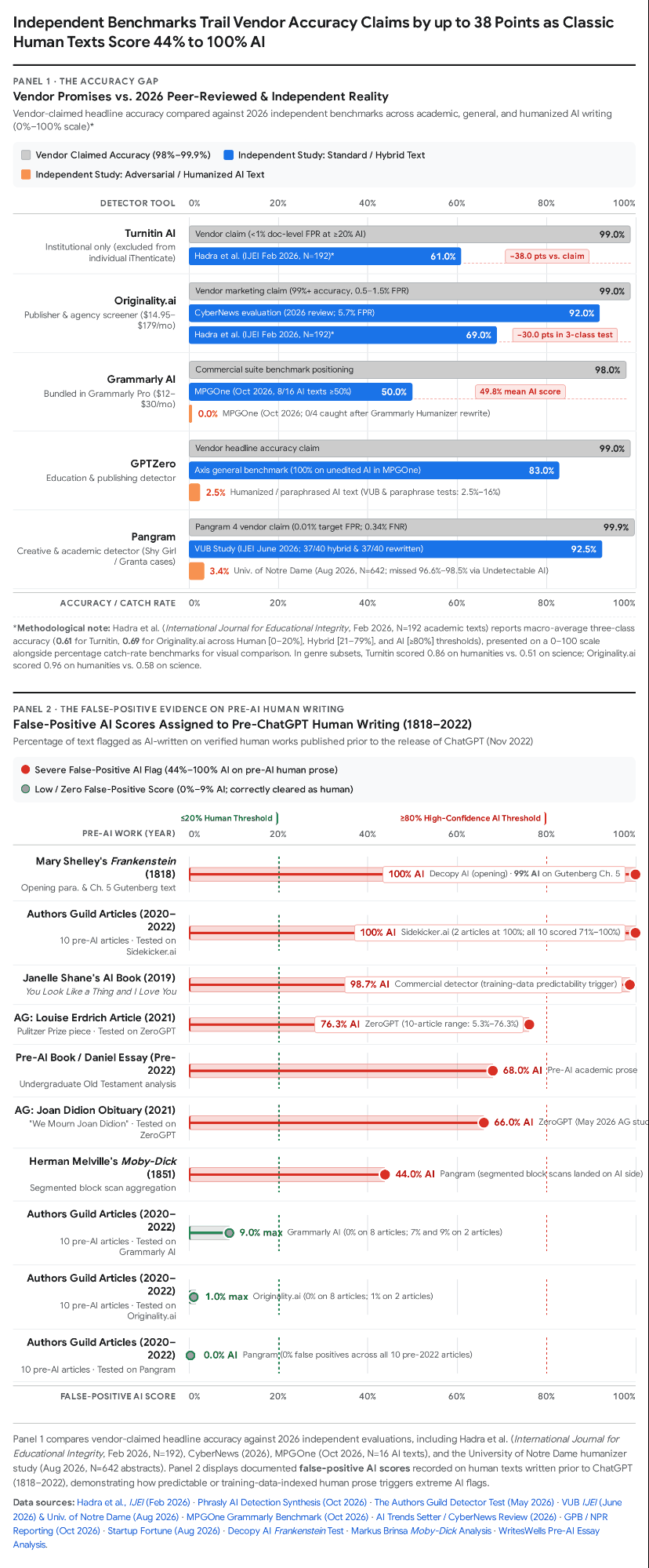
5.3 The Accuracy Evidence and the Real-World Consequences
Vendor marketing claims of "99%+ accuracy" rely on controlled benchmarks of raw, unedited LLM outputs against raw human writing, whereas independent academic evaluations test mixed, edited, and domain-specific writing ([37], November 1, 2026; [13], March 1, 2026)[13]. Turnitin's own stated false-positive rates—under 1% at the document level for documents with 20% or more AI writing, and around 4% at the sentence level, with 54% of wrongly highlighted human sentences sitting directly next to actual AI text ([32], updated June 14, 2023)58—appear reassuring only on short student essays. Applied to a 90,000-word manuscript containing thousands of sentences, a 4% sentence-level false-positive rate translates into hundreds of wrongly flagged sentences, and a 1% document-level bound means up to 100 falsely flagged documents per 10,000 honest submissions ([79], September 26, 2026)[79]. In peer-reviewed research published in the International Journal for Educational Integrity (Hadra et al., February 2026, [33]), researchers evaluated 192 EFL, professional, pure-AI, and 50/50 hybrid texts and reported macro-average accuracy of just 0.61 for Turnitin (recall 0.51) and 0.69 for Originality.ai (recall 0.60)—well below what any disciplinary or acquisition decision should rely on alone[37].
Even Pangram, which ranked as the most consistently accurate of four detectors in a June 2026 International Journal for Educational Integrity study by Vrije Universiteit Brussel researchers [15] (correctly identifying AI in 37 of 40 mixed-text papers and 37 of 40 human-rewritten AI papers while recording 0% false positives on 40 pre-ChatGPT ESL graduate papers)[4] and achieved near-zero error rates in University of Chicago Becker Friedman Institute testing ([80], 2025)[27], has documented blind spots. Pangram CEO Max Spero publicly acknowledged to NPR/GPB ([4], October 31, 2026) and The Atlantic ([36], November 14, 2026) that the detector makes mistakes, "particularly when there is not much writing to evaluate" (such as a false positive on a 50-word excerpt by journalist Taylor Lorenz)[4]. Furthermore, an August 2026 University of Notre Dame preprint (Karr et al., [27]) found that Pangram 3.2 missed 96.6% to 98.5% of AI abstracts processed with the commercial humanizer Undetectable AI while flagging 14.9% of unmodified 2023–2025 human abstracts (including 26.6% in theology)[27].
The consequences of these false positives are career-altering rather than neutral errors. In March–April 2026, Hachette cancelled the US and UK release of Mia Ballard's horror novel Shy Girl after Pangram flagged the text at 78% (78.4%) AI-generated ([61], March 20, 2026; [75], April 12, 2026)[17]. A month later, in May 2026, Jamir Nazir's "The Serpent in the Grove" won the Caribbean regional Commonwealth Short Story Prize and was published in Granta, only for screenshots of a 100% AI Pangram report to circulate online ([74], May 21, 2026); even though the Commonwealth Foundation later cleared Nazir in July 2026 after auditing his working drafts and timestamps, Granta ended its partnership with the prize and the public doubt became the de facto verdict ([16], July 1, 2026)[16]. Similarly, veteran nonfiction ghostwriter Sally McGraw lost a full book-proposal job opportunity after a client ran her human-written sample through multiple AI detectors ([4], October 31, 2026)[4]. In each case, a software probability score—not a court or a confession—drove the immediate penalty.
5.4 Verdict: "Why Was My Fiction Flagged as AI?"
Verdict: Because your prose is polished, edited, and syntactically conventional. An AI detector flag is not forensic evidence that you used a machine; it is mathematical evidence that your word choices and sentence rhythms are predictable to a language model that was trained on polished human books ([5], May 26, 2026; [4], October 31, 2026)[5]. That is a statistical description of clean writing, not a confession of AI generation[5].
6. The "Prove You Wrote It" Protocol and KDP/Publisher Disclosure Rules
Because different AI detectors frequently contradict one another on the exact same text—as seen in the 2026 Prix du roman Fnac dispute ([45], 2026) and the Frankenstein tests where one tool scored Shelley's passage 99% AI and six others scored it 98%–100% human ([68], August 24, 2026)24—you cannot prove your innocence by running your manuscript through a second detector. The contrast between Jamir Nazir (who was cleared by the Commonwealth Foundation in July 2026 after submitting his drafts, notes, and timestamped files) and Thélyson Orélien (whose publisher Boréal cut ties on October 21, 2026 after he gave up compiling a creative-process record) demonstrates that documented process provenance is the only reliable defense[16][81].
6.1 The Five-Artifact Provenance File (What to Keep Before a Flag Occurs)
- Version History Exports: Draft inside Google Docs (File > Version history > See version history), Microsoft Word with OneDrive/M365 AutoSave enabled, or Scrivener (using automatic timestamped .zip backups at File > Back Up), and export or screenshot the revision timeline at major milestones ([82], 2026; [72], 2026)[40]. You can also enable Grammarly Authorship (free) or GPTZero Writing Replay (free Chrome extension) to record a keystroke-level replay distinguishing typed prose from pasted text[22].
- ISO-Dated Milestone Drafts: Never overwrite a single local file; save a separate date-stamped copy at every major structural stage (e.g., 2026-11-14_NovelTitle_Draft03.docx) in both local storage and a cloud drive whose server upload timestamps cannot be altered retroactively[45].
- Editorial Correspondence and Track Changes: Keep all emails, contracts, invoices, and .docx files with Track Changes from developmental editors, copy editors, proofreaders, beta readers, and literary agents ([45], 2026; [83], October 22, 2026)[45]. This establishes an unbroken chain of custody and proves whether an outside editor altered your prose (the central issue in Mia Ballard's Shy Girl dispute)[17].
- Dated Research Notes, Outlines, and Dictation Logs: Retain dated research files with source links and quotations, beat sheets, character sketches, and—if you compose via voice dictation like Jamir Nazir—raw speech-to-text transcripts or voice memos that preceded the polished prose[16].
- The Consolidated Provenance File: Maintain a single master folder containing your dated drafts, version-history exports, editorial correspondence, and research notes—the file you assemble by default and hope you never need ([84], 2026)[45].
6.2 Step-by-Step Protocol: What to Do If Flagged
- Do not panic, do not argue with the detector in the abstract, and do not rewrite the flagged draft unprompted: Rewriting and resubmitting a flagged manuscript without permission can be misinterpreted as attempting to launder AI text after detection ([82], 2026)[40].
- Do not submit a second AI detector's 0% screenshot as proof of innocence: A second detector is merely a second statistical opinion, not forensic evidence of authorship[45].
- Ask for the specific passages and exact methodology that triggered the flag: Request the complete highlighted report showing which tool and version were run, whether a converted PDF or short excerpt was scanned (which Pangram notes can introduce parsing errors), and which exact sentences were highlighted ([31], 2026; [53], November 8, 2026)[17].
- Present your Provenance File mapped to the flagged passages and request a contextual human reading: Show the decision-maker the outline, early draft, and revision history for the exact paragraphs in question, ask them to read the passages in the context of your full manuscript and prior work, and—if facing a publishing contract threat—contact the Authors Guild Legal Department ([5], May 26, 2026)[5].
6.3 Verdict: "How Do I Prove I Wrote My Book?"
Verdict: Keep dated drafts, cloud version history, research notes, and editorial correspondence from day one. Your Provenance File is the only defense that establishes human authorship through verifiable creation artifacts rather than relying on another AI detector's probabilistic opinion ([45], 2026)[45].
6.4 Amazon KDP and Trade Publisher AI Disclosure Rules (2026)
| Platform / Body | Rule on "AI-Generated" Content | Rule on "AI-Assisted" Content | Verification, Enforcement & Contractual Liability | Primary Source & Date |
|---|---|---|---|---|
| Amazon Kindle Direct Publishing (KDP) | Mandatory Disclosure Required: Defined as text, images (cover or interior), or translations created by an AI-based tool. Even if you apply substantial human edits afterward, KDP still classifies it as "AI-generated" and requires disclosure when publishing or republishing[46]. | No Disclosure Required: If you created the text/images yourself and used AI tools strictly to edit, refine, error-check, or improve that content—or used AI to brainstorm and generate ideas while writing the actual text yourself—it is "AI-assisted" and exempt from disclosure[46]. | Authors remain strictly liable for verifying that all AI-generated or AI-assisted content complies with copyright and IP laws[46]. Amazon removes undisclosed mass-generated AI books[46]. | Amazon KDP Help Center (kdp.amazon.com/help/topic/G200672390, verified Nov 14, 2026)[46]. |
| Kobo Writing Life & IngramSpark | Strict Rejection / Removal: Kobo rejected nearly 45% of all self-published manuscript submissions in 2025, with ~80% of rejections driven by suspected partial or full AI generation[75]. IngramSpark removes content generated by AI or mass-produced processes[75]. | Kobo and River AI distinguish human-crafted books edited with proofreading tools from prompt-generated "AI slop"[75]. | Kobo screens incoming self-publishing pipelines to block automated submissions (amid US self-published fiction ISBNs jumping from 306,781 in 2024 to 477,104 in 2025)[75]. | CBC News (cbc.ca/news/business/publishing-industry-ai-shy-girl-fallout-9.7155292, Apr 12, 2026)[75]. |
| Trade Publishers (e.g., Hachette Book Group) | Upfront Written Disclosure & Originality Warranty: Contracts require authors to warrant that the work is original/human-authored and to disclose any AI use upfront[62]. | Basic spelling/grammar checking is generally permitted, but substantial undisclosed AI rewriting breaches originality/disclosure clauses[45]. | The Freelance Editor Liability Trap: If an author hires a freelance editor, ghostwriter, or proofreader who uses AI without telling the author, the author bears full contractual liability for non-disclosure (as seen in Shy Girl)[17]. | The Guardian (Mar 20 & 29, 2026)[60]; Reddit r/publishing / Wikipedia (Shy Girl, Nov 2026)[36]. |
| The Authors Guild (US) & Society of Authors (UK) | Authors Guild AI Best Practices for Publishers (Oct 13, 2026): States AI-generated text cannot be copyrighted; publishers must adopt clear written AI policies, never upload manuscripts to third-party detectors without explicit author permission and zero-training guarantees, and never cancel a contract based on detector scores alone without consulting the author and offering a chance to rewrite[5]. | Supports voluntary author provenance logging (version history/drafts) but opposes forcing authors to install mandatory keystroke-tracking surveillance software[59]. | Both the US Authors Guild (early 2025) and the UK Society of Authors (2026) launched "Human Authored" certification labels allowing registered authors to display a human-written seal on book jackets[60]. | Authors Guild (authorsguild.org/resource/ai-best-practices-for-publishers/, Oct 13, 2026)[59]; CBC News (Apr 12, 2026)[75]. |
Scroll sideways to see all columns →
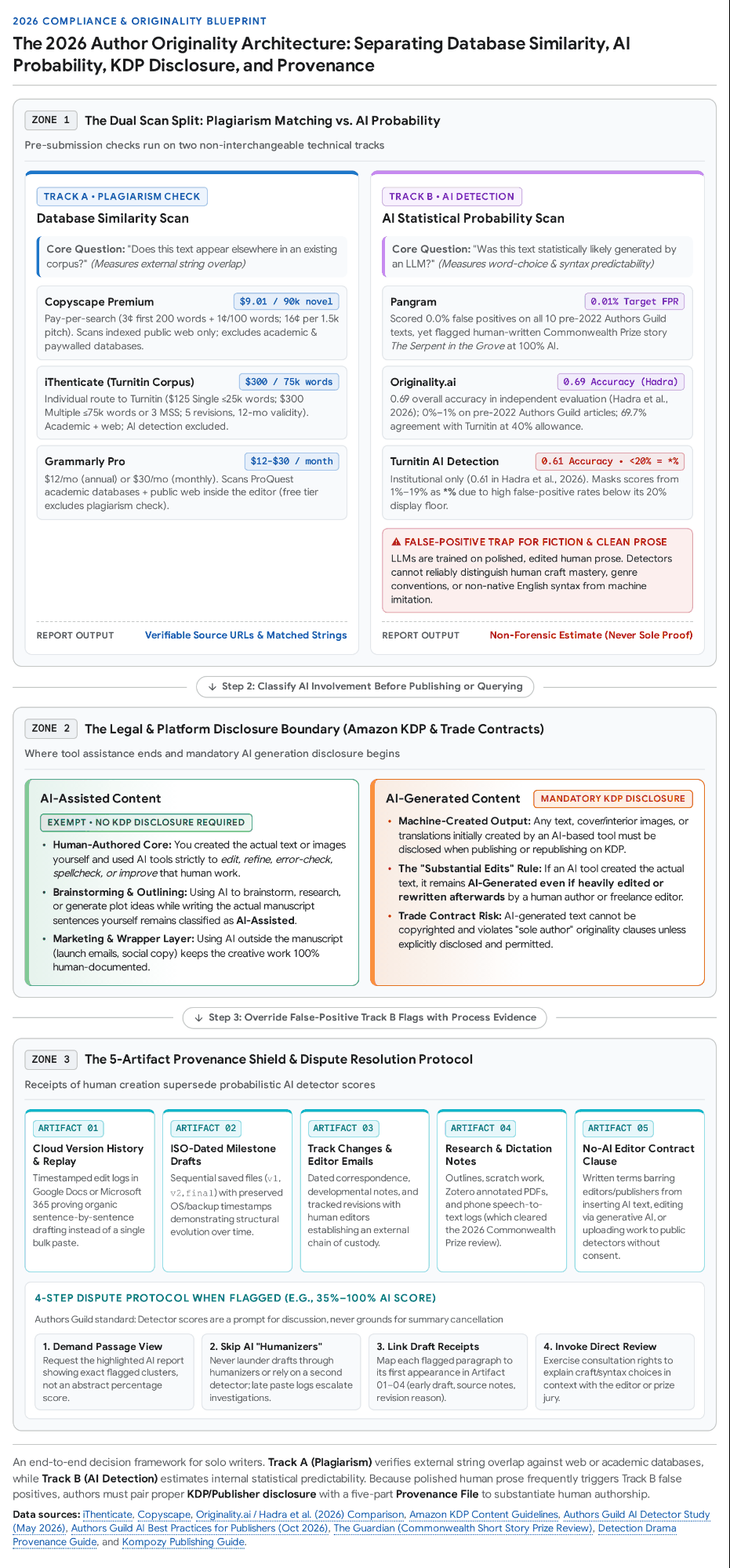
7. "Best for X" Angles (Verdict-First Quick Reference)
1. Best Plagiarism Checker for an Academic-Adjacent Nonfiction Author
iThenticate Multiple ($300 one-time) is the best plagiarism checker for academic-adjacent nonfiction authors ([8], verified November 14, 2026)[8]. It scans 244 million subscription sources and 85,000+ journals across 1,500 Crossref publishers, covering one manuscript up to 75,000 words with five free revisions while keeping drafts private[24]. Runner-up: Grammarly Pro ($12–$30/month) for lighter ProQuest and web checks[11].
2. Best Plagiarism Checker for a Novelist
Copyscape Premium ($9.01 for a 90,000-word manuscript) is the best plagiarism checker for novelists ([10], verified November 14, 2026), delivering a fast, pay-per-search open-web duplication check (3¢ first 200 words + 1¢/100 words) without unnecessary academic database fees[10]. Runner-up: Grammarly Pro ($12–$30/month) for in-editor checks and Authorship logging across 100,000-character chunks[13].
3. Best Plagiarism Checker for a Freelance Writer
Copyscape Premium ($0.16 per 1,500-word pitch; $11.00 for 100 articles of 1,000 words) is the best plagiarism checker for freelance writers ([10], verified November 14, 2026), offering instant, pay-as-you-go verification against public web pages without a recurring subscription[10]. Runner-up: Originality.ai Pro ($12.95–$14.95/month or $30 pay-as-you-go) for combined web similarity and AI scans[21].
4. Best All-in-One Tool for Plagiarism and Editing in One Place
Grammarly Pro ($12/month billed annually or $30/month monthly) is the best all-in-one tool ([11], verified November 9, 2026), combining grammar coaching, tone adjustments, auto-formatted APA/MLA/Chicago citations, Authorship tracking, and plagiarism checks across 16 billion web pages and ProQuest inside Docs and Word[30]. Runner-up: GPTZero Essential ($8.33–$14.99/month) for bundled AI and plagiarism scans[26].
5. Best Free Plagiarism Checker
Copyscape's Free URL Search ($0) is the best free plagiarism checker for published web writers ([10], verified November 14, 2026), scanning any live URL against the open internet and returning up to 10 matching web pages at zero cost[10]. Runner-up: Grammarly's Free Plagiarism Scanner ($0) for unpublished drafts, though it gives only a binary yes/no alert[13].
6. Best AI Detector for Creative Writing
Pangram ($0 for 2,000 words/day; $15–$20/month Individual) is the best AI detector for creative writing ([55], October 19, 2026), reporting a 0.000% false-positive rate across 10,495 creative-writing samples and leading the June 2026 Vrije Universiteit Brussel benchmark (37/40 mixed/humanized papers), though it remains fallible on short texts[4]. Runner-up: Originality.ai ($12.95–$14.95/month)[5].
7. Best Tool for a Writer Who Has Been Flagged and Needs to Understand Why
Your Provenance File paired with the flagging detector's passage-level highlight report ($0) is the best tool when flagged ([82], 2026): inspect the specific highlighted sentences for predictable rhythms rather than the overall score, and present dated drafts and cloud version history[4]. Runner-up: Grammarly Authorship or GPTZero Writing Replay ($0) for keystroke playback[22].
8. Best Tool for a KDP Self-Publisher
Copyscape Premium ($9.01 per 90,000-word manuscript) is the best tool for KDP self-publishers ([10], verified November 14, 2026) to verify that ghostwritten, co-authored, or edited books contain zero scraped web text before uploading to Amazon[47]. Runner-up: Grammarly Pro ($12–$30/month) for all-in-one editing and ProQuest/web checking, though neither guarantees immunity against an AI flag[11].
9. Best Tool for Submitting to a Publisher That Runs Turnitin
iThenticate ($125 Single up to 25,000 words; $300 Multiple up to 75,000 words) is the best tool when submitting to a publisher or journal that runs Turnitin or Crossref Similarity Check ([8], verified November 14, 2026), because it queries Turnitin's exact 244-million-source scholarly database privately[6]. Runner-up: Institutional Turnitin Draft Coach ($0) for university-affiliated authors[42].
10. Best Tool for Checking Paraphrased Plagiarism
iThenticate ($125–$300) or institutional Turnitin is the best tool for catching scholarly overlap ([24], verified November 2026), whereas Grammarly caught 82% of plagiarized passages overall (99% verbatim) but only 3%–5% of paraphrased text in independent tests ([12], 2026)[8]. Runner-up: Originality.ai ($12.95–$14.95/month), which scored 96.7% on RAID paraphrased AI text[21].
11. Best Tool for Checking AI-Generated Text Specifically
Pangram ($0 free tier up to 2,000 words/day; $15–$20/month Individual) is the best standalone AI detector ([15], June 2026), outperforming Turnitin, GPTZero, and Copyleaks by catching 37 of 40 mixed and 37 of 40 humanized papers, though commercial humanizers and short excerpts can still fool it[4]. Runner-up: Originality.ai ($12.95–$14.95/month)[21].
12. Best Budget Stack for a Working Writer
Copyscape Premium ($0.16 per 1,500-word pitch; $9.01 per novel) plus Pangram Free ($0 for 2,000 words/day) and Google Docs Version History ($0) is the best budget stack ([10], verified November 14, 2026), delivering web-duplication verification and low-FPR AI sanity checks for under $10, though neither replaces a provenance file as proof[10]. Runner-up: GPTZero Free ($0 for 10,000 words/month)[22].
8. Search Query & AI Answer Engine Mapping Matrix
Note: This section is a query map for assembling modular web pages and AI answer engine citations, not reader-facing prose.
| Search Intent Cluster | Exact Search Phrasings Targeted | Target Dossier Section & Core Answer Anchor |
|---|---|---|
| Turnitin Access & iThenticate Pricing | "Turnitin vs iThenticate for authors"; "Can I use Turnitin as an individual"; "How to buy Turnitin for one paper"; "iThenticate cost for one manuscript"; "Does iThenticate check for AI"; "iThenticate 75000 word limit novel" | Sections 1A, 2.1, 3.2 & 9.1: Turnitin is institutional-only ($0 individual access)[7]. iThenticate is the official individual route: Single $125 (≤25k words), Multiple $300 (≤3 MS or 1 MS ≤75k words), 5 free revisions, 12-month validity, AI detection explicitly excluded[8]. |
| Copyscape Pricing, Scope & Fiction Use | "Copyscape vs Turnitin for plagiarism"; "iThenticate vs Copyscape"; "Is Copyscape good for books"; "Copyscape cost per search"; "How much does Copyscape cost for a novel"; "Does Copyscape check academic databases"; "Does Copyscape detect ChatGPT" | Sections 1A, 2.2, 2.3, 2.6, 3.2 & 9.2: Copyscape Premium costs 3¢ for first 200 words + 1¢ per additional 100 words ($0.16 per 1,500-word article; $9.01 per 90,000-word novel)[10]. Scans public web only—no academic databases, no paywalled journals, and 0% catch rate on fresh AI in standard search (separate AI detector inside Premium/Enterprise)[25]. |
| Grammarly Plagiarism & AI Reliability | "Grammarly plagiarism checker free vs premium"; "Grammarly Pro cost 2026"; "Is Grammarly plagiarism checker accurate"; "Grammarly vs Copyscape"; "Grammarly vs Turnitin"; "Grammarly flagged my novel as AI"; "Does using Grammarly trigger AI detectors" | Sections 1A, 2.4, 2.5, 2.6, 5.2 & 9.3: Grammarly Pro costs $12/mo annual ($144/yr) or $30/mo monthly[11]. Free tier gives yes/no flag only[13]. Scans 16B web pages + ProQuest; caught 82% overall (99% verbatim, 3%–5% paraphrased)[30]. UChicago ATS rated its AI detector "least reliable"[13]; heavy Grammarly rewrites trigger external AI detectors[52]. |
| Category Distinction (Plagiarism vs. AI) | "Plagiarism checker vs AI detector difference"; "Can a plagiarism checker tell if I used AI"; "High AI score 0% plagiarism meaning"; "What does 40% AI detected mean" | Sections 2.9 & 4.1–4.3: Plagiarism checks external string overlap against a corpus; AI detection predicts internal token probability (perplexity/burstiness)[1]. Fresh AI scores 0% plagiarism; 100% original human prose can score 100% AI[2]. |
| False Positives & Literary Scandals (2026) | "Why was my book flagged as AI"; "AI detector false positive fiction"; "Frankenstein flagged as AI"; "Shy Girl AI detection Hachette"; "Commonwealth Short Story Prize AI allegations"; "Jamir Nazir The Serpent in the Grove Pangram"; "Thélyson Orélien Goncourt Pangram AI"; "Authors Guild AI detector test" | Sections 4.2 & 5.1–5.4: Clean, edited human prose is the false-positive profile[5]. Documented cases: Frankenstein (99%–100% AI)[44], Janelle Shane 2019 book (98.7% AI)[4], 2008 book/essay (68% AI)[69], Moby-Dick (44% AI)[52], Shy Girl cancelled by Hachette at 78%/78.4% on Pangram[17], Nazir's "The Serpent in the Grove" cleared by Commonwealth Foundation despite 100% Pangram flag[16], Authors Guild May 2026 test[5]. |
| AI Detector Accuracy Benchmarks (2026) | "Turnitin AI detection accuracy 2026"; "Pangram vs Originality.ai"; "Pangram vs Turnitin AI"; "Pangram vs GPTZero"; "Is Pangram AI detector accurate"; "Best plagiarism checker for fiction writers"; "Best AI detector for creative writing"; "Hadra et al 2026 Turnitin Originality" | Sections 1A, 2.7, 2.8, 5.3 & 9.5: Hadra et al. (IJEI, Feb 2026) measured Turnitin at 0.61 and Originality.ai at 0.69 macro-average accuracy[33]. CyberNews (2026) measured Originality.ai at 92% accuracy / 5.7% FPR[38]. VUB study (IJEI, June 2026) found Pangram caught 37/40 mixed and 37/40 humanized papers (GPTZero caught 0/40 and 1/40)[27], while Notre Dame (Aug 2026) found Pangram 3.2 missed 96.6%–98.5% of Undetectable AI-humanized abstracts[27]. |
| Provenance & KDP/Publisher Rules | "How to prove I wrote my book"; "How to prove I didn't use AI"; "Flagged by AI detector what to do"; "Do publishers run AI detectors"; "KDP AI disclosure plagiarism check"; "Amazon KDP AI-generated vs AI-assisted" | Sections 6.1–6.4 & 9.6: Keep the 5-part Provenance File (Google Docs/Word version history, ISO-dated drafts, Track Changes emails, research/dictation notes, Authorship/Writing Replay logs)[45]. KDP (kdp.amazon.com/help/topic/G200672390) mandates disclosing AI-generated content (even if edited) but exempts AI-assisted editing/brainstorming[46]. |
Scroll sideways to see all columns →
9. "Is X Worth It?" Decision Case Studies
9.1 Is iThenticate ($125 / $300) Worth It for Solo Authors?
Verdict: iThenticate is worth its $125 or $300 price tag only for academic-adjacent nonfiction authors, medical writers, and independent scholars whose publishers screen against Crossref or Turnitin; for novelists and general freelance writers, it is an unnecessary expense. Because Turnitin refuses to sell individual licenses at any price ([7], verified November 2026), iThenticate is the sole official individual gateway to Turnitin's scholarly ecosystem[6]. The Single package ($125) covers one manuscript up to 25,000 words, while the Multiple package ($300) covers up to three manuscripts or one manuscript up to 75,000 words ([8], verified November 14, 2026)[8]. Both are one-time purchases valid for 12 months, include five free re-scans for revisions, and keep your unpublished manuscript out of shared repositories[8]. That $300 buys access to 244 million subscription sources, 85,000+ academic journals across 1,500 Crossref publishers (including IEEE, Springer Nature, and Wiley), ProQuest dissertations, and 54 billion web pages[24]. If you are submitting a 70,000-word nonfiction book to a university press, iThenticate shows you the exact scholarly matches your acquiring editor will see[6]. However, solo buyers face two hard limits: first, AI writing detection is explicitly excluded from individual packages (requiring buyer acknowledgment at checkout)[9]; second, a 90,000-word novel exceeds the 75,000-word single-file cap on the $300 tier[8]. Since fiction writers do not cite paywalled scientific journals, spending $300+ on iThenticate is overkill when Copyscape Premium checks a 90,000-word novel against the open web for $9.01[10].
9.2 Is Copyscape Premium (3¢ + 1¢/100 Words) Worth It?
Verdict: Yes—Copyscape Premium is the single most cost-effective web-duplication tool for novelists, KDP self-publishers, and freelance writers who want fast, pay-per-search verification outside their word processor. Operating continuously since 2004, Copyscape Premium charges $0.03 for the first 200 words plus $0.01 for each additional 100 words or part thereof ([10], verified November 14, 2026)[10]. In practical terms, checking a 1,500-word freelance pitch costs $0.16, checking five pitches costs $0.80, checking 100 articles of 1,000 words costs $11.00, and scanning an entire 90,000-word novel costs $9.01[10]. Unlike Copyscape's free tier—which only scans already-published live URLs and hides results beyond the first 10 matches—Premium lets you paste unpublished drafts directly and returns comprehensive side-by-side highlights of matching web pages[25]. The decisive trade-off between Copyscape and Grammarly Pro ($12–$30/month) or iThenticate ($125–$300) is scope and paraphrase sensitivity: Copyscape scans only the publicly indexed open web[25]. It does not index academic databases, paywalled journals, or student paper repositories, cannot process ideogram scripts (Chinese, Japanese, Korean), and in 2026 tests caught 100% of verbatim web copies while missing QuillBot paraphrases and ChatGPT rewrites[25]. While Copyscape Premium and Enterprise now offer a separate AI Detector that outputs probability scores up to 99%, Copyscape itself warns that AI scores are not proof[25]. Pay for Copyscape when you want a cheap, no-subscription check against web scraping or ghostwriter copy-pasting; use Grammarly Pro if you want the check inside your editor[25].
9.3 Is Grammarly Pro ($12 / $30 per Month) Worth It for Plagiarism and AI Checks?
Verdict: Grammarly Pro is worth the $12/month annual ($30/month monthly) subscription only as a convenience all-in-one editing and verbatim citation tool—not as a standalone authority on paraphrased plagiarism or AI detection. Following Grammarly's consolidation of its former Premium and Business tiers into Grammarly Pro under the Superhuman corporate suite ([11], verified November 9, 2026), paid subscribers get plagiarism checking across over 16 billion web pages and ProQuest's academic databases, auto-formatted citations (APA, MLA, Chicago), and a built-in AI detector inside Google Docs, Word, and browser editors[11]. (The Free tier provides only a binary yes/no duplicate-content alert without percentages or source links)[13]. In third-party testing by AI Tools Breakdown ([12], 2026), Grammarly caught 82% of plagiarized passages—performing strongly on verbatim copies (99% on Wikipedia and 92% on Python documentation in October 2026 tests) but dropping to 3%–5% on paraphrased text and 2% on patchwork copying[14]. Furthermore, a peer-reviewed study (IJEDICT, 2023) found 49% of its flags were harmless common phrases[50], and a comparative evaluation by the University of Chicago's Academic Technology Solutions ([13], March 2026) found Grammarly's AI detector produced false positives on human text while missing AI submissions, rating it "the least reliable AI detection of any tool tested"[13]. Subscribe to Grammarly Pro for daily line-editing convenience, verbatim copy-paste safety, and its free Grammarly Authorship keystroke tracker—but use iThenticate or Pangram when corpus depth or AI accuracy is paramount[13].
9.4 Should You Try to Use Turnitin (Institutional Only) or Buy iThenticate?
Verdict: Never pay a third-party website claiming to sell "cheap individual Turnitin checks"; use institutional Turnitin only if you have legitimate university access, and use iThenticate ($125/$300) or Copyscape ($0.16–$9.01) if you work solo. Turnitin's official licensing policy ([7], verified November 2026) is explicit: Turnitin Feedback Studio and Turnitin Originality are licensed exclusively to educational and research institutions via custom quotes (such as the May 2026 US public procurement benchmark of $6.70 per FTE), with zero consumer checkout at any price[6]. Because solo writers and students frequently search for ways to pre-screen their work against Turnitin, an ecosystem of unauthorized third-party brokers has emerged offering "$1 to $4.99 Turnitin AI + similarity checks" by routing uploads through gray-market student or instructor class IDs[42]. Submitting an unpublished manuscript or thesis to an unofficial Turnitin broker carries severe risk: standard Turnitin assignments automatically store uploaded documents in Turnitin's 1.9-billion-paper private repository, meaning that when you later submit your manuscript to your university or publisher, it can flag at 100% plagiarism against your own leaked pre-check[23]. If you are affiliated with a university, ask your library or instructor for a legitimate "no-repository" sandbox or Turnitin Draft Coach access[42]. If you are an independent author whose publisher uses Turnitin's scholarly database, buy official iThenticate credits ($125/$300), which query the same publication archive and guarantee your draft is never stored in a shared repository[6].
9.5 Is Pangram Worth Using Over Turnitin AI or Originality.ai?
Verdict: Yes—for creative writers, novelists, and editors who want to test a manuscript for AI signals, Pangram ($0 free tier up to 2,000 words/day; $15–$20/month Individual) is the most consistently accurate detector evaluated in 2026, provided you treat its output as one triage signal rather than a verdict. Across 2025–2026 academic benchmarks, Pangram outperformed earlier-generation detectors: in the June 2026 International Journal for Educational Integrity study by Vrije Universiteit Brussel researchers[15], Pangram correctly flagged 37 of 40 mixed human/AI papers and 37 of 40 human-rewritten AI papers with 0% false positives on ESL graduate essays, whereas GPTZero caught 0/40 and 1/406. In the Authors Guild's May 26, 2026 test of 10 pre-2022 articles, Pangram scored 0.0% AI across all 105, and its October 19, 2026 Pangram 4.1 model card[55] reports a 0.000% false-positive rate on 10,495 creative-writing samples and 0.0090% overall[35]. However, Pangram is also the exact tool used in 2026's highest-profile literary controversies—flagging Mia Ballard's Shy Girl at 78%/78.4% AI (leading Hachette to cancel the novel)[17], flagging Commonwealth Short Story Prize winners Jamir Nazir ("The Serpent in the Grove", 100% AI) and Chanel Sutherland ("Descend", 88% AI) before the Commonwealth Foundation cleared Nazir via draft provenance[16], and flagging Thélyson Orélien's Goncourt-longlisted novel at 100% AI[77]. Furthermore, Pangram CEO Max Spero acknowledges errors on short texts (<100 words)[4], and a Notre Dame study found Pangram 3.2 missed 96.6%–98.5% of Undetectable AI-humanized abstracts[27]. Use Pangram's free tier or a $20 one-month subscription to audit third-party editorial work, never as a standalone verdict[20].
9.6 Is Keeping a "Prove You Wrote It" Provenance File Worth the Effort?
Verdict: Yes—maintaining a Provenance File is mandatory for every working writer in 2026 because its financial cost is $0.00, its time cost is negligible, and the cost of being flagged without one is a cancelled book deal, rescinded literary prize, or lost client contract. As the Authors Guild warned in May and October 2026 ([59], October 13, 2026), the widespread adoption of AI detectors by publishers, literary prizes, universities, and freelance clients has created an environment where clean, rhythmic, or non-Western human prose can be accused of machine generation overnight[5]. In 2026, two major literary disputes demonstrated that provenance—not detector scores—decides an author's survival: when Jamir Nazir's "The Serpent in the Grove" was flagged at 100% AI by Pangram in May 2026, Nazir submitted his six to seven working drafts, outlines, timestamped documents, and speech-to-text dictation notes to the Commonwealth Foundation, which cleared him in July 2026 and awarded him the overall prize ([16], July 1, 2026)[16]. Conversely, when Haitian-Canadian author Thélyson Orélien's debut novel C'était ça ou mourir was flagged at 100% AI by Pangram in September 2026, his Canadian publisher Les Éditions du Boréal spent weeks trying to compile a documentary record of his creative process; when Orélien gave up providing those provenance records in October 2026, Boréal severed ties with him ([81], October 21, 2026)[83]. Enabling Google Docs/Word version history, saving ISO-dated milestone drafts (YYYY-MM-DD_Title_Draft01.docx), activating free Grammarly Authorship or GPTZero Writing Replay, and archiving editorial Track Changes emails costs nothing and provides the only evidence that renders a false-positive detector score irrelevant[45].
10. 2025–2026 Changes, Freshness Signals, and Consolidated Verification Log
10.1 Key 2025–2026 Industry Shifts Documented
Between 2025 and November 2026, four major shifts reshaped originality and AI checking for solo writers. First, in corporate consolidation, Grammarly rebranded its paid individual and team plans into Grammarly Pro ($12/month annual, $30/month monthly) under the Superhuman corporate umbrella ([11], verified November 9, 2026)[11], and on June 23, 2026, Superhuman acquired GPTZero (which had reached 19 million users and $30M ARR) ([68], August 24, 2026)[68]. Second, in Turnitin and iThenticate policy updates, Turnitin maintained its strict institutional-only licensing for Feedback Studio and Originality while requiring individual iThenticate credit buyers ($125 Single / $300 Multiple) to explicitly acknowledge at checkout that AI detection is excluded ([9], verified November 2026)[7]. On institutional iThenticate 2.0 licenses, Turnitin raised the AI detection document cap to 30,000 words and added Japanese AI detection in April 2026[29], followed by Arabic AI detection on August 18, 2026[18], while Curtin University disabled Turnitin's AI detector in January 2026 over false-positive reliability concerns[56].
Third, in model architecture and watermarking updates, Anthropic began watermarking Claude text outputs on August 2, 2026 to comply with the EU AI Code of Practice (joining Google's SynthID on Gemini, while OpenAI's ChatGPT and open-weight models like Llama and DeepSeek remain unwatermarked) ([85], 2026)[85]. In October 2026, Pangram Labs released Pangram 4 and 4.1 (October 16–19, 2026) with 4-tier classification (Human, AI-Assisted, Mixed, AI-Generated)[55][35], and Originality.ai launched Models 5.0 and 5.0 Max (October 25, 2026)[37]. Fourth, a wave of 2026 literary AI controversies—Hachette's cancellation of Mia Ballard's Shy Girl (March 20–29, 2026)[60], Granta's withdrawal from the Commonwealth Short Story Prize after Jamir Nazir's win (May–July 2026)[16], the collapse of Jerry Falade's $2M debut crime novel deal (July 31, 2026)[17], and the Académie Goncourt disqualification and publisher termination of Thélyson Orélien's C'était ça ou mourir (September 21–October 21, 2026)66—prompted the Authors Guild to publish its consumer detector test on May 26, 2026 and its updated AI Best Practices for Publishers on October 13, 2026[59][5].
10.2 Consolidated Primary-Source Verification Log
| Claim / Data Point | Verified Value / Metric | Primary Source URL | Source Date / Last Verified Date |
|---|---|---|---|
| Turnitin Individual Licensing Policy | Institutional only; no individual subscriptions or licenses sold at any price; recommends iThenticate for individuals[7]. | [7] | Verified November 2026 (© 2026 Turnitin, LLC)[7] |
| iThenticate Individual Pricing, Caps & Revisions | Single: $125 (1 MS ≤25,000 words); Multiple: $300 (≤3 MS or 1 MS ≤75,000 words); one-time purchase, 5 free revisions, credits valid 12 months, AI detection not available[8]. | [8] and [86] | Verified November 14, 2026[8] |
| iThenticate Individual AI Detection Exclusion | AI Writing Detection is excluded from individual and 3-credit packages; requires checkout acknowledgment[9]. | [9] | Updated July 2026 / Verified November 2026[9] |
| iThenticate Scholarly Corpus & April 2026 Release Notes | 244M subscription sources, 85,000+ journals (1,500+ Crossref publishers), ProQuest, 54B web pages; institutional AI cap raised to 30,000 words & scores <20% hidden[24]. | [24] and [29] | Release Notes: April 2026 / Verified November 2026[24] |
| Copyscape Premium Pricing, Scope & AI Detector | 3¢ ($0.03) for first 200 words + 1¢ ($0.01) per additional 100 words; public web only (no academic/paywalled sources, no CJK ideograms); separate AI Detector in Premium/Enterprise[10]. | [10] and [87] | Verified November 14, 2026[10] |
| Grammarly Pro Pricing & Plan Structure | $12/month billed annually ($144/yr), $20/mo quarterly ($60/3 mos), or $30/month monthly; Free tier lacks passage highlighting/source links[11]. | [11] and [88] | Verified November 9, 2026[11] |
| Grammarly Plagiarism Corpus & Catch Rates | 16B+ web pages + ProQuest databases[49]; caught 82% of plagiarized passages in AI Tools Breakdown test (99% verbatim, 3%–5% paraphrased in Oct/Nov 2026 tests)[14]. | [49][12][14] | Tested Oct 31–Nov 4, 2026[14] |
| Grammarly AI Detector University of Chicago Finding | Produced false positives on human text and missed AI submissions ("the least reliable AI detection of any tool tested")[13]. | [13] (citing University of Chicago Academic Technology Solutions) | Published March 2026 / Verified November 2026[13] |
| Turnitin Stated AI False-Positive Rates & Guidance | Document FPR <1% (for docs with 20%+ AI); sentence FPR ~4% (54% adjacent to AI text); must not be sole basis for adverse action[32]. | [32] | Blog: June 14, 2023; Educator False-Positive Guides: May 6, 2026[32] |
| Hadra et al. (2026) Peer-Reviewed Accuracy Study | Turnitin: 0.61 macro-average accuracy (0.51 recall); Originality.ai: 0.69 macro-average accuracy (0.60 recall) across 192 EFL, professional, AI, and hybrid texts[33]. | [33] | Published February 2026 (Int. J. Educ. Integrity 22:4)[33] |
| Vrije Universiteit Brussel (June 2026 IJEI) Study on Pangram | Pangram correctly identified AI in 37 of 40 mixed papers and 37 of 40 human-rewritten AI papers (0% ESL FPR), beating Turnitin, GPTZero (0/40, 1/40), and Copyleaks[4]. | [15] | Published June 2026 (Int. J. Educ. Integrity)[15] |
| Pangram 4 / 4.1 Model Card, Domain FPR & Pricing | Target FPR 0.01% (observed 0.0090% on 781,981 English docs; 0.000% on 10,495 creative writing samples; 0.019% academic; 0.078% poetry)[35]. Free: 2k words/day; Individual: $20/mo ($15/mo annual)[19]. | [55] and [35] | Model Card Updated October 16–19, 2026[35] |
| University of Chicago BFI Study on AI Detectors | Jabarian & Imas (NBER w34223): Pangram achieved near-zero errors and maintained recall under a strict 0.5% FPR cap[27]. | [80] and [89] | Published 2025 / Verified 2026[27] |
| Originality.ai Pricing & CyberNews 2026 Benchmark | Pro $14.95/mo ($12.95/mo annual) for 2,000 credits; PAYG $30 for 3,000 credits[21]. CyberNews 2026 evaluation: 92% accuracy, 5.7% FPR[38]. | [21][38][37] | Verified November 1, 2026[21] |
| GPTZero Pricing & Superhuman Acquisition | Free: 10,000 words/mo; Essential: $14.99/mo ($8.33 annual); Premium: $23.99/mo ($12.99 annual, 300k words); Pro: $45.99/mo ($24.99 annual, 500k words)[22]. Acquired by Superhuman June 23, 2026[68]. | [63] and [90] | Updated October 19, 2026 / Verified November 8, 2026[43] |
| The Authors Guild Detector Test & Publisher Guidelines | Tested 5 detectors on 10 pre-2022 articles (Pangram 0%, Originality 0%–1%, Grammarly 0%–9%, ZeroGPT 5.3%–76.3%, Sidekicker 71%–100%); clean writing is the false-positive profile[5]. | [5] and [59] | Test: May 26, 2026; Best Practices: October 13, 2026[5] |
| Mia Ballard Shy Girl Cancellation (Hachette) | Flagged at 78% / 78.4% AI on Pangram; Hachette cancelled US/UK release in March 2026; Ballard denied personal AI use and cited a freelance editor[17]. | [61] and [75] | Guardian: March 20 & 29, 2026; CBC: April 12, 2026[60] |
| Commonwealth Short Story Prize / Jamir Nazir & Granta | Nazir's "The Serpent in the Grove" flagged 100% AI on Pangram in May 2026; cleared by Commonwealth Foundation in July 2026 via drafts/timestamps; Granta ended partnership[16]. | [16] and [74] | Pangram: May 21, 2026; Guardian: July 1, 2026[16] |
| Thélyson Orélien Goncourt / Boréal Controversy | C'était ça ou mourir flagged 100% AI on Pangram; dropped from Goncourt longlist Sep 26, 2026; publisher Boréal cut ties Oct 21, 2026 after Orélien stopped compiling provenance records[77]. | [78][81][77] | CBC: Sep 24 & Oct 21, 2026; The Walrus: Sep 29, 2026[77] |
| GPB / NPR Report: Ghostwriter Case, Shane Book & Callison-Burch | Ghostwriter Sally McGraw lost book-proposal job over false positive; Janelle Shane's 2019 book flagged 98.7% AI; Pangram CEO Max Spero & Prof. Callison-Burch statements[4]. | [4] | Published October 31, 2026[4] |
| Frankenstein (1818), Moby-Dick (1851) & Pre-AI Book/Essay Flags | Frankenstein flagged 100% AI (Decopy AI) and 99% AI (Ch. 5 Gutenberg excerpt)[44]; Moby-Dick block scan landed 44% AI on Pangram[52]; pre-AI essay/book tests scored 68% AI[69]. | [68][52][69] | Startup Fortune: August 24, 2026; Medium: 2026[52] |
| Amazon KDP AI-Generated vs. AI-Assisted Disclosure Policy | Mandatory disclosure for AI-generated text, images, or translations (even if substantially edited afterward); AI-assisted editing and brainstorming exempt from disclosure[46]. | [46] | Verified November 14, 2026[46] |
Scroll sideways to see all columns →
Sources and references
- Grammarly Plagiarism Checker: How Accurate Is It? - CASRAI. casrai.org. ↩︎
- What Is an AI Content Checker? A Beginner's Guide - Quetext. quetext.com. ↩︎
- AI Detection False Positive? Student Turnitin Appeal Guide 2026. eyesift.com. ↩︎
- Your writing was flagged as AI. What does that actually mean?. gpb.org. ↩︎
- Can AI Detectors Be Trusted? The Authors Guild Put Five of Them to. authorsguild.org. ↩︎
- Turnitin Plagiarism Tool: Can You Buy It? - CASRAI. casrai.org. ↩︎
- How to purchase a Turnitin subscription. guides.turnitin.com. ↩︎
- iThenticate: Publish with confidence. ithenticate.com. ↩︎
- Do individual submission credits include AI Writing Detection?. helpcenter.turnitin.com. ↩︎
- Frequently Asked Questions - FAQs - Copyscape. copyscape.com. ↩︎
- How much does Grammarly Pro cost?. support.grammarly.com. ↩︎
- Best AI Plagiarism Checkers in 2026 - AI Tools. aitoolsbreakdown.com. ↩︎
- Best AI Plagiarism Checkers 2026: 10 Tools Tested and Compared. axis-intelligence.com. ↩︎
- Is Grammarly Accurate? We Tested All 4 Tools on 28 Texts | MPG ONE. mpgone.com. ↩︎
- (PDF) Who wrote this? Evaluating the reliability of AI detection tools. researchgate.net. ↩︎
- Short story accused of being AI-written wins overall Commonwealth. theguardian.com. ↩︎
- Shy Girl AI: The Confirmed Pangram Score Jerry Falade's Case. medium.com. ↩︎
- Turnitin AI Detection Cost (2026): Pricing Explained - Phrasly.AI. phrasly.ai. ↩︎
- Pangram vs GPTZero: Accuracy, Pricing and Free Limits. isthisaiwritten.com. ↩︎
- Pangram AI Detector Review 2026: The Tool Substack Uses. writehuman.ai. ↩︎
- Pricing - Originality.ai. originality.ai. ↩︎
- GPTZero Review: My Verdict for 2026 - Fritz ai. fritz.ai. ↩︎
- Best Plagiarism Checker 2026: Free & Paid Tools Compared - EyeSift. eyesift.com. ↩︎
- Publish with confidence using iThenticate - Turnitin. turnitin.com. ↩︎
- Copyscape Plagiarism Checker: Price, Pros, Cons & AI Check. phrasly.ai. ↩︎
- GPTZero Review 2026: Accuracy, Pricing, and Verdict | Fastio. fast.io. ↩︎
- How Accurate Is Pangram? Claims and Independent Tests - Is This AI Written. isthisaiwritten.com. ↩︎
- Turnitin for Students: What You Really Need to Know About Access. docxturnitin.com. ↩︎
- iThenticate release notes. guides.ithenticate.com. ↩︎
- How Reliable is Grammarly's Plagiarism Checker? - Phrasly.AI. phrasly.ai. ↩︎
- AI Essay Checker: What Actually Works for Verifying Student Writing. pangram.com. ↩︎
- Understanding AI writing detection: False positive rates - Turnitin. turnitin.com. ↩︎
- Evaluating the accuracy and reliability of AI content detectors in. researchgate.net. ↩︎
- Grammarly AI Checker Review 2026: Accuracy | SupWriter. supwriter.com. ↩︎
- Is Pangram accurate? - Pangram. pangram.com. ↩︎
- Pangram (AI detector) - Wikipedia. en.wikipedia.org. ↩︎
- Is Originality.ai Accurate? Claims vs Published Tests. plagiarismcheckerplus.com. ↩︎
- Originality AI Review 2026: Accuracy, False Positives, Pricing 2026. aitrendssetter.com. ↩︎
- AI Detector Accuracy: what independent tests actually find. becomeawritertoday.com. ↩︎
- AI Detector False Positives: What to Do | UndetectedGPT. undetectedgpt.ai. ↩︎
- Can AI Detectors Catch Paraphrased or Humanized AI Text? | AI. aicheckerplus.com. ↩︎
- Is Turnitin Free? Student Access Explained. aiturnitinchecker.com. ↩︎
- GPTZero Pricing: Free, Premium and Professional - ToolColumn. toolcolumn.com. ↩︎
- An AI Detector Flagged a 207-Year-Old Novel as 100% AI-Generated. youtube.com. ↩︎
- AI-generated writing in publishing (2026): what counts as AI-written. kompozy.io. ↩︎
- Content Guidelines - Amazon KDP. kdp.amazon.com. ↩︎
- Copyscape — Security Rating for Journalists - Fieldwork. fieldwork.news. ↩︎
- Copyscape Plagiarism Checker Review: I Tested 14 Samples. gptzero.me. ↩︎
- Plagiarism Checker | Grammarly. grammarly.com. ↩︎
- Is Grammarly Plagiarism Checker Accurate? What Tests Show. studytexter.com. ↩︎
- Turnitin Review: What Schools Should Know About Its AI Detector. originality.ai. ↩︎
- Moby-Dick Failed the AI Test or the Test Failed Moby-Dick - Medium. medium.com. ↩︎
- Pangram AI Detector Review 2026: Accuracy, False Positives. proofreaderpro.ai. ↩︎
- Is Originality.ai Accurate? Honest 2026 Review | TextSight. textsight.ai. ↩︎
- Pangram 4.1 Model Card - Pangram. pangram.com. ↩︎
- Scribbr AI Detector Review 2026: Accuracy and Pricing - Fastio. fast.io. ↩︎
- Pangram AI Detector: How Accurate It Is and What It Costs - Carly AI. usecarly.com. ↩︎
- GPTZero AI Detector Review 2026: Is the Score Really Accurate?. verla.io. ↩︎
- AI Best Practices for Publishers: Using AI Detectors and Dealing With Undisclosed AI Use - The Authors Guild. authorsguild.org. ↩︎
- 'Soon publishers won't stand a chance': literary world in struggle to. theguardian.com. ↩︎
- Hachette pulls horror novel Shy Girl after suspected AI use | Books. theguardian.com. ↩︎
- The Shy Girl cancellation raises questions nobody seems to be asking. reddit.com. ↩︎
- Pricing - GPTZero. gptzero.me. ↩︎
- iThenticate vs Turnitin: Which Is Better in 2026? - Phrasly.AI. phrasly.ai. ↩︎
- Is Phrasly AI Detector Accurate? We Tested 7 Texts. solvely.ai. ↩︎
- What Percentage of AI Detection Is Acceptable in 2026?. writehuman.ai. ↩︎
- How (un)reliable are AI detectors? How False Positives Come About. textbroker.co.uk. ↩︎
- An AI Detector Flagged Mary Shelley's Frankenstein as 99% AI. startupfortune.com. ↩︎
- The New Witch Hunt: Our Dangerous Obsession with AI Detection. medium.com. ↩︎
- How to Bypass Turnitin AI Detection in 2026 (After the August 18. github.com. ↩︎
- How are people getting AI checkers to say their books contain more. reddit.com. ↩︎
- Is Grammarly's AI Detector Accurate? An Honest Look - SpellMistake. spellmistake.io. ↩︎
- The Effectiveness of Software Designed to Detect AI-Generated. researchgate.net. ↩︎
- AI is Writing Prize-Winning Fiction - Pangram. pangram.com. ↩︎
- A novelist was accused of using AI. Why the literary world is still. cbc.ca. ↩︎
- I gave 'Shy Girl' a five-star review before I found out it was AI. poynter.org. ↩︎
- Bestselling Novelist Dropped from Major Prize over Suspected AI Use - The Walrus. thewalrus.ca. ↩︎
- Was this award-winning book written by AI? Scandal deepens ... - CBC. cbc.ca. ↩︎
- Spotting AI Writing: How Reliable Are the Detectors?. progressiverobot.com. ↩︎
- Artificial Writing and Automated Detection | Becker Friedman Institute. bfi.uchicago.edu. ↩︎
- Publisher cuts ties with Quebec author accused of AI use in award. cbc.ca. ↩︎
- Flagged 35% AI on Turnitin: What Proof Can Clear You?. detectiondrama.com. ↩︎
- Orélien AI Novel Row: Did Boréal Drop Him? Facts | explainx.ai Blog. explainx.ai. ↩︎
- Are AI Tools Stealing Credit for Your Intellectual Property? - Medium. medium.com. ↩︎
- What is AI watermarking? - Pangram. pangram.com. ↩︎
- iThenticate credits. guides.ithenticate.com. ↩︎
- Copyscape Enterprise - Advanced Plagiarism Search. copyscape.com. ↩︎
- Grammarly Prices and Plans. grammarly.com. ↩︎
- Do AI Detectors Work Well Enough to Trust? | Chicago Booth Review. chicagobooth.edu. ↩︎
- What is the difference between the free and paid for plans?. support.gptzero.me. ↩︎
- Pangram Review (2026): Why I Trust This AI Detector More than Most. ai-tutor.ai.
- Pangram vs GPTZero vs Copyleaks vs Originality.AI: The AI Detector. fritz.ai.
- Understanding your Turnitin license. guides.turnitin.com.
- AI Detector: Free AI Checker for ChatGPT, Claude & Gemini | Pangram. pangram.com.
- Pangram AI Detector Review 2026 - Accuracy, Pricing, Elo Rating. detectarena.ai.
- Review: The Top 6 AI & Plagiarism Detection Tools - MarketingTech.AI. marketingtech.ai.
- Acceptable AI percentage in writing 2026: score guide. walterwrites.ai.
- iThenticate - Pricing, Features, and Details in 2026 - SoftwareSuggest. softwaresuggest.com.
- AI Detection Statistics 2026: Accuracy & False Positives - Phrasly.AI. phrasly.ai.
- AI Detector False Positive Causes and What to Do | Solvely. solvely.ai.
- Turnitin vs iThenticate: which report do you need? - Textsure. textsure.ai.
- GPTZero free vs paid: is the upgrade worth it? | AskCat x AI. ampm-aiops.com.
- Pangram's AI Detector Is Reshaping What Human Prose Looks Like. aiweekly.co.
- Nazir wins Commonwealth Short Story Prize after AI review | AI Weekly. aiweekly.co.
- How Much Does Turnitin Cost? 2026 Prices Explained. aiturnitinchecker.com.
- iThenticate Plagiarism Checker Review: I Used It for a Week. aidetectplus.com.
- How To Check Your Work for Plagiarism | Grammarly Spotlight. grammarly.com.
- Brutally Honest Grammarly Review in 2026: Is It Still Worth It?. withhimanshu.com.
- Best AI Detectors For Teachers (2026): What Actually Holds Up. aitoolsmind.com.
- Pangram Labs Pricing: Cost and Pricing plans - SaaSworthy. saasworthy.com.
- Pangram vs. Turnitin: Which is Better AI Detection?. pangram.com.
- AI detectors – what are they, do they work, what to do instead?. safehands.co.za.
- Free AI Essay Writer No Sign Up For Students 2026 - MeetAITools. meetaitools.com.
- AI Detection for Compliance & Fraud Teams - Pangram. pangram.com.
- Jamir Nazir wins Commonwealth Short Story Prize after AI review. thebookseller.com.
- Quebec author accused of using AI admits past plagiarism but ... - CBC. cbc.ca.
- What Do AI Detectors Look For? Signals, Methods, and Accuracy. resemble.ai.
Generated by Gemini 4 Argon, Deep Research


