

Structured Legal and Commercial Decision Matrix
| Topic / Decision Point | Verified Cost (Date-Stamped) | What It Actually Protects | What It Does Not Do | Who It Is For | The Decision Rule | Key Limitation | Last Verified Date & Primary Source |
|---|---|---|---|---|---|---|---|
| Nielsen UK Single ISBN | £93.00 incl. VAT (plus £15.00 optional barcode)[1] | Establishes the author or custom imprint as the official publisher of record across global bibliographic databases[1]. | Does not confer exclusive legal ownership of the imprint name or protect the book's title under trademark law[2]. | Debut UK self-publishers releasing a single print edition with no plans for additional formats or sequels[3]. | Purchase only when releasing exactly one physical format of a standalone book that requires wide distribution outside Amazon[1]. | Buying two single ISBNs (£186.00) costs £12.00 more than purchasing a block of 10 (£174.00)[4][1]. | 11 Nov 2026[4][1] |
| Nielsen UK Block of 10 ISBNs | £174.00 incl. VAT (£17.40 per unit); 100 for £387.00; 1,000 for £994.00[2] | Secures publisher-of-record status and full format portability across 10 distinct formats or editions indefinitely[2]. | Does not permit the transfer, resale, or sharing of unused ISBNs with other authors or separate publishing entities[2]. | Multi-format self-publishers (paperback, hardback, wide ebook, audiobook) and series authors[1]. | Purchase whenever an author plans at least two print/wide formats or more than one book across a career[1]. | All 10 numbers are permanently bound to the single publisher prefix registered at purchase[4][2]. | 11 Nov 2026[4][1] |
| Amazon KDP Free ISBN | £0.00 / $0.00[1] | Assigns a valid EAN-13 identifier for physical print-on-demand distribution exclusively within Amazon's ecosystem[1]. | Does not allow the author to list a custom imprint name or distribute that print edition via IngramSpark, BookVault, or physical bookshops[1]. | Amazon-exclusive self-publishers testing a low-budget paperback with zero bookstore or library ambitions[3]. | Use when upfront capital is zero and print distribution will remain strictly confined to Amazon KDP[3]. | Lists "Independently published" as the imprint and locks metadata after publication, requiring a new edition to migrate wide[5][1]. | 28 Oct 2026[5][2] |
| Third-Party Reseller ISBN | £27.99 ($34.99) single; £97.99 ($124.99) 3-pack; £197.99 ($249.99) 10-pack (+ VAT)[3] | Provides a functional identifier at a lower single-unit entry cost than official national agencies[1]. | Does not register the author's custom imprint with Nielsen or Bowker; records the reseller's entity as the official publisher[1]. | Hobbyist or one-off authors seeking non-Amazon print distribution without paying £93.00 for a single Nielsen number[3]. | Skip if building an author brand or buying 3+ numbers; use only for a single wide print title when budget is constrained[1]. | Third-party resellers frequently supply US Bowker numbers that fail to register as UK prefixes in Nielsen BookData[4][1]. | 2 Oct 2026[3] |
| Amazon ASIN (Kindle Ebook) | £0.00 / $0.00[2] | Tracks digital inventory, sales rank, and customer reviews inside the Kindle store while allowing custom imprint naming in metadata[2]. | Does not function outside Amazon's proprietary ecosystem or satisfy aggregator requirements on Apple Books, Kobo, or OverDrive[3]. | All self-published and hybrid authors releasing digital editions on Amazon KDP[2]. | Rely on the free ASIN for Kindle editions rather than consuming a paid £17.40–£93.00 Nielsen ISBN[2]. | Cannot be used to track bibliographic records in national library catalogues or non-Amazon retail channels[5][2]. | 12 Oct 2026[5][2] |
| UK Automatic Copyright | £0.00 (Automatic under CDPA 1988) | Grants exclusive economic rights (reproduction, distribution, adaptation) and moral rights immediately upon fixation in tangible form. | Does not create a public government registry entry or self-proving certificate of authorship date in a court dispute. | All UK authors, translators, and illustrators across traditional, hybrid, and self-published routes. | Rely on automatic protection automatically; retain dated manuscript files, cloud version histories, and British Library deposit records[6]. | Because no official UK copyright register exists, proving priority in an infringement claim requires independent dated evidence[7]. | 11 Nov 2026[7] |
| US Copyright Office Registration | $45.00 (Single Application online); $65.00 (Standard online); $125.00 (Paper)[8] | Establishes a public record, satisfies the statutory prerequisite to file a US federal infringement suit, and unlocks statutory damages ($750–$150,000/work) and attorney's fees[8]. | Does not create copyright itself (which attaches at fixation) and does not protect titles, names, short phrases, or AI-generated text[8]. | US authors and international authors with significant US commercial distribution or piracy exposure[8]. | Register online via the $45.00 Single Application prior to publication or within three months of first publication[8]. | Failing to register within three months of publication or prior to infringement forfeits statutory damages, attorney's fees, and major AI class-action payouts[9][10]. | 29 Oct 2026[9][8] |
| Private "Copyright Registration" Services | £59.50 (5 yrs online) / £99.00 (10 yrs online); £69.50–£109.00 postal (legacy: £51–£85)[11] | Provides an encrypted third-party custodial timestamp proving a specific digital file existed in an archive on a stated date[11]. | Does not create legal copyright, confer statutory damages, substitute for US Copyright Office filing, or prove who wrote the file[8]. | Authors lacking automated cloud versioning who desire third-party custodial file archiving[12]. | Skip in almost all cases; use free cloud version histories, British Library deposit, or official $45.00 US registration instead[6]. | Requires recurring renewal fees (£47.50 for 5 years; £79.00 for 10 years) to maintain archive custody[11]. | 11 Nov 2026[11] |
| UK Legal Deposit (British Library & ALDL) | £0.00 fee + cost of 1 print copy (5 more if requested) + £3.00–£5.00 tracked postage[6] | Fulfils statutory compliance under the Legal Deposit Libraries Act 2003, preserves the work in perpetuity, and establishes independent publication-date evidence[6]. | Does not automatically distribute books to local public lending libraries for Public Lending Right (PLR) royalties or generate retail stock orders[6]. | Every self-published, hybrid, and trade publisher issuing a print or digital-only book to the UK public[6]. | Post 1 finished print copy to Boston Spa within 1 month of publication automatically; hold 5 copies only if ALDL sends a written request within 12 months[13]. | KDP and IngramSpark never deposit copies on an author's behalf; non-compliance breaches statutory law[14][6]. | 11 Oct 2026[14][15][16] |
| Publishing Contract: Grant of Rights | Negotiated (0% upfront cash cost; determines 100% of long-term asset value)[17] | Defines the exact scope of formats, territories, languages, and duration licensed to the publisher[17]. | An exclusive licence does not transfer underlying copyright ownership unless phrased as a copyright assignment[18]. | Trade, small-press, and hybrid authors signing publishing agreements[17]. | Grant a limited-term exclusive licence restricted to formats and territories the publisher actively exploits; never sign an outright assignment[17]. | Granting worldwide, all-language, life-of-copyright (life + 70 years) rights without reversion forfeits control for generations[19][20]. | 27 Sep 2026[21][17] |
| Advance & Royalty Provisions | Negotiated (Advance paid in 2–4 instalments; royalties on retail vs net receipts)[18] | Establishes guaranteed minimum compensation, royalty escalators, accounting frequency, and caps on returns reserves[18]. | Does not guarantee net profit if royalties are calculated on "net receipts" subject to deep-discount clauses (>50% discount) and uncapped reserves[22]. | Trade and hybrid authors, translators, and illustrators[17]. | Demand royalties based on Recommended Retail Price (RRP) for print, 25%–50% of net for ebooks, and a strict cap (e.g., 15%–20%) on reserves against returns[18]. | High-discount clauses can slash author royalty rates by half on wholesale and Amazon bulk sales[19][17]. | 23 Jul 2025[17] |
| Subsidiary Rights & Splits | Negotiated (50%–90% author share depending on sub-right category)[23] | Allocates revenue from third-party licensing (translations, audio, film/TV, serialization, AI licensing) between author and publisher[23]. | Does not obligate the publisher to actively sell foreign or audio rights unless tied to a reversion timer for unexploited rights[23]. | Trade and small-press authors, particularly unagented writers who lack a literary agency to retain sub-rights[17]. | Retain audio, translation, and dramatic rights whenever possible; if granted, require 75%–80% author share on foreign/audio licenses and 18–24 month reversion for unexploited rights[23]. | Allowing a publisher to bundle unexploited subsidiary rights indefinitely freezes secondary income streams[19][23]. | 2 Sep 2026[23] |
| Option Clause (Next Book) | Negotiated (£0 upfront; restricts open-market bidding on subsequent work)[17] | Gives the current publisher an exclusive window to review or bid on the author's next work before competitors[17]. | Does not obligate the publisher to buy the next book or match a higher competing offer unless containing a harsh "matching right"[17]. | Debut and series trade authors[17]. | Limit the option strictly to the next single work in the same genre/series, triggered by a synopsis and sample chapters (not a finished book), with a 30–60 day decision window[17]. | Overbroad options covering "all future works" or requiring delivery of a complete manuscript can stall an author's career for a year[19][17]. | 23 Jul 2025[17] |
| Rights Reversion / Out-of-Print Clause | Negotiated (Recovers 100% of backlist equity and sole-owner settlement rights)[20] | Creates a contractual mechanism to terminate the grant of rights when sales or royalty income fall below a specified minimum floor[20]. | Does not trigger automatically; requires the author to monitor royalty statements, serve formal written notice, and track the publisher's grace period[20]. | All trade, small-press, and hybrid authors[20]. | Define "out of print" strictly by unit sales or minimum royalty income over two consecutive accounting periods—never by mere digital or POD "availability"[20]. | Clauses tying "in print" status to mere ebook or print-on-demand availability trap rights indefinitely for life + 70 years[19][20]. | 29 Oct 2026[20] |
| Moral Rights Assertion vs Waiver | Negotiated (Statutory right under UK CDPA 1988 ss.77–85)[21] | Protects the paternity right (to be identified as author) and integrity right (to object to derogatory treatment distorting reputation). | Paternity rights do not apply in the UK unless explicitly asserted in writing; waivers surrender all protection against mutilation of the text. | UK trade authors, translators, ghostwriters, and illustrators[24]. | Explicitly assert the right of paternity in the contract and refuse blanket moral rights waivers[21]. | Once a blanket moral rights waiver is signed, the author cannot legally block the publisher from altering text or using AI to rewrite or translate the work[25]. | 27 Sep 2026[21] |
| AI Clauses (Model Training & Output) | Negotiated (80%–90% author split for AI training; 50/50 for RAG/Summary if licensed)[23] | Prohibits unauthorized generative AI training, AI audiobook narration, AI translation, and uploading manuscripts to commercial LLMs[23]. | Does not retroactively claw back pirated shadow-library copies already ingested prior to contract execution[10]. | All authors, translators, and illustrators signing contracts in 2026[23]. | Insert the Authors Guild AI Model Clause reserving all AI rights to the author, requiring written consent for audio/translation AI, and capping author AI text disclosure at >5%[23]. | Uncabined "internal operational use" carve-outs can expose unpublished manuscripts to third-party commercial LLM data leakage[23]. | 2 Sep 2026[23] |
| UK Fair Dealing vs US Fair Use | £0.00 (Statutory affirmative defence; litigation costs tens of thousands if contested)[10] | Permits limited, unpermissioned quotation solely for criticism, review, quotation, news reporting, or parody (UK) or transformative uses under a 4-factor test (US)[26]. | Does not establish a safe word-count threshold (e.g., "under 250 words is free") or cover decorative chapter epigraphs. | Non-fiction scholars, critics, biographers, and novelists referencing cultural works. | Use only when engaging directly and critically with the quoted prose, keeping the extract minimal and attributing the source; never rely on it for decorative epigraphs. | UK fair dealing (CDPA ss.29–30A) is strictly purpose-limited and rejects decorative uses that US fair use might occasionally tolerate[27]. | 28 Oct 2026[27][9][26] |
| Song Lyrics & Poetry Licensing | £250–£5,000+ per line/extract; up to $48,000 reported for a single line without music[24] | Grants an express contractual licence from the music publisher or literary estate to reproduce copyrighted verse in specified formats and territories[24]. | Purchasing a print licence does not automatically cover ebook, audiobook, or international editions unless explicitly negotiated in the grant[24]. | Authors insisting on verbatim song lyrics or modern poetry in fiction or non-fiction[24]. | Do not quote copyrighted song lyrics; mention song titles (which are uncopyrightable), paraphrase the mood, or quote pre-1929 public-domain verse instead[28]. | Even a single line of a song lyric represents the creative "heart" of a short work, defeating fair use/dealing defences and shifting all clearance fees onto the author[24]. | 11 Nov 2026[24] |
| Defamation & Privacy Mitigation in Fiction | £150.00 + VAT (PA/Reviewed & Cleared synopsis review) to £650+ (full legal read)[29] | Identifies actionable libel, false light, and misuse of private information risks involving recognisable living individuals prior to publication[30]. | A front-matter "all characters are fictitious" disclaimer does not immunise the author if a living person remains identifiable to acquaintances. | Memoirists, autofiction writers, true-crime authors, and novelists drawing on real-world individuals. | Alter at least five core identifying markers (name, physical traits, location, profession, timeline) or commission a pre-publication legal read[30]. | Under English defamation law, once a claimant proves a statement is defamatory and refers to them, falsity is presumed and the burden of proving truth falls on the author. | 30 Jul 2025[30][29] |
| Specialist Solicitor / Attorney Review | UK: £495.00 fixed fee (3 working days; £995 for AI policy)[18]; US: $500–$1,500 fixed or $300–$600/hr | Provides a bespoke, annotated markup of a publishing, hybrid, or platform contract with redlines and commercial negotiation strategy[18]. | Fixed-fee reviews (£495) generally cover markup, written advice, and one follow-up email round, but exclude direct back-and-forth negotiation with the publisher[18]. | Unagented trade authors, hybrid authors, film/TV option recipients, and co-authors[17]. | Commission a fixed-fee review before signing any unagented trade, hybrid, or option contract if ineligible for union vetting[17]. | Direct adversarial negotiation or redrafting an agreement from scratch incurs separate hourly or custom fee quotes[21][18]. | 30 Sep 2026[21][18] |
| Union / Society Contract Vetting | UK SoA: £135/yr DD (£142 card; £95 concession)[31]; US Authors Guild: $135–$150/yr[32]; WGGB: £108–£198/yr[33] | Delivers unlimited, confidential, clause-by-clause contract vetting by specialist in-house publishing advisers as a membership benefit[17]. | Does not provide formal courtroom litigation representation in author-versus-author disputes or vanity-press production disputes[34]. | All eligible emerging and established authors, translators, and illustrators[17]. | Join the SoA (UK) or Authors Guild (US) immediately upon receiving a publishing contract; annual dues cost less than 30 minutes of private legal counsel[31]. | The Society of Authors provides general advice on paid-for/vanity publishing agreements but declines direct intervention where the author funds production[34]. | 11 Nov 2026[31][19][17] |
Scroll sideways to see all columns →
Core Decision Pairing Matrix
Authors rarely evaluate legal mechanisms in isolation; rather, every operational choice represents a trade-off between upfront capital, long-term asset portability, statutory enforceability, and administrative friction. The eleven pairings below resolve the primary binary decisions searched by independent and hybrid writers in 2026.
1. Buy an ISBN vs Use KDP's Free ISBN
Verdict: Purchasing a Nielsen ISBN (£174.00 for a block of 10) wins for any author seeking bookstore stocking, library availability, or multi-platform portability, whereas KDP's free ISBN (£0) wins solely for budget-constrained authors whose print editions will remain permanently exclusive to Amazon[4][5][1].
| Dimension | Buy an ISBN (Nielsen UK / Bowker US) | Use KDP's Free ISBN |
|---|---|---|
| Cost | £93.00 single or £174.00 for 10 (£17.40/unit) incl. VAT in the UK ($125 single / $295 for 10 via Bowker in the US)[1]. | £0.00 / $0.00[3]. |
| Control & Imprint Identity | The author's chosen imprint or publishing company is recorded as the official publisher of record in global trade directories[1]. | Permanently displays "Independently published" on the Amazon product page and in bibliographic logs[1]. |
| Portability | Fully portable across KDP, IngramSpark, BookVault, Draft2Digital Print, Gardners, and Waterstones simultaneously[1]. | Zero portability; cannot be used on IngramSpark or any non-Amazon printer or distributor[3]. |
| Risk of Loss / Lock-In | Zero platform lock-in; unused numbers in a block never expire and remain valid indefinitely[2]. | High migration friction; moving wide later requires publishing a brand-new edition with a new ISBN, stranding print metadata[2]. |
Scroll sideways to see all columns →
Decision Rule (Choose X vs Choose Y) and 2025–2026 Shifts: An author should choose an official paid ISBN if intending to build an independent publishing imprint, distribute print copies via IngramSpark to reach physical bookstores and public libraries, or release multiple formats across a multi-book career[1]. Conversely, an author should choose KDP's free ISBN only if releasing a one-off, low-budget paperback intended strictly for Amazon retail sales with no plans for wide bookstore distribution[3]. In 2025–2026, Amazon KDP enforced stricter automated metadata validation: when using a custom Nielsen ISBN, the publisher name, book title, and author name entered on KDP must match the Nielsen ISBN Store registration letter-for-letter, or KDP blocks publication[2]. Furthermore, KDP permanently locks both the ISBN and imprint fields immediately upon publication, making post-launch migration impossible without issuing a new edition[2].
2. Official Nielsen ISBN vs Reseller ISBN
Verdict: Buying directly from Nielsen (£174.00 for 10) wins for serious UK self-publishers establishing an imprint and requiring clean UK bibliographic data, while a reseller ISBN (£27.99 + VAT single) is viable only for a hobbyist publishing a single wide print book on a minimal budget[4][3][1].
| Dimension | Official Nielsen UK ISBN | Third-Party Reseller ISBN |
|---|---|---|
| Cost | £93.00 for 1; £174.00 for 10 (£17.40 each); £387.00 for 100 (all VAT-inclusive)[2]. | £27.99 ($34.99) for 1; £97.99 ($124.99) for 3; £197.99 ($249.99) for 10 (plus UK VAT at checkout)[3]. |
| Publisher of Record | Lists the author or the author's custom imprint name in Nielsen BookData[1]. | Lists the reseller's corporate entity as the official publisher of record[3]. |
| Bibliographic Certainty | Guaranteed recognition as an authentic UK prefix (978-1- / 978-0-) by UK wholesalers and retailers[1]. | Resellers frequently allocate cheap US Bowker bulk numbers, which can confuse UK retail ordering systems[1]. |
| Multi-Unit Economics | Drops to £17.40 per ISBN at the 10-unit tier (VAT included)[3]. | Costs £19.80 + VAT (£23.76 incl. VAT) per unit at the 10-pack tier—more expensive than Nielsen's 10-block[3]. |
Scroll sideways to see all columns →
Decision Rule (Choose X vs Choose Y) and 2025–2026 Shifts: An author should choose an official Nielsen ISBN if wanting a custom imprint name on the spine, copyright page, and Nielsen BookData record, or if requiring two or more ISBNs across formats and titles[1]. An author should choose a reseller ISBN only if publishing exactly one print edition outside Amazon, remaining indifferent to a third-party company appearing as the official publisher of record, and prioritizing a £27.99 + VAT (£33.59 total) cash outlay over £93.00[3]. As verified in October–November 2026, reseller 10-packs (£197.99 + 20% UK VAT = £237.59) actually exceed the cost of an official Nielsen 10-block (£174.00 VAT-inclusive), eliminating any price advantage for resellers beyond the 1-to-3 ISBN range[3].
3. UK Automatic Copyright vs US Copyright Office Registration
Verdict: UK automatic copyright (£0) provides complete statutory protection for works enforced exclusively in UK courts, whereas US Copyright Office registration ($45.00–$65.00) is indispensable for US authors and any UK author with substantial US sales or AI class-action exposure[7][9][8].
| Dimension | UK Automatic Copyright (CDPA 1988) | US Copyright Office Registration (17 U.S.C. § 411/412) |
|---|---|---|
| Cost | £0.00 (No application or government register exists)[2]. | $45.00 online Single Application; $65.00 online Standard Application; $125.00 paper[8]. |
| Right to Sue | Immediate standing to bring an infringement action in the UK Intellectual Property Enterprise Court (IPEC) or High Court. | Mandatory precondition before a US work (and in practice for statutory remedies) can be litigated in US federal court[8]. |
| Damages & Remedies | Actual damages (compensatory license value), account of profits, and discretionary additional damages. | Unlocks statutory damages ($750 to $150,000 per infringed work) and recovery of attorney's fees without proving actual financial loss[8]. |
| AI Class-Action Eligibility | Excluded from US statutory-damage classes unless registered with the US Copyright Office prior to infringement[10]. | Directly qualified works for the ~$3,000/book payout in the $1.5 billion Bartz v. Anthropic settlement[10]. |
Scroll sideways to see all columns →
Decision Rule (Choose X vs Choose Y) and 2025–2026 Shifts: An author should choose UK automatic protection alone only if writing strictly for a local UK market with negligible US commercial distribution or digital piracy risk. Conversely, an author should choose US Copyright Office registration if domiciled in the US, or if operating as an international or UK author selling widely on Amazon.com who requires statutory damages leverage and eligibility for US AI copyright settlements[8]. The Bartz v. Anthropic settlement (granted final approval on July 20, 2026) demonstrated the massive financial divergence between the two regimes: only books registered with the US Copyright Office within three months of publication (or within five years of publication and before the August 10, 2022 piracy download date) qualified for the ~$3,000 per-book settlement pool, leaving unregistered UK and international books excluded despite possessing automatic Berne Convention copyright[10].
4. Private "Copyright Registration" vs Doing Nothing (Dated Drafts & Legal Deposit)
Verdict: Doing nothing—relying on automatic UK copyright paired with free cloud version histories and mandatory British Library legal deposit—wins for virtually all UK authors, while private registration services (£59.50–£99.00) sell redundant timestamped file custody rather than legal rights[7][35][6].
| Dimension | Private "Copyright Registration" Services | Doing Nothing (Automatic Copyright + Free Evidence) |
|---|---|---|
| Cost | £59.50 for 5 years or £99.00 for 10 years online per work (£69.50–£109.00 postal; £24.75 per update)[11]. | £0.00 for cloud versioning/emails; £3.00–£5.00 postage for British Library legal deposit[6]. |
| Legal Certainty | Zero statutory effect; GOV.UK explicitly states there is no official copyright register in the UK. | Full statutory copyright under CDPA 1988 from the moment of fixation. |
| Evidentiary Value | Proves only that a specific digital file was uploaded to a private server on a specific date; does not prove original authorship[12]. | Google Docs/Word version histories, KDP upload logs, and British Library catalogue timestamps provide equally robust chronological proof[6]. |
| Recurring Burden | Requires paying £47.50 (5 yrs) or £79.00 (10 yrs) at expiry to maintain archive storage[11]. | Permanent and free; British Library holds deposited works in perpetuity[6]. |
Scroll sideways to see all columns →
Decision Rule (Choose X vs Choose Y) and 2025–2026 Shifts: An author should choose a private registration service only if working entirely offline without cloud backups on an unpublished manuscript not yet eligible for British Library legal deposit and desiring paid third-party file custody[12]. An author should choose doing nothing (relying on automatic protection and free evidentiary trails) whenever using standard cloud word processors, publishing through retail platforms, and complying with British Library legal deposit[6]. Online registration fees at the UK Copyright Service[11] rose from legacy benchmarks (£51.00 for 5 years / £85.00 for 10 years) to £59.50 for 5 years and £99.00 for 10 years (VAT-inclusive) as verified in November 2026, further eroding the cost-benefit ratio of private timestamping[11].
5. Fixed-Fee Contract Review vs Hourly Publishing Lawyer
Verdict: A fixed-fee contract review (£495.00 in the UK; $500–$1,500 in the US) wins for initial contract vetting and redlining because it caps financial exposure, whereas an hourly publishing lawyer ($300–$600/hr) is necessary only for multi-round adversarial negotiations or active litigation[21][18].
| Dimension | Fixed-Fee Contract Review | Hourly Publishing Lawyer |
|---|---|---|
| Cost | UK: £495.00 flat fee (3 working days)[18]; US: $500 (1–5 pages) to $1,500 (10+ pages) flat fee. | US: $300–$600 per hour (UK specialist media solicitors: £250–£500+ per hour). |
| Cost Predictability | 100% predictable upfront; scope and fee confirmed in writing before work commences[18]. | Open-ended; prolonged back-and-forth negotiations with a publisher's legal department can rapidly exceed $3,000–$5,000. |
| Scope of Deliverable | Full annotated markup of the agreement, written explanation of redlines, assessment of market norms, and one round of follow-up questions[18]. | Includes direct negotiation with opposing counsel, custom contract drafting from scratch, and dispute resolution[18]. |
| Turnaround Time | Guaranteed delivery window (e.g., 3 working days for Geoffrey Caesar's £495 UK service)[18]. | Variable depending on counterparty responsiveness and billing increments. |
Scroll sideways to see all columns →
Decision Rule (Choose X vs Choose Y) and 2025–2026 Shifts: An author should choose a fixed-fee review when presented with a standard trade, small-press, or hybrid publishing contract, requiring an expert redline and plain-English explanation of which clauses to contest while sending the negotiation email personally[18]. An author should choose an hourly lawyer when negotiating a complex multi-party film/TV option, restructuring a corporate imprint, litigating a copyright infringement claim, or requiring counsel to negotiate directly with the publisher's legal team across multiple rounds[17]. In 2025–2026, specialist UK practitioners unbundled legal services into transparent productized tiers—such as £495.00 for a standard publishing or self-publishing platform review and £995.00 for bespoke AI contracts and AI use policies[36][18].
6. Private Publishing Lawyer vs Union/Society Contract Advice
Verdict: Union or society contract vetting (SoA at £135/year or Authors Guild at $135–$150/year) wins on return on investment for initial contract reads, while a private publishing solicitor (£495.00+) wins when the author needs formal legal representation, bespoke drafting, or vetting of a paid-for hybrid contract that unions decline to handle directly[25][19][36][18].
| Dimension | Private Publishing Lawyer | Union / Society Advice (SoA / Authors Guild / WGGB) |
|---|---|---|
| Cost | £495.00 fixed fee (UK) or $500–$1,500 fixed / $300–$600/hr (US)[18]. | Included free with annual membership: SoA £135/yr DD (£95 concession)[31]; Authors Guild $135–$150/yr[32]; WGGB £108–£198/yr[33]. |
| Depth of Vetting | Formal solicitor-client retainer with full legal liability insurance, redlined Word document, and bespoke drafting[18]. | Clause-by-clause commercial and legal vetting by experienced industry advisers benchmarked against hundreds of current publisher deals[37]. |
| Hybrid / Vanity Eligibility | Reviews any contract type, including paid-for hybrid agreements, platform terms, and university research collaborations[18]. | SoA offers general advice but declines direct involvement where the author contributes toward production costs[34]. |
| Turnaround Speed | Fast guaranteed turnaround (e.g., 3 working days)[18]. | Typically requires 1 to 3 weeks depending on union advisory queue volume. |
Scroll sideways to see all columns →
Decision Rule (Choose X vs Choose Y) and 2025–2026 Shifts: An author should choose a private lawyer when facing an urgent 72-hour signing deadline, requiring custom contract drafting, evaluating a paid-for hybrid agreement, or needing a solicitor to step into a formal dispute[18]. An author should choose union or society vetting when possessing 2–3 weeks before signing a traditional or royalty-paying contract and seeking comprehensive clause-by-clause vetting plus year-round professional benefits for less than 30 minutes of a lawyer's hourly rate[31]. In 2025, the Authors Guild amended its constitution to remove static numerical dues caps while expanding its legal services around AI model clauses and Bartz v. Anthropic claim assistance[23], while the Society of Authors maintained its £135 Direct Debit (£142 standard) subscription tier alongside free ALCS membership[31].
7. US Fair Use vs UK Fair Dealing
Verdict: US fair use (17 U.S.C. § 107) offers a significantly broader, more flexible defence for transformative creative and analytical works sold solely in the US, whereas UK fair dealing (CDPA 1988 ss.29–30A) imposes a strict, narrow statutory ceiling that governs any book distributed in the UK or Commonwealth[27][9][26].
| Dimension | US Fair Use (17 U.S.C. § 107) | UK Fair Dealing (CDPA 1988 ss.29–30A) |
|---|---|---|
| Statutory Structure | Open-ended, equitable four-factor balancing test applicable to any potentially transformative purpose[26]. | Closed list of exhaustive statutory exceptions: research/private study, criticism/review, quotation, news reporting, parody/caricature/pastiche. |
| Transformative Scope | Heavily weights whether the new work adds new expression, meaning, or message (e.g., AI model training held transformative in Bartz summary judgment)[26]. | Does not recognise a general "transformative use" defence outside the enumerated statutory categories; requires strict proportionality and necessity. |
| Acknowledgement | Attribution is helpful for good faith but not a strict statutory prerequisite under § 107. | "Sufficient acknowledgement" of the source and author is a mandatory statutory condition for criticism, review, and quotation exceptions. |
| Predictability | Fact-intensive and unpredictable prior to litigation; expensive to defend in federal court[10]. | Narrowly predictable: if the use falls outside the listed statutory purposes (such as a decorative lyric epigraph), it infringes. |
Scroll sideways to see all columns →
Decision Rule (Choose X vs Choose Y) and 2025–2026 Shifts: An author may rely on US fair use standards alone only if the publication is distributed exclusively within US jurisdiction and the quoted material is demonstrably transformative, brief, and non-substitutional. Conversely, an author must comply with stricter UK fair dealing standards whenever the book is sold in the UK, Ireland, or Commonwealth markets (including global KDP or IngramSpark distribution), requiring strict adherence to criticism, review, or necessary quotation with full attribution. While Judge William Alsup's June 23, 2025 partial summary judgment in Bartz v. Anthropic ruled that training LLMs on lawfully purchased books constituted "exceedingly transformative" fair use in the US, the court held that downloading pirated shadow-library copies was not fair use[26]. In the UK, CDPA ss.29–30A remained unexpanded through 2026, maintaining strict boundaries on literary quotation.
8. Quote Song Lyrics with Permission vs Paraphrase / Omit
Verdict: Paraphrasing the mood or naming only the uncopyrightable song title and artist (£0) wins for 99% of independent and trade authors, while clearing a formal lyric licence (£250 to $48,000+) is viable only when verbatim lyrics are indispensable to the narrative and backed by a dedicated permissions budget[24].
| Dimension | Quote Lyrics with Permission | Paraphrase / Reference Song Title Only |
|---|---|---|
| Cost | Typically £250–£2,500+ per line/extract for print/ebook; major hits can reach $48,000 for a single line without music[38]. | £0.00[38]. |
| Administrative Timeline | 2 to 6 months waiting on music publishers' permissions desks (often requiring multiple co-publishers' sign-off). | Immediate publication with zero clearance delay. |
| Format & Territory Limits | Licences are frequently restricted by print run, territory (e.g., UK/Commonwealth vs North America), or format (excluding audiobooks). | Unlimited global distribution across print, ebook, audiobook, and translations without re-licensing. |
| Infringement Risk | Zero risk once the licence fee is paid and credit lines are printed exactly as dictated. | Zero risk; song titles, artist names, and general thematic descriptions are not subject to copyright protection[28]. |
Scroll sideways to see all columns →
Decision Rule (Choose X vs Choose Y) and 2025–2026 Shifts: An author should pursue a paid lyric licence only when backed by an established permissions budget of thousands of pounds or dollars, a lead time of six months, and a narrative or critical biography that collapses without the exact verbatim lyric[24]. An author should choose to paraphrase or name the song title whenever the lyric is used as a decorative chapter epigraph or background atmosphere in a novel where a character hears a song playing[28]. In 2025–2026, music publishers tightened automated digital text scraping of ebooks to detect unlicensed lyrics, and industry disclosures confirmed quotes as high as $48,000 for a character speaking a single line of a famous song with no music[38].
9. Rights Reversion Clause vs Unconditional Life-of-Copyright Grant
Verdict: A sales-threshold rights reversion clause wins unconditionally for every author, whereas signing an unconditional life-of-copyright grant (author's life plus 70 years) with no reversion mechanism is the single most destructive contractual error in publishing[19][20].
| Dimension | Sales-Threshold Rights Reversion Clause | Unconditional Life-of-Copyright Grant |
|---|---|---|
| Duration of Lock-In | Terminates early whenever sales or royalties drop below the agreed minimum floor over 12 months[20]. | Locks the work up for the author's entire life plus 70 years after death. |
| Backlist Monetization | Allows the author to reclaim the book, refresh the cover, self-publish, or resell audio/translation rights[20]. | Permits the publisher to warehouse the title on a dormant POD/ebook listing earning pennies while blocking republication[20]. |
| AI Settlement Entitlement | Reverted authors qualify as "sole owners," receiving 100% (~$3,000/book) of AI class-action settlements[20]. | Authors under active contracts default to a 50/50 split (~$1,500 each) with the publisher[20]. |
| Negotiation Leverage | Forces the publisher to either invest in marketing/re-licensing within the grace period or surrender the asset[20]. | Removes all publisher incentive to market backlist titles once the initial release window passes. |
Scroll sideways to see all columns →
Decision Rule (Choose X vs Choose Y) and 2025–2026 Shifts: An author must insist on a sales-threshold reversion clause when signing any trade, small-press, or hybrid publishing contract[20]. An author should accept a life-of-copyright grant without reversion only when executing an explicit, highly compensated corporate work-for-hire commission where the writer has no expectation of royalties or backlist ownership[20]. The Authors Guild's 2026 survey data highlighted that publishers are increasingly denying reversion requests by pointing to minimal ebook earnings (up sharply from 22% of denials in 2020)[39], while the Bartz v. Anthropic payout rules (distributing initial checks of ~$2,203.56 per work in November 2026 toward a ~$3,000 gross award) proved that holding a reverted contract doubles an author's AI settlement recovery from 50% to 100%[20].
10. AI Rights Reserved vs AI Rights Licensed as Subsidiary Rights
Verdict: Reserving all AI rights via a strict prohibition clause wins for authors prioritizing creative integrity and market protection against generative replacement, while licensing narrow AI uses as subsidiary rights (at an 80%–90% author split for training or character chat and 50/50 for RAG/summaries) wins for non-fiction and reference authors seeking regulated secondary revenue[23].
| Dimension | AI Rights Strictly Reserved (Prohibition) | AI Rights Licensed as Subsidiary Rights |
|---|---|---|
| Direct Licensing Income | £0 / $0 from publisher-brokered AI deals (author retains 100% control to license independently later)[23]. | Generates shared revenue: 80%–90% to author for AI training/character chat; 50% to author for RAG and personal summaries[23]. |
| Control & Veto Power | Absolute prohibition; publisher acquires zero right to use or sublicense the work for AI training or outputs[23]. | Requires express written author approval or 15 business days' prior written notice to veto specific AI licensees (e.g., xAI, Meta)[23]. |
| Derivative Protection | Blocks AI-generated sequels, style mimicry, and unauthorized synthetic voice cloning[23]. | Risks style dilution unless strictly cabined to non-commercial personal end-user tools (e.g., "Chat with a Book")[23]. |
| Market Substitution Risk | Minimizes the risk that the author's prose trains a competing commercial LLM[23]. | Contributes training tokens to commercial AI developers in exchange for upfront licensing fees[10]. |
Scroll sideways to see all columns →
Decision Rule (Choose X vs Choose Y) and 2025–2026 Shifts: An author should choose full AI rights reservation when writing literary or commercial fiction, poetry, or narrative non-fiction where voice and style are the core commercial assets[23]. Conversely, an author may choose negotiated AI subsidiary licensing when writing technical, academic, or reference works well-suited for Retrieval-Augmented Generation (RAG), provided the contract guarantees an 80%–90% training split plus a 15-day written veto window[23]. In 2025–2026, the Authors Guild released updated AI Model Clauses establishing explicit revenue split benchmarks (80%–90% author share for training/character chat; 50/50 for RAG/summaries) and capping mandatory author disclosure of AI-generated text at a de minimis 5% threshold[23].
11. Moral Rights Waiver vs Moral Rights Retention & Assertion
Verdict: Retaining and explicitly asserting moral rights wins for every author and translator to protect attribution and prevent derogatory edits or AI manipulation, whereas signing a blanket moral rights waiver is a severe contractual red flag acceptable only in ghostwriting or corporate copywriting[21].
| Dimension | Moral Rights Retention & Assertion (CDPA 1988) | Blanket Moral Rights Waiver |
|---|---|---|
| Right of Paternity | Guarantees the author's legal right to be credited prominently on every edition and adaptation. | Allows the publisher or licensee to omit, minimize, or replace the author's credit without breach. |
| Right of Integrity | Empowers the author to legally block "derogatory treatment"—additions, deletions, or alterations that prejudice honour or reputation. | Permits the publisher to heavily rewrite, bowdlerize, abridge, or feed the text through AI editing/translation tools without recourse[23]. |
| Statutory Mechanism | Under UK law (CDPA s.78), the paternity right must be positively asserted in writing inside the contract to bind third parties. | Operates via an express written waiver clause under CDPA s.87, extinguishing statutory remedies. |
| Reputational Risk | High protection; preserves the integrity of the author's voice across translations and editions[23]. | Severe risk; the author's name may remain attached to a mutilated or AI-altered version of the text, or be stripped entirely[40]. |
Scroll sideways to see all columns →
Decision Rule (Choose X vs Choose Y) and 2025–2026 Shifts: An author must choose moral rights retention and assertion whenever publishing under a legal name or established pen name in trade, small-press, or hybrid publishing[21]. An author should agree to a narrowed or blanket moral rights waiver only when executing a paid ghostwriting agreement where anonymity is the core commercial bargain, or when consenting to a narrowly tailored waiver limited strictly to minor copyediting adjustments[24]. The emergence of unauthorized AI-assisted editing—highlighted by 2025–2026 controversies such as the withdrawal of Shy Girl over alleged editor-inserted AI text—has made retaining the moral right of integrity coupled with an explicit "No Substantive Editing with AI" clause essential[23].
Cost Mathematics and Break-Even Analysis Across Author Profiles
Understanding the financial geometry of publishing law requires separating mandatory statutory or infrastructure costs from high-leverage risk-mitigation investments, while eliminating zero-value expenditures such as private copyright registries[1].
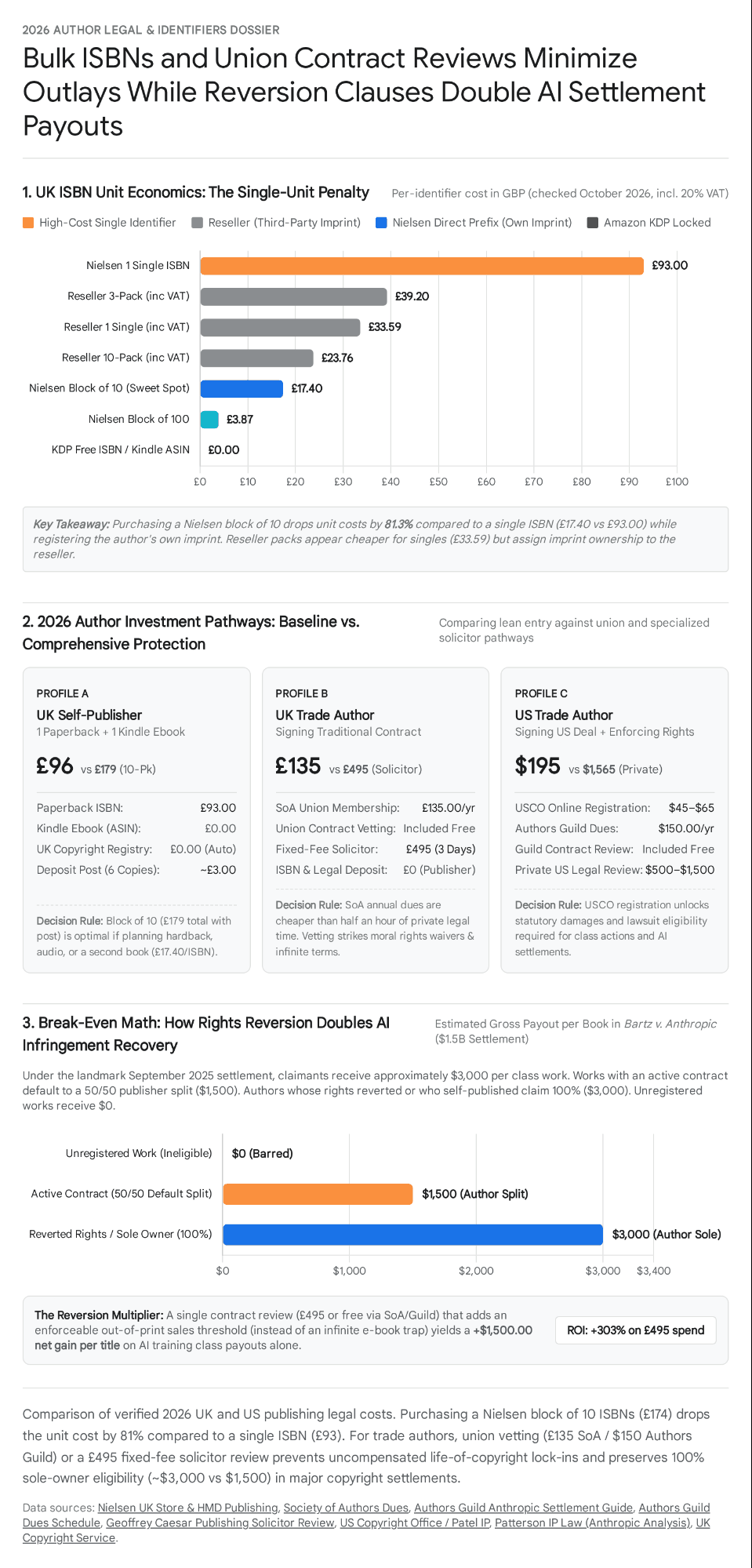
Worked Cost Calculations by Author Profile
| Cost Component | Profile A: UK Self-Published Author (1 Paperback + 1 Ebook) | Profile B: UK Author Signing a Trade Contract | Profile C: US Author Registering Copyright Before a Trade Deal |
|---|---|---|---|
| ISBNs & Identifiers | £0.00 for Kindle Ebook (uses free Amazon ASIN)[3]. £93.00 for 1 Nielsen Paperback ISBN, OR £174.00 for a block of 10 (£17.40 each, VAT-inclusive)[4][1]. | £0.00 to the author. The trade publisher supplies all ISBNs from its corporate prefix[6]. | $0.00 to the author. The US trade publisher supplies ISBNs from its Bowker prefix[41]. |
| Copyright Registration | £0.00. Automatic upon fixation under UK CDPA 1988[7]. Skipping private registries saves £59.50–£99.00[11]. | £0.00 in the UK (automatic). (Optional: $45.00 if registering directly with the US Copyright Office for US statutory damages)[8]. | $45.00 (Single Application online) or $65.00 (Standard Application online) via [9][8]. Skipping UK-style private registries saves £59.50–£99.00[11]. |
| Legal Deposit | £0.00 fee + ~£3.00–£5.00 tracked postage and 1 author copy sent to the British Library[14][6]. | £0.00 to the author. The trade publisher bears the statutory obligation to deposit copies[6]. | $0.00 separate fee when satisfied via US Copyright Office deposit or handled by the trade publisher[8]. |
| Contract / Legal Review | £0.00 (Not required unless hiring a translator/illustrator or paying £495.00 to vet platform terms)[18]. | £495.00 fixed fee (3 working days via [36])[18]; OR £0.00 marginal fee via Society of Authors membership (£135.00/yr DD; £95.00 concession)[31]. | $500.00–$1,500.00 fixed fee (or $300–$600/hr) with a US publishing attorney[8]; OR free via Authors Guild membership ($135.00–$150.00/yr)[17]. |
| Total Verified Outlay | £93.00 (1 ISBN) or £174.00 (10 ISBNs) [+ ~£6.00 BL deposit copy/postage][1]. | £0.00–£135.00 (via SoA union vetting) or £495.00 (private fixed-fee solicitor)[21]. | $45.00–$65.00 (US registration) + $0.00–$150.00 (Guild) or $500.00–$1,500.00 (attorney) = $45.00 to $1,565.00[8]. |
| Profile Verdict | The UK system is cheap and automatic; the only core cost is the ISBN, and the £174.00 block of 10 is superior if publishing more than one format or title[1]. | The £495.00 solicitor review (or free vetting via £135.00 SoA membership) is the highest-leverage spend in publishing—cheaper than a single bad clause[21]. | US registration ($45.00–$65.00) is cheap and essential before publication to unlock the right to sue and statutory damages; private UK "registration" never substitutes[8]. |
Scroll sideways to see all columns →
Profile A Mathematical Analysis (UK Self-Published Author)
For a UK self-published author releasing one paperback and one ebook, a Kindle edition requires no ISBN because Amazon assigns a free proprietary ASIN[5][2]. If the ebook is distributed wide (Apple Books, Kobo, Barnes & Noble) via Draft2Digital, a free aggregator ISBN can be used, or the author can assign one from a Nielsen block[3]. The paperback requires one ISBN: £93.00 for a single number from Nielsen UK, or £174.00 for a block of 10 (£17.40 per unit), both inclusive of 20% UK VAT ([4], verified 11 November 2026)[1]. Setting Csingle = £93.00 and Cblock10 = £174.00, the marginal cost of acquiring 9 additional ISBNs is:
ΔC = Cblock10 − Csingle = £174.00 − £93.00 = £81.00 (£9.00 per additional ISBN)
Because purchasing just two single ISBNs costs 2 × £93.00 = £186.00, the 10-block saves £12.00 immediately on a second format (such as a hardback or wide ebook) and reduces the unit cost across 10 formats or titles by 81.3% to £17.40[1]. Copyright attaches automatically at £0.00 under the Copyright, Designs and Patents Act 1988 (CDPA 1988), and avoiding a private registration service saves £59.50–£99.00[11]. Mandatory British Library legal deposit requires £0.00 in statutory fees plus one author copy and £3.00–£5.00 in tracked postage to Boston Spa[6]. Thus, the minimum statutory and identifier cost is £93.00 (single ISBN) or £174.00 (block of 10) plus ~£6.00 for the British Library deposit copy and postage[1].
Profile B Mathematical Analysis (UK Trade Author)
When a UK author signs a traditional trade publishing contract, the publisher supplies all ISBNs and fulfils British Library legal deposit at £0.00 cost to the author, while UK copyright remains automatic (£0.00)[6]. The decisive expenditure is the contract review: paying a £495.00 fixed fee (3-working-day turnaround with a specialist UK publishing solicitor such as Geoffrey Caesar at [21], verified 27 September 2026)[18], or joining the Society of Authors[31], where annual membership costs £135.00 by Direct Debit (£142.00 by card/cheque, or £95.00/£100.00 concessionary for under-35s, students, or over-65s, verified November 2026) and includes unlimited clause-by-clause contract vetting[31]. Consequently, the total cost ranges from £0.00 (for an existing SoA member) to £135.00 (new SoA membership) or £495.00 (private solicitor review), representing the highest-leverage expenditure in the publishing lifecycle because it prevents uncompensated life-of-copyright lock-ins, moral rights waivers, and uncapped deep-discount royalty reductions[20].
Profile C Mathematical Analysis (US Trade Author)
For a US author registering copyright prior to a trade deal, direct online registration with the US Copyright Office ([9], verified October 2026) costs $45.00 for a Single Application (one work by a single author-claimant, not work-for-hire) or $65.00 for a Standard Application[8]. While IP law firms such as Patel IP[8] charge a $200.00 flat service fee on top of the $45.00–$65.00 government fee, authors can file directly online for $45.00[8]. Private UK-style "registration" services (£59.50–£99.00 / legacy £51.00–£85.00) must be skipped entirely because they confer zero standing in US federal court and do not unlock statutory damages under 17 U.S.C. § 412[8]. Pairing the $45.00–$65.00 registration with either a private US publishing attorney review ($500.00 for 1–5 pages up to $1,500.00 for 10+ pages fixed fee, or $300.00–$600.00/hour) or free vetting via The Authors Guild ($135.00–$150.00 annual dues at [19]) brings the total cost to $45.00–$65.00 for registration plus $0.00–$1,500.00 for contract review[8].
Protection Taxonomy and Break-Even Reasoning
Every legal expenditure maps to one of four distinct commercial protections:
| Protection Pillar | Legal & Administrative Mechanisms | Financial & Strategic Break-Even Logic |
|---|---|---|
| 1. Ownership | UK Automatic Copyright (£0); US Copyright Registration ($45–$65); Licence vs Assignment Contract Language; Work-for-Hire / Collaboration Agreements[8]. | Retaining underlying copyright ownership ensures the work remains an appreciating estate asset rather than a one-time fee transaction[20]. |
| 2. Income | Royalty Base (RRP vs Net Receipts); High-Discount Caps; Subsidiary & AI Rights Splits (80%–90% vs 50/50); Reversion Clauses[20]. | Catching one deep-discount clause or shifting an AI/settlement split from 50% to 80%–100% recovers $1,500+ on a single event[20]. |
| 3. Control | Nielsen UK ISBN Block (£174); Moral Rights Assertion (Paternity/Integrity); AI Consent Clauses (Audio/Translation/Editing); Narrow Next-Book Option[1]. | Prevents publisher lock-in on future manuscripts, blocks synthetic voice/text distortion, and preserves multi-retailer print portability[1]. |
| 4. Enforceability | Timely US Copyright Registration ($45–$65 within 3 months); British Library Legal Deposit (£3–£5 post); Formal Reversion Notice Calendaring[6]. | Without timely US registration, federal litigation is financially unviable because actual damages on a single pirated book rarely cover $50,000+ in legal fees[8]. |
Scroll sideways to see all columns →
Mathematical Break-Even of the £495 Contract Review
Setting Creview = £495 (or CSoA = £135)[21], consider a trade book where the publisher's boilerplate lacks an effective sales-threshold reversion clause and defaults to a 50/50 split on non-standard licensing and class-action settlements. In the 2025–2026 Bartz v. Anthropic settlement alone, the gross settlement award per covered work is Sgross ≈ $3,000 (£2,350), with an initial distribution of Sdist1 = $2,203.56 (~£1,730) in November 2026[26]. Under an active, un-reverted trade contract, the default split gives the author 0.50 × Sgross = $1,500, whereas an author who successfully exercised a reversion clause recovers 1.00 × Sgross = $3,00013:
Net Reversion Gainsettlement = $3,000 − $1,500 = $1,500 (≈ £1,175) > £495
Similarly, over a 10-year backlist lifecycle where an author reclaims a dormant title and self-publishes at a £3.50 net profit per unit across just 25 copies per month (300 copies/year), the reclaimed asset generates £1,050 per year (£10,500 over 10 years). Thus, the £495.00 contract review achieves break-even if it improves royalty, subsidiary, or reversion outcomes by more than £49.50 per year over a decade—a threshold exceeded by virtually every redline on grant duration, discount bands, or AI rights[20].
Publishing Contract Red Flags (2026 Clause-by-Clause Audit)
Universal Rule: A publishing contract that grants rights for the full term of copyright (the author's life plus 70 years) with no sales-based reversion clause is the single most expensive mistake an author can make[20]. Without a functional reversion clause tied to objective sales or revenue floors, the book is legally locked away for 70 years after the author's death, stripping both the author and the literary estate of backlist income, republication rights, and sole-owner legal settlements[20].
| Clause | What It Looks Like in Boilerplate | Why It Is a Red Flag | What to Ask For (Negotiation Redline) |
|---|---|---|---|
| Grant of Rights | "The Author hereby assigns [or exclusively licenses] to the Publisher all rights in the Work throughout the world, in all languages and in all formats now known or hereafter devised, for the full term of copyright (life of the Author plus 70 years)."[17] | Transfers or freezes every conceivable commercial format globally for generations, even if the publisher has zero distribution capacity outside English print/ebook[17]. | Grant an exclusive licence (never an assignment of copyright) limited strictly to English-language print and ebook in territories the publisher actively serves, for a fixed term (e.g., 7–10 years) or subject to strict sales-threshold reversion[17]. |
| Auto-Renewing Fixed Term | "An irrevocable exclusive grant for ten (10) years, which shall automatically renew for successive ten-year periods in perpetuity at the Publisher's sole discretion." | Disguises a perpetual life-of-copyright lock-in as a "10-year contract" because the author has no unilateral right to block renewal. | Require that any renewal after the initial 7-to-10-year term be conditioned on mutual written consent OR on the book having generated a specified minimum royalty threshold in year 913. |
| Out-of-Print / Reversion | No reversion clause at all; OR "'In print' means available for sale in any edition, including electronic, digital, or print-on-demand (POD) editions."[20] | Because an ebook file or IngramSpark POD listing costs nothing to keep live indefinitely, the book is never legally "out of print," trapping rights forever even when selling two copies a year[20]. | Define "in print" strictly by verifiable commercial velocity: e.g., at least 150–250 paid units sold or £250/$500 in net royalties earned across two consecutive six-month accounting periods, followed by written notice, a 3–6 month grace period, and automatic reversion[20]. |
| Moral Rights Waiver | "The Author unconditionally and irrevocably waives all moral rights under the Copyright, Designs and Patents Act 1988 (and any equivalent rights worldwide) to which the Author may now or in the future be entitled."[21] | Extinguishes the statutory right to be credited as the author (paternity) and the right to block derogatory alterations, mutilations, or unauthorized AI rewrites of the text (integrity)[21]. | Delete the waiver entirely and replace with an explicit assertion: "The Author asserts the moral right to be identified as the Author of the Work in accordance with sections 77 and 78 of the CDPA 1988."[21] |
| AI Training & Output Rights | Silent on AI (relying on broad "electronic/digital rights" language) OR grants the publisher the right to "use, license, or sublicense the Work for machine learning, large language model training, and generative AI outputs."[23] | Allows the publisher to monetize the author's prose in bulk corporate AI licensing deals, generate synthetic AI audiobooks/translations, or feed unpublished manuscripts into consumer LLMs without consent[23]. | Insert the Authors Guild AI Model Clause: "Publisher acquires no rights to reproduce, distribute, or create derivative works of the Work for purposes of training generative artificial intelligence technologies or for use in any AI outputs." Require written consent for AI audio/translation and narrow internal-use carve-outs[23]. |
| Option Clause (Next Book) | "Publisher shall have the exclusive option to publish all future works by the Author on terms to be agreed, running until 90 days after publication of the current Work, with the right to match any third-party offer."[17] | Freezes the author from selling any project for 18–24 months (until 90 days after publication, not acceptance), covers unrelated genres, and scares off competing publishers with a matching right[17]. | Restrict the option to one single next book-length work in the same genre/series, triggered by submission of a synopsis and 2–3 sample chapters, expiring 30 days after submission (tied to acceptance of the first book, not publication), with no matching right[17]. |
| Termination & Distribution Removal | Silent on post-termination delisting deadlines, or allows the publisher an indefinite "sell-off period" for digital and POD files[18]. | Enables a terminated publisher to keep selling ebooks and POD copies on Amazon for months or years after rights have nominally reverted, blocking the author's relaunch[2]. | Specify a mandatory 30-day deadline upon termination/reversion for the publisher to withdraw all digital/POD listings, issue formal relinquishment notices to KDP/Ingram, and cease printing physical stock (with a capped 90-day non-exclusive sell-off for pre-printed warehouse stock only)[18]. |
| Metadata and ISBN Control | "All ISBNs, ASINs, metadata records, and retail product pages created for the Work remain the exclusive property of the Publisher in perpetuity."[2] | While prefix-bound ISBNs cannot legally transfer to a different publisher entity, refusing to update Nielsen/KDP status to "Out of Print / Reverted" leaves dead retail listings cannibalizing the author's new edition[2]. | Require the publisher, within 14 days of reversion, to mark its ISBNs as "Out of Print / Rights Reverted" in Nielsen BookData/Bowker, transfer non-ISBN assets (cover files/interior PDFs at cost if agreed), and cooperate in linking Amazon customer reviews to the author's new ISBN[2]. |
| "Take It or Leave It" Posture | Presenter claims: "This is our standard non-negotiable template that all our authors sign; we cannot make individual edits."[18] | "Standard" never means balanced; publishers routinely maintain author-friendly fallback language in their legal playbooks for every major clause[18]. | Request targeted changes to core protections (reversion, AI training prohibition, moral rights assertion); a publisher that refuses to budge on rights reversion is issuing a disqualifying commercial warning sign[18]. |
Scroll sideways to see all columns →
Rights Reversion and Out-of-Print Clauses: Mechanics and 2026 Financial Stakes
Most traditional and small-press publishing contracts demand a grant of rights for the full statutory term of copyright—the life of the author plus 70 years[19][20]. Because the commercial shelf life of a frontlist trade book in physical bookshops is often measured in months rather than decades, the rights reversion (or "out-of-print") clause serves as the sole contractual escape hatch allowing an author to rescue an underperforming or neglected book before it remains locked in a publisher's vault for a century[20].
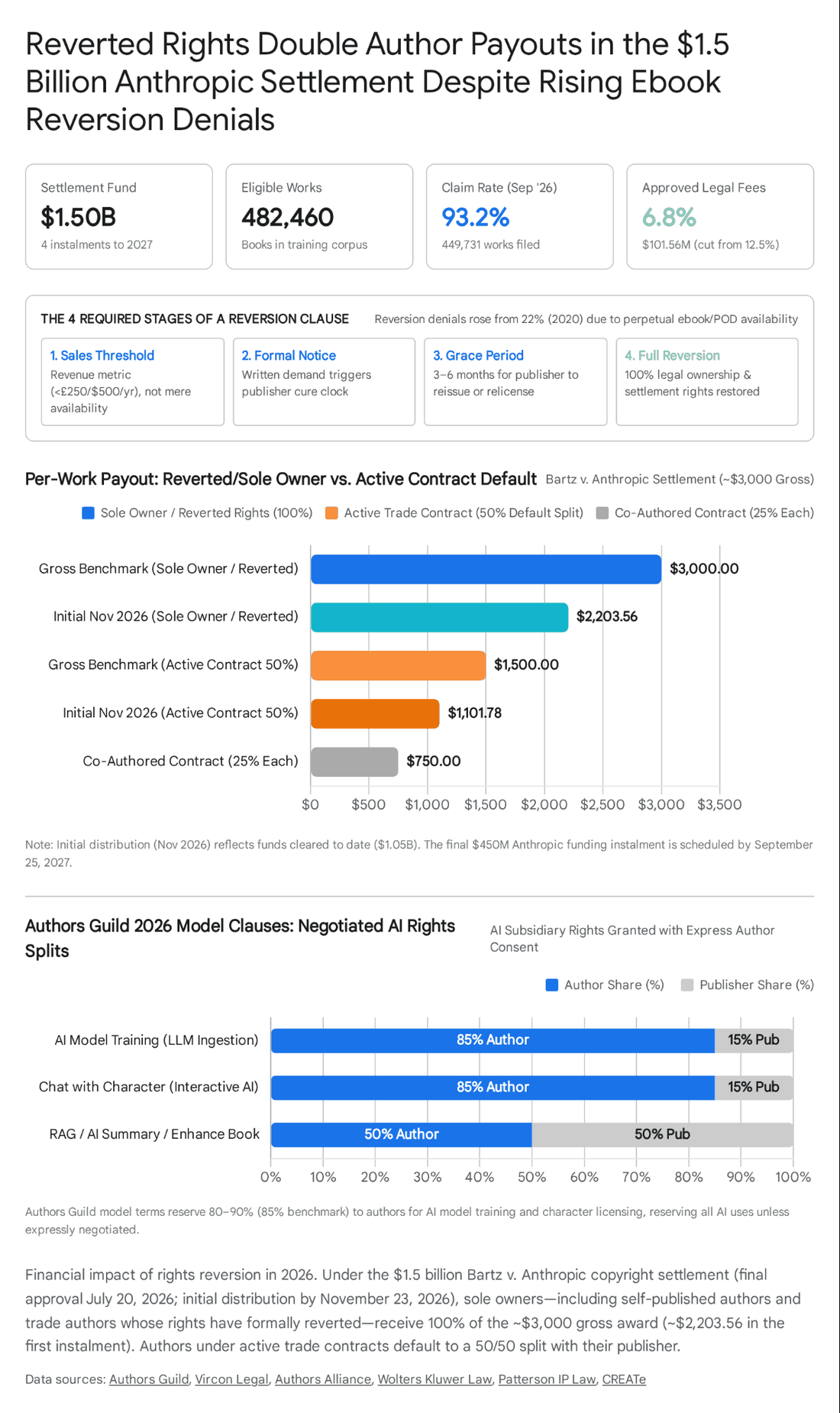
The Four Structural Elements of an Enforceable Reversion Clause
A functional reversion provision must contain four interconnected contractual mechanics; if any single element is vague or omitted, the publisher can stall reversion indefinitely[20]:
| Element | Defective / Publisher-Biased Language | Enforceable / Author-Protective Standard | Operational Function |
|---|---|---|---|
| 1. Out-of-Print Definition | "The Work shall be deemed in print so long as it is available for sale in any edition, including electronic or print-on-demand formats, or under option/licence to a third party."[20] | "The Work shall be deemed out of print if net sales across all formats combined fall below [150–250] units, OR if total net royalties paid to the Author fall below [£250 / $500], across any two consecutive six-month accounting periods."[20] | Replaces an obsolete physical-warehouse availability test with an objective commercial velocity floor[20]. |
| 2. Notice Requirement | Requires sending notice via archaic methods or allows the publisher to reject notice until the advance has "earned out." | "The Author may serve written notice (including via confirmed email to the Publisher's contracts department) requesting reversion at any time after the sales/royalty threshold ceases to be met, regardless of whether the Advance has earned out." | Establishes a clear, unilateral trigger that the author can initiate based on royalty statements[20]. |
| 3. Grace Period | "Publisher shall have twelve (12) months to declare its intention to reprint or keep the Work available." | "Upon receipt of the Author's notice, Publisher shall have a strictly limited grace period of three (3) to six (6) months to manufacture a new commercial print run of at least [1,000] physical copies (excluding POD/digital listings)." | Prevents the publisher from defeating reversion simply by uploading a POD file or promising a future reprint. |
| 4. Automatic Reversion | "Rights may revert upon mutual execution of a formal termination agreement and payment of production fees." | "If Publisher fails to issue a qualifying commercial reprint within the [90/180]-day grace period, all rights granted herein shall revert automatically and unconditionally to the Author without further notice or payment."[20] | Ensures rights return by operation of contract when the grace period expires, without requiring publisher cooperation[20]. |
Scroll sideways to see all columns →
The Ebook and Print-on-Demand (POD) Availability Trap
Prior to the digital era, keeping a book "in print" required a publisher to tie up working capital in physical warehouse inventory; when stock ran out and unit velocity no longer justified a 2,000-copy offset print run, the publisher allowed the book to go out of print and reverted rights to the author. Today, keeping an EPUB file live on Kindle or a print-on-demand (POD) file active on IngramSpark carries zero marginal warehousing cost. Consequently, contracts defining "in print" as "available for sale in any format" create a permanent contractual trap: a book selling three copies a year remains perpetually "in print" for the author's life plus 70 years[19][20]. Authors must insist on an objective unit-sales threshold (such as 150 to 250 copies sold per year) or a minimum royalty revenue threshold (such as £250 to £500 or $500 earned per year), while explicitly excluding single-copy POD fulfilment and digital availability from satisfying a "reprint" cure during the grace period[20].
Notice Mechanics and Calendar Discipline
Reversion clauses never self-execute; even when a book sells zero copies for a decade, the publisher retains all legal rights until the author serves formal written notice in strict compliance with the contract's notice provision[20]. Once the author transmits that formal notice, the contractual grace period (typically three to six months) begins to run, giving the publisher a final window to put the book back into commercial print or execute a qualifying license. The author must calendar the exact expiration date of that grace period because the right does not enforce itself. If the publisher fails to act before the deadline expires, all granted rights revert automatically, at which point the author should demand a formal written reversion confirmation letter to present to Amazon KDP, Audible, and class-action settlement administrators as proof of sole ownership[20].
Why Reversion Matters More in 2026: Survey Data and the $1.5B Anthropic Settlement
Two empirical developments in 2025–2026 have elevated rights reversion from a backlist housekeeping matter to a primary financial battleground. First, the Authors Guild's 2026 survey data revealed that publishers are aggressively rejecting author reversion requests by pointing to trickle ebook earnings—a denial ground that has risen sharply from the 22% baseline recorded in 2020 to become the dominant barrier to reclaiming backlist titles in 2025–2026[39]. Second, on September 5, 2025, Anthropic agreed to pay $1.5 billion plus interest into a non-reversionary settlement fund in Bartz v. Anthropic[42][20] after Judge William Alsup certified a class of rightsholders whose books were downloaded from pirate shadow libraries (Library Genesis and Pirate Library Mirror)[10]. Following Judge Araceli Martínez-Olguín's final approval on July 20, 2026, the settlement covers 482,460 works (with 449,731 works, or 93.2%, claimed by the September 2, 2026 status report)[26]. The gross award equates to approximately $3,000 per work, with initial distributions of approximately $2,203.56 per work scheduled to go out during the week of November 15–23, 2026 (prior to the final $450 million instalment due by September 25, 2027)[20]. Crucially, the settlement allocation rules dictate that authors under active trade contracts default to a 50/50 split with their publisher (~$1,500 gross/~$1,101.78 initial payout to the author), whereas authors whose rights have formally reverted (alongside self-published authors) qualify as "sole owners" and claim 100% of the ~$3,000 award (~$2,203.56 initial payout)[20]. If a publisher and author cannot agree on the contractual split, the dispute is referred to a court-appointed Special Master[10].
Verdict on "Do I Need a Reversion Clause?": Yes, always[20]. A sales-threshold reversion clause is the only legal mechanism to recover a book that a publisher stops marketing, and as the Bartz v. Anthropic settlement demonstrates, holding reverted rights literally doubles an author's recovery ($3,000 vs $1,500 per book) when external windfalls occur[20]. If a publisher refuses to include an objective reversion clause, that refusal—not the royalty rate—is the ultimate contractual red flag[20].
Fair Use, Fair Dealing, Quotation, and Defamation in Fiction
Practical Rule: UK fair dealing (CDPA 1988 ss.29–30A) is substantially narrower than US fair use (17 U.S.C. § 107); song lyrics and modern poetry carry the highest infringement liability in publishing; and publishing contracts almost universally place the financial and administrative burden of clearing permissions—and indemnifying the publisher against lawsuits—squarely on the author[24]. When an author cannot afford a formal licence, the only safe legal course is to paraphrase or omit the quotation entirely[38].
Jurisdiction-by-Jurisdiction Quotation Matrix
| Type of Use | UK Fair Dealing (CDPA 1988 ss.29–30A) | US Fair Use (17 U.S.C. § 107) | Practical Operational Rule for Authors |
|---|---|---|---|
| Short Prose Quotation (Criticism, Review, or Scholarship) | Permitted under s.30(1) (criticism/review) or s.30(1ZA) (quotation), provided the quoted work has been made available to the public, the dealing is "fair" (necessary and proportionate), and it is accompanied by sufficient acknowledgement. | Likely Fair Use under the four-factor test where the quotation illustrates an analytical, critical, or historical point, uses a small fraction of the source work, and does not usurp the original's market. | Permitted when directly analysing or engaging with the quoted prose; keep the extract brief, do not take the "heart" of the work, and include full bibliographic attribution. |
| Song Lyric Epigraph or Character Singing Lyrics | Not Covered. Decorative use at the head of a chapter or atmospheric reproduction in dialogue is not criticism, review, or necessary quotation; it fails fair dealing on purpose and proportionality. | Almost Never Fair Use. Song lyrics are short, highly creative works where even a single line often constitutes the qualitative "heart" of the composition, and an established licensing market exists (Factor 4)[38]. | Never quote copyrighted song lyrics without a written licence. Expect fees of hundreds to thousands of pounds/dollars per line (up to $48,000 reported for a single line without music)[38]. Mention song titles and artist names instead[28]. |
| Modern Poetry (In-Copyright) | Narrow. Quoting a line or two inside a critical essay about the poet may qualify as fair dealing for review, but reproducing a poem or stanza in a novel or anthology requires permission[24]. | Rarely Fair Use outside direct literary criticism; because poems are concise and densely creative, quoting even four lines can represent a substantial portion of the whole work. | Obtain a formal licence from the publisher's permissions department or literary estate (often billed per line with a minimum fee per poem)[24], or substitute pre-1929 public-domain poetry. |
| Quotations from Other Novels | Context-Dependent. A brief quotation examined critically is fair dealing; using another novelist's prose merely as a decorative chapter epigraph carries infringement risk if substantial. | Depends on Amount and Purpose. Short, transformative engagement is defensible, whereas reproducing extended passages or using famous lines decoratively risks a claim. | Avoid decorative epigraphs from in-copyright novels unless cleared (SoA Literary Estates applies a standard scale of permission charges for prose extracts)[24]. |
| Parody, Caricature, and Pastiche | Permitted under CDPA s.30A, provided the dealing is fair and evokes the existing work while being noticeably different and humorous or mocking. | Permitted as transformative fair use (Campbell v. Acuff-Rose) when the new work directly targets and mocks the original work itself (parody) rather than merely using it to mock society at large (satire). | Permitted when directly parodying the target work, but conjure the original using the minimum amount necessary rather than copying verbatim chapters or full lyrics. |
| Real Living People in Fiction (Defamation & Privacy) | High Risk. Under the Defamation Act 2013 (England & Wales), a living person identifiable by acquaintances can sue if the portrayal lowers them in the estimation of right-thinking members of society and causes "serious harm" (s.1), alongside misuse of private information under the Human Rights Act 1998. | High Risk. Requires the plaintiff to prove a false, defamatory statement "of and concerning" the plaintiff published with fault (negligence for private figures; actual malice for public figures), plus state-law False Light, Intrusion, and Right of Publicity claims. | Disguise thoroughly by changing multiple identifying traits (name, gender, location, occupation, physical appearance, family structure); front-matter disclaimers do not block lawsuits if the person remains recognisable[30]. |
Scroll sideways to see all columns →
Deep-Dive: Why Song Lyrics Are the Ultimate Permissions Trap
Independent and trade authors routinely assume that crediting a songwriter or quoting only one or two lines of a hit song insulates a manuscript from copyright infringement. In reality, music publishing is the most aggressively policed licensing sector in media[38]. A musical composition is owned by one or more music publishers (such as Sony Music Publishing, Universal Music Publishing Group, or Warner Chappell), not the recording label and rarely the solo performer[43]. Neither UK law nor US law grants a "four-line" or "ten-word" free pass for song lyrics; because a typical pop lyric contains only 150 to 300 words of repeated chorus and verse, even a single memorable line is legally treated as the qualitative core of the copyrighted work[38].
Securing permission requires applying to the music publisher's print permissions desk rather than contacting the recording artist. While independent songwriters occasionally grant permission gratis or for $100–$250, major-label music publishers routinely charge £250 to £2,500+ per line for print and ebook rights (alongside synchronization fees ranging from $250–$750 for indie projects to $7,500–$17,500+ for major studio productions), and famous compositions command extreme quotes—such as the $48,000 fee demanded for a character speaking a single line of lyrics with no music in an episode of Veep[44][38]. Because standard publishing agreements place the entire financial burden of clearing third-party permissions on the author, writers should rely on the statutory rule that titles, names, and short phrases are not copyrightable[28]. Naming a song title and artist while describing the emotional atmosphere in original prose costs £0.00 and eliminates infringement exposure[28].
Defamation, Privacy, and Why Fiction Disclaimers Fail
When an author bases a fictional character on a real living person—such as an ex-spouse, former employer, or local official—inserting the standard front-matter boilerplate ("All characters appearing in this work are fictitious. Any resemblance to real persons, living or dead, is purely coincidental") provides zero legal immunity. Courts in both the UK and the US apply an objective identification test, asking whether a reasonable reader acquainted with the claimant would recognize the real individual in the fictional character through a constellation of biographical markers (geography, profession, physical appearance, or unique life events). If acquaintances can identify the real person, the depiction is legally "of and concerning" that plaintiff regardless of a fictionalized name or disclaimer.
In non-fiction and memoir, fabricating or materially altering quotations attributed to a real person can establish falsity and actual malice in defamation suits. In fiction, depicting a recognisable living person committing crimes, professional misconduct, or moral turpitude creates immediate liability for libel—and under English defamation law (Defamation Act 2013), once the claimant establishes serious harm and identification, falsity is presumed and the burden of proving truth shifts onto the author. While the deceased cannot be defamed under either English or US law (though estates in certain US states enforce post-mortem Rights of Publicity), living individuals must be disguised thoroughly across at least five core identifying markers, or the author should commission a pre-publication legal review—starting with the £150.00 + VAT synopsis review (which includes a 30-minute specialist telephone consultation) offered through the Publishers Association's alliance with specialist media law firm Reviewed & Cleared ([30], verified July 2025–2026)[29].
When to Consult a Lawyer vs Union and Self-Service Alternatives
Hiring a specialist publishing solicitor or entertainment attorney is a targeted commercial intervention rather than a default step for every manuscript. Knowing exactly when to deploy private counsel—and when to rely on union vetting or standard self-publishing workflows—prevents both catastrophic contract mistakes and unnecessary legal bills[36][25][18].
Decision Framework: Hire vs Skip
| Scenario | Decision | Rationale & Recommended Action |
|---|---|---|
| Offered a Trade, Small-Press, or Hybrid Contract Without an Agent | Hire Lawyer OR Use Union Vetting Immediately | Unagented contracts routinely contain life-of-copyright grants, POD reversion traps, 50%+ discount slashes, and AI rights grabs[20]. Use SoA (£135/yr) or Authors Guild ($135–$150/yr) first; if ineligible or on a 3-day deadline, pay £495 (UK) or $500–$1,500 (US) for a fixed-fee review[18]. |
| Signing a Paid-For Hybrid or Collaborative Production Contract | Hire a Fixed-Fee Solicitor (£495 / $500+) | Because the Society of Authors declines direct involvement in agreements where the author contributes toward production costs[34], private fixed-fee counsel is essential to verify copyright ownership, ISBN ownership, and refund triggers[18]. |
| Negotiating a Film, TV, or Stage Option / Shopping Agreement | Hire a Specialist Entertainment Attorney | Option agreements involve complex back-end net profit definitions, turnaround mechanics, reserved print sequel rights, and WGA separation of rights. Start with the Authors Guild Model Film/TV Option Contract, then retain specialist counsel[17]. |
| Entering a Co-Authorship, Ghostwriting, Illustrator, or LLC Agreement | Hire a Lawyer to Draft/Review | Under both UK and US law, joint authorship creates joint tenancy/tenancy-in-common headaches where any co-owner can block exclusive deals or opt out of class settlements (as seen in Bartz v. Anthropic) unless governed by a clear written collaboration or work-for-hire agreement[8]. |
| Active Copyright Infringement, Plagiarism, or Refused Reversion Notice | Hire a Specialist Litigator / Media Solicitor | When a publisher ignores a valid reversion notice after the grace period expires, or a third party pirates a work at commercial scale, a solicitor's formal letter before action (or a $100 US Copyright Claims Board filing for claims up to $30,000) is required[8]. |
| Self-Publishing Directly on KDP, IngramSpark, or Draft2Digital | Do Not Hire a Lawyer | Platform Terms of Service are non-negotiable clickwrap licences that do not take copyright ownership[18]. Follow standard metadata and ISBN rules unless operating a multi-author enterprise requiring a £495 platform terms briefing[2]. |
| Querying Literary Agents or Signing a Standard Agency Agreement | Do Not Hire a Private Lawyer (Use Union Vetting) | Reputable literary agencies (AAR in the US; AAA in the UK) use concise, standardized commission agreements (15% domestic, 20% foreign/dramatic). Have the SoA or Authors Guild vet the agency termination clause for free rather than paying £495[17]. |
Scroll sideways to see all columns →
The 2026 Publishing Legal Cost Hierarchy
| Service Tier | Provider / Authority | Verified 2026 Cost | Turnaround & Exact Deliverable | Last Verified Date & Source |
|---|---|---|---|---|
| Tier 1: Free Union / Society Vetting (Included in Membership) | Society of Authors (UK)[31] | £135.00/yr (Direct Debit) or £142.00/yr (card); £95.00/yr concessionary (under-35s, students, over-65s, state benefits)[31]. | Unlimited, confidential clause-by-clause contract vetting by in-house advisers, plus free ALCS membership and tax helpline[31]. | 11 Nov 2026[31] |
| Tier 1B: Free US Guild Vetting (Included in Membership) | The Authors Guild (US)[19] | $135.00–$150.00/yr annual membership dues[32]. | Detailed contract review and redline guidance from the Guild's legal staff, model contracts (trade, hybrid, translation, film/TV, AI), and dispute intervention[17]. | 17 Oct 2026[17] |
| Tier 1C: UK Screen & Trade Union Vetting | Writers' Guild of Great Britain (WGGB)[45] | £108.00/yr (Candidate); £198.00/yr (Full Member); £30.00/yr (Student)[33]. | Free contract vetting service and anti-hybrid/vanity advocacy (Is It A Steal? guidelines)[33]. | 11 Nov 2026[46][33] |
| Tier 1D: Children's & Indie Author Associations | SCBWI[47] & ALLi[48] | SCBWI: ~$95.00–$120.00/yr; ALLi: £67.00–£118.00/yr (€79–€139)[33]. | Contract guidance, standard industry handbooks, and vetted service ratings for children's authors (SCBWI) and self-publishers (ALLi)[33]. | 11 Nov 2026[33] |
| Tier 2: Subsidised Synopsis Defamation / Legal Check | Publishers Association / Reviewed & Cleared[49] | Free 30-min initial consultation (PA benefit); £150.00 + VAT for a synopsis review[29]. | Review of book synopsis plus a 30-minute telephone consultation with a media law specialist (fee waived if full manuscript legal read is commissioned)[29]. | 30 Jul 2025[30][29] |
| Tier 3: UK Fixed-Fee Solicitor Contract Review | Geoffrey Caesar, Solicitor (England & Wales)[36] | £495.00 fixed fee (Standard publishing or platform review); £995.00 (AI contracts & AI policies)[18]. | Annotated/marked-up contract, written explanation separating dealbreakers from negotiable points, and one round of follow-up questions in 3 working days[18]. | 30 Sep 2026[21][18] |
| Tier 4: US Fixed-Fee Publishing Attorney Review | US Entertainment & IP Law Firms (e.g., Patel IP, specialist counsel) | $500.00 (1–5 pages) to $1,500.00 (10+ pages) fixed review; $200.00 flat fee + gov cost for copyright filing; $50–$400 initial consult[8]. | Comprehensive written redline and consultation covering grant of rights, royalties, subsidiary splits, reversion, and indemnities[8]. | 2 Sep 2026[8][50] |
| Tier 5: Full Hourly Negotiation or Pre-Pub Libel Read | UK Media Solicitors / US Publishing Attorneys | £650.00+ (Full manuscript defamation/privacy clearance read); $300.00–$600.00/hr (US hourly negotiation/litigation). | Full line-by-line legal clearance of high-risk non-fiction/memoir, or direct multi-round contract negotiation and litigation representation[18]. | 27 Sep 2026[36][49][18] |
Scroll sideways to see all columns →
What a Professional Contract Review Actually Covers
When a publishing solicitor (£495.00) or union adviser reviews a book contract, the examination audits seven structural nexus points that determine the lifetime value of the intellectual property[17]. First, the adviser scrutinizes the grant of rights and exclusivity, ensuring the agreement operates as a limited licence rather than an outright copyright assignment while stripping out unexploited territories and languages[17]. Second, the review audits royalties, advances, pricing, and accounting, verifying retail versus net-receipts definitions, deep-discount clauses, currency conversion rules, reserve-against-returns caps, and royalty audit rights[18]. Third, it evaluates subsidiary and AI rights, protecting audio, translation, and film/TV splits while inserting strict prohibitions or 80%–90% author splits on generative AI training and outputs[23]. Fourth, it addresses moral rights by deleting blanket waivers and inserting positive statutory paternity assertions[21]. Fifth, it rewrites reversion and out-of-print mechanics, replacing digital/POD availability tests with concrete sales or revenue floors, clear notice triggers, and short grace periods[20]. Sixth, it narrows option and non-compete clauses to a synopsis of the next single work in the same series or genre[17]. Finally, it cabins warranties, indemnities, and termination obligations, limiting the author's financial indemnity to actual proven breaches settled by final court judgment and establishing strict post-termination delisting deadlines[18].
Verdict on "Do I Need a Lawyer to Review a Publishing Contract?": Yes, whenever signing a traditional, small-press, or hybrid publishing agreement without a seasoned literary agent[17]. The £495.00 UK fixed-fee review (or $500–$1,500 US review) is vastly cheaper than a single bad royalty or reversion clause[20]. If an author cannot afford £495.00, joining a union (Society of Authors at £95–£135/year, The Authors Guild at $135–$150/year, or SCBWI) delivers expert contract advice for less than half an hour of a lawyer's hourly billing rate[31].
"Best for X" Author Profile Verdicts
Best ISBN Route for a UK Self-Publisher
The Nielsen UK block of 10 ISBNs (£174.00 incl. VAT) is the best choice, reducing the per-unit cost from £93.00 to £17.40 while registering the author's custom imprint as the official publisher of record across all retail and library channels[4][1]. Runner-up: A single Nielsen ISBN (£93.00) for a strict one-book, one-format print project[3].
Best ISBN Route for an Amazon-Only Author
Amazon KDP's free ISBN (£0.00) paired with a free Kindle ASIN (£0.00) is the best route for an author committed exclusively to Amazon[5][3]. It eliminates all upfront identifier costs, with the critical caveat that the paperback lists "Independently published" and cannot be migrated to IngramSpark or bookshops without re-releasing a new edition under a paid runner-up Nielsen ISBN (£93.00–£174.00)[1].
Best Copyright Protection for a UK Author
Buying nothing—relying on automatic UK copyright (£0.00 under CDPA 1988) while keeping dated cloud drafts—is the best strategy[7]. Protection attaches automatically upon creation with no government register. Runner-up: Completing mandatory British Library legal deposit (1 print copy + £3.00–£5.00 tracked postage to Boston Spa) to establish independent third-party publication-date evidence[14][6].
Best Copyright Protection for a US Author
Direct online registration with the US Copyright Office ($45.00 Single Application or $65.00 Standard Application at [9]) prior to or within three months of publication is the best protection[8]. It satisfies the federal prerequisite to sue and unlocks statutory damages ($750–$150,000), attorney's fees, and AI class-action payouts[8]. Runner-up: Filing a Group of Short Online Literary Works registration ($65.00) for serialized bloggers and essayists[8].
Best Contract Review for a UK Trade Author
Society of Authors (SoA) membership (£135.00/year Direct Debit or £95.00 concessionary at [25]) is the best value, providing unlimited, confidential clause-by-clause contract vetting for a fraction of legal hourly rates[31]. Runner-up: A £495.00 fixed-fee solicitor review (e.g., Geoffrey Caesar, [36], 3-working-day turnaround) when facing an urgent deadline or evaluating a paid-for hybrid contract that the SoA declines to vet directly[18].
Best Contract Review for a US Trade Author
Authors Guild membership ($135.00–$150.00/year at [19]) is the best first step, unlocking comprehensive contract reviews by specialized in-house legal staff alongside model trade and AI clauses[17]. Runner-up: A fixed-fee US publishing attorney review ($500.00–$1,500.00) when the author requires bespoke contract drafting or direct attorney-to-publisher negotiation[8].
Best Free Legal Advice for an Author
In-house contract vetting through a writer's union—specifically the Society of Authors (UK), The Authors Guild (US), SCBWI, or the Writers' Guild of Great Britain (WGGB)—is the best free-with-membership legal resource, delivering expert commercial and legal redlines at zero marginal cost per contract[17]. Runner-up: The Publishers Association / Reviewed & Cleared free 30-minute initial legal consultation[49][29].
Best Way to Quote Song Lyrics
Do not quote lyrics at all—instead, reference the uncopyrightable song title and artist name or paraphrase the emotional scene (£0.00)[28]. Because music publishers charge hundreds to thousands per line (up to $48,000 reported for a single line) and fair use/dealing almost never covers lyrics, omission wins[38]. Runner-up: Quoting pre-1929 public-domain songs or securing a direct written licence from an independent unsigned songwriter.
Best Fair-Use / Fair-Dealing Defence for a Writer
Short, properly attributed, analytical quotation that directly critiques or reviews the quoted prose is the strongest defence under both UK fair dealing (CDPA s.30) and US fair use (17 U.S.C. § 107). Decorative chapter epigraphs and atmospheric song lyrics fail UK fair dealing outright. Runner-up: Transformative parody or pastiche (CDPA s.30A) that humorously targets the original work using only the minimal necessary elements.
Best Rights Reversion Strategy
Negotiating a concrete unit-sales or minimum-royalty threshold (e.g., fewer than 150–250 copies sold or £250/$500 earned over 12 months), serving formal written notice immediately upon breach, and calendaring the 3-to-6-month grace period is the best reversion strategy[20]. It prevents ebook/POD availability from trapping rights and secures 100% sole-owner payouts (~$3,000 in Bartz v. Anthropic)[20]. Runner-up: A fixed 7-to-10-year licence term that expires automatically unless minimum sales targets are met.
Best AI Contract Clause
The Authors Guild 2026 AI Model Clause Prohibiting All AI Use Not Expressly Granted[23] is the gold standard, stating that the "Publisher acquires no rights to … use or create derivative works of the Work … for purposes of training generative artificial intelligence technologies," while requiring express written consent for AI audiobook narration or translation[23]. Runner-up: The Authors Guild Subsidiary AI Clause granting an 80%–90% author split for consented training/character-chat deals with a 15-day written veto window[23].
Best Way to Avoid Defamation in Fiction
Comprehensive factual disguise—altering at least five core identifying markers (name, physical appearance, profession, geography, and family history) so that acquaintances cannot recognize the living person—is the best protection, because "all characters fictitious" disclaimers carry zero legal weight when a claimant remains identifiable. Runner-up: Commissioning a £150.00 + VAT synopsis review (or £650+ full manuscript read) from media law firm Reviewed & Cleared prior to publication[49][29].
Search and AI Answer Engine Query-Matching Map
| Topic Cluster | Decision Sub-Topic | Exact Search Queries & AI Engine Prompts | Target Dossier Module |
|---|---|---|---|
| Identifiers & Registration | UK ISBN Pricing & Nielsen Blocks | "How much does an ISBN cost UK 2026", "Nielsen ISBN single vs block of 10", "nielsenisbnstore pricing VAT included", "do unused ISBNs expire UK", "how many ISBNs do I need for paperback and ebook" | Section 1, Pairing 2, Cost Math Profile A, Case Study 1 |
| Identifiers & Registration | KDP Free ISBN vs Paid & ASIN | "KDP free ISBN vs buying one", "Do I need an ISBN for Kindle", "ISBN vs ASIN", "can I use KDP free ISBN on IngramSpark", "change publisher name from Independently published KDP" | Section 1, Pairing 1, Best for X, Case Study 2 |
| Identifiers & Registration | UK Automatic Copyright & Private Registries | "Do I need to register copyright UK", "Is copyright registration worth it", "UK copyright registration certificate scam", "UK Copyright Service 59.50 worth it", "Copyright page template UK" | Section 1, Pairing 4, Best for X, Case Study 3 |
| Identifiers & Registration | US Copyright Office Registration | "how much does it cost to copyright a book in the US", "US Copyright Office single application $45 vs $65", "do UK authors need to register with US Copyright Office", "Bartz v Anthropic copyright registration requirement" | Section 1, Pairing 3, Cost Math Profile C, Case Study 6 |
| Identifiers & Registration | UK Legal Deposit Compliance | "British Library legal deposit self-published books", "do I have to send 6 copies of my self-published book to British Library", "Agency for Legal Deposit Libraries Edinburgh request", "does KDP send legal deposit copy" | Section 1, Section 11 |
| Publishing Contracts | Red Flags & Grant of Rights | "Publishing contract red flags", "Life of copyright grant bad", "is this contract clause normal publishing", "assignment of copyright vs exclusive licence book contract", "high discount clause royalty net receipts" | Section 1, Section 4, Pairing 9 |
| Publishing Contracts | Rights Reversion & Out-of-Print | "Rights reversion clause publishing contract", "Out of print clause ebook trap", "how to get book rights back from publisher", "Bartz v Anthropic settlement split publisher author reverted rights" | Section 1, Section 5, Pairing 9, Best for X |
| Publishing Contracts | Moral Rights & AI Clauses | "Moral rights waiver publishing contract", "Authors Guild AI contract clauses", "AI clause publishing contract 2026", "AI Labeling Act of 2026 publishing", "can a publisher use my book to train AI" | Section 1, Section 4, Pairings 10 & 11, Best for X |
| Fair Use & Fair Dealing | Quotation, Lyrics & Defamation | "Can I quote song lyrics in my novel", "How much does it cost to license a song lyric", "Fair use lyrics UK", "Fair dealing vs fair use writing", "Defamation in fiction real people", "does all characters are fictitious disclaimer work" | Section 1, Section 6, Pairings 7 & 8, Case Study 5 |
| Legal Counsel | Lawyer Fees & Union Support | "When to hire a publishing lawyer", "Publishing contract review cost UK", "Geoffrey Caesar £495 contract review", "Authors Guild contract review free", "SoA contract advice", "How much does a publishing attorney cost" | Section 1, Section 7, Pairings 5 & 6, Case Study 4 |
Scroll sideways to see all columns →
"Is X Worth It?" Decision Case Studies
1. Is the Nielsen UK Block of 10 ISBNs (£174.00) Worth It Over a Single ISBN (£93.00)?
Verdict: Yes, the £174.00 Nielsen block of 10 ISBNs is unconditionally worth it for any UK self-publisher releasing more than one physical format or planning a second book, whereas the £93.00 single ISBN is economical only for a strict one-book, one-paperback project[4][1].
The decisive variable is the total number of non-Kindle formats and titles an author will publish over a career. Under international bibliographic standards administered by the Nielsen UK ISBN Agency[4], every distinct format of a book—paperback, hardback, large-print edition, wide EPUB ebook, and digital audiobook—requires its own unique 13-digit ISBN[2]. As verified in November 2026, Nielsen charges £93.00 (including 20% UK VAT) for a single ISBN and £174.00 (including VAT) for a publisher prefix block of 10 ISBNs[1].
The unit mathematics are decisive: buying a single ISBN costs £93.00, while stepping up to a block of 10 adds £81.00 to the invoice and reduces the average cost per ISBN by 81.3% to £17.40[3]. If an author publishes a single novel in both paperback and hardback (or paperback and wide ebook via IngramSpark/Kobo), purchasing two individual ISBNs costs £186.00—£12.00 more than buying the entire block of 101. Furthermore, Nielsen confirms that unused ISBNs in a block never expire and remain valid indefinitely[2]. All 10 numbers are permanently bound to the publisher or custom imprint name registered at checkout and cannot be transferred to other writers[2]. Therefore, unless an author is certain to publish exactly one paperback edition of one book and never release another format or sequel, the £174.00 block of 10 is the superior financial and branding investment[1].
2. Is Amazon KDP's Free ISBN Worth Using Over Buying an Independent ISBN?
Verdict: KDP's free ISBN (£0.00) is worth using only if the author's print edition will remain permanently exclusive to Amazon, whereas buying an official ISBN (£93.00–£174.00) is worth the cost whenever bookstore stocking, library availability, or imprint branding matters[5][4][1].
The decisive factor governing KDP's free print ISBN is distribution portability and metadata lock-in[2]. While a Kindle ebook requires no ISBN at all (using Amazon's free proprietary ASIN while still allowing the author to enter a custom publisher name in the metadata field), every print paperback or hardcover on KDP requires an ISBN[2]. If the author selects KDP's free ISBN at setup, the upfront cash cost is £0.00, but two permanent restrictions attach immediately. First, Amazon sets the publisher of record in global bibliographic directories and on the Amazon product page to "Independently published", preventing the author from displaying a custom publishing imprint[1]. Second, that free ISBN is legally restricted to Amazon's print-on-demand network; the author cannot take that ISBN to IngramSpark, BookVault, or Draft2Digital Print to distribute the exact same edition to Waterstones, Barnes & Noble, independent bookshops, or public libraries[1].
Crucially, Amazon KDP permanently locks both the ISBN and the imprint name the moment a paperback is published[5][2]. If a debut author uses KDP's free ISBN to save £93.00 today and later decides to expand into bookstores via IngramSpark, the author cannot swap the ISBN on the existing listing. Instead, the author must unpublish the original paperback and release a brand-new edition under a newly purchased ISBN, creating a duplicate historical listing on Amazon and fragmenting print sales rank[2]. Consequently, any author who anticipates going wide or building a professional imprint should purchase a Nielsen ISBN from day one[2].
3. Is Private "UK Copyright Registration" (£59.50–£99.00) Worth It?
Verdict: No—paying £59.50 to £99.00 for a private "UK copyright registration" certificate is unnecessary for 99% of authors because UK copyright is automatic and free, and free cloud version histories plus British Library legal deposit provide superior evidentiary proof[7][35][6].
The decisive factor is distinguishing between a statutory legal right and a commercial file-archiving service. Under the UK Copyright, Designs and Patents Act 1988 (CDPA 1988), copyright protection attaches automatically the instant an original literary work is fixed in tangible form. Official guidance at [7] states plainly that authors receive copyright protection automatically, do not have to apply or pay a fee, and that there is no official register of copyright works in the UK.
Commercial websites operating under official-sounding names—such as the UK Copyright Service[11], which charges £59.50 for 5 years or £99.00 for 10 years online per work (£69.50 and £109.00 by post, plus £24.75 for updates and £47.50–£79.00 for renewals as of November 2026; legacy rates were £51.00–£85.00)14—do not create copyright and are not affiliated with the UK Intellectual Property Office. What these companies actually sell is custodial timestamping: they store an encrypted copy of an uploaded manuscript on private servers and issue a certificate confirming that the file existed in their archive on a stated date[12]. Even in a plagiarism dispute, a private certificate does not prove who authored the text; it proves only that the depositor possessed the file on that date. An author achieves the exact same chronological priority—for £0.00—by retaining timestamped Google Docs, Microsoft OneDrive, or Scrivener cloud version histories, emailing drafts to a secondary account, and fulfilling mandatory British Library legal deposit (which records an official national bibliography publication timestamp for the £3.00–£5.00 cost of postage)[6]. If an author wishes to spend ~$45.00 (£35.00) on registration, filing with the official US Copyright Office[9] actually confers federal statutory damages and class-action eligibility[8].
4. Is a £495 Fixed-Fee Publishing Contract Review Worth Paying For?
Verdict: Yes, a £495.00 fixed-fee solicitor review is worth every penny for an unagented author signing a paid-for hybrid contract or facing an urgent deadline, whereas joining the Society of Authors (£135.00/year) is the smarter first move for standard trade contracts[36][25][18].
The decisive factor is whether the author qualifies for—and has the timeline to use—union contract vetting, and whether the contract involves a paid-for hybrid publisher[37]. In the UK, specialist publishing solicitors such as Geoffrey Caesar ([21], verified September 2026) offer an author-side fixed-fee contract review for £495.00 (with a guaranteed 3-working-day turnaround), delivering a fully marked-up agreement, a written explanation distinguishing dealbreakers from negotiable points, and a round of follow-up questions[18]. In the US, comparable fixed-fee attorney reviews cost $500.00 to $1,500.00 depending on contract length.
Before spending £495.00, however, a UK author should check eligibility for the Society of Authors (SoA)[31], where annual membership costs £135.00 by Direct Debit (£142.00 by card, or £95.00 concessionary for under-35s, students, or over-65s)[31], and a US author should check The Authors Guild ($135.00–$150.00/year at [19])[32]. Both unions provide unlimited, confidential, clause-by-clause contract vetting by seasoned publishing advisers at zero additional charge—meaning an annual union subscription costs less than 30 minutes of a private lawyer's time[17]. However, paying the £495.00 fixed fee to a private solicitor is the superior choice in three specific situations: when the publisher demands a response within 3 to 5 business days and the union queue is 2–3 weeks long; when the agreement is a contributory or hybrid publishing contract where the author pays toward production costs, because the SoA explicitly declines direct involvement in paid-for publishing agreements[34]; or when the author requires formal solicitor-client liability protection to redraft complex bespoke clauses[18]. In all cases, spending £135.00 or £495.00 easily pays for itself by catching a single life-of-copyright trap or AI training grab[20].
5. Is Buying a Song Lyric Licence Worth the Cost, or Does Paraphrasing Win?
Verdict: Paraphrasing or naming only the song title (£0.00) is the right choice for 99% of books; paying for a formal lyric licence is worth it only when verbatim lyrics are structurally indispensable to the text and backed by a four-figure budget[24].
The decisive factor is whether the exact copyrighted words of the song are essential to the book's thesis or merely decorative atmosphere. Unlike prose novels—where quoting a brief sentence inside a critical review can qualify as UK fair dealing (CDPA s.30) or US fair use (17 U.S.C. § 107)—song lyrics are treated by courts and rightsholders as ultra-compact, high-value creative works where even a single line captures the "heart" of the composition[38]. Decorative chapter epigraphs and scenes where a fictional character sings a line of a pop song fail UK fair dealing outright because they do not constitute criticism, review, or necessary quotation.
Securing a print and ebook lyric licence requires contacting the permissions department of the music publisher(s) that control the composition—a process that frequently takes two to six months and requires approval from multiple co-publishers. Standard fees from major music publishers run from £250 to £2,500+ per line or brief extract, often capped by territory (requiring separate North American and UK/Commonwealth clearances) or print run, and often excluding audiobook rights entirely. For iconic hits, quotes can reach extreme heights: television and book writers have documented music publishers demanding $48,000 for a character speaking a single line of lyrics with no music[38]. Furthermore, standard trade publishing contracts place the entire financial burden of clearing third-party permissions on the author. Unless an author is writing an authorized music biography with a dedicated publisher permissions budget, quoting lyrics is a ruinous gamble. Naming the song title, naming the artist, and describing the emotional feel of the music in original prose is 100% legal, costs £0.00, and requires zero permission[28].
6. Is US Copyright Office Registration ($45.00–$65.00) Worth It for US and UK Authors?
Verdict: Yes—at $45.00 for a single-author online application[9], US Copyright Office registration is essential for every US author and highly worthwhile for commercially active UK authors selling in the US market[8].
The decisive factor is whether the author requires the legal leverage to enforce copyright in the United States—the world's largest book market—and participate in billion-dollar US class-action settlements[10]. While copyright exists automatically upon creation in both the US and the UK under the Berne Convention, the US Copyright Act imposes strict statutory gatekeeping under 17 U.S.C. §§ 411 and 4128. First, a US work cannot be the subject of a federal copyright infringement lawsuit until the US Copyright Office has issued a registration decision[8]. Second, and critically for both US and UK/international authors, unless a book is registered prior to the infringement or within three months of first publication, the rightsholder forfeits statutory damages ($750 to $150,000 per work) and attorney's fees[8]. Because proving actual financial damages from a single pirated book or unauthorized AI scrape is nearly impossible—and federal litigation costs hundreds of thousands of dollars—an unregistered copyright is practically unenforceable in the US on a contingency or individual basis[10].
The real-world financial proof arrived in 2025–2026 with the $1.5 billion Bartz v. Anthropic class-action settlement[20][10]. Although Anthropic pirated over seven million books from shadow libraries, the certified settlement class of 482,460 books—paying roughly $3,000 per book ($2,203.56 in the initial November 2026 distribution)—was restricted strictly to works registered with the US Copyright Office within three months of publication (or within five years of publication and prior to the August 2022 piracy date)[10]. Authors who spent $45.00 on timely US registration received a ~$3,000 payout (a 6,566% return on a $45.00 fee), whereas unregistered authors received $0.00[8].
2025–2026 Legal, Regulatory, and Market Shifts
1. Nielsen UK ISBN Pricing and KDP Metadata Lock-In (October–November 2026)
Verified directly against the Nielsen UK ISBN Store[4] in October and November 2026, official UK ISBN pricing stands at £93.00 for 1 ISBN, £174.00 for a block of 10 (£17.40 each), £387.00 for 100, and £994.00 for 1,000, with all listed prices inclusive of standard-rate 20% UK VAT[1]. Unused numbers remain valid indefinitely[2]. Where sources appear to disagree on UK ISBN costs, the discrepancy stems from third-party resellers (such as HMD Publishing at [3] quoting £27.99/$34.99 for 1, £97.99 for 3, and £197.99 for 10, excluding UK VAT added at checkout)[3] versus official Nielsen agency blocks. Crucially, while UK print books and ebooks are zero-rated (0%) for VAT to consumers (audiobooks remain subject to 20% VAT), ISBN purchases themselves attract 20% VAT[1]. Simultaneously, Amazon KDP tightened its automated validation in 2026: publisher imprint names entered on KDP must match the Nielsen registration character-for-character, and KDP locks both ISBN and imprint fields permanently upon publication[2].
2. UK Automatic Copyright vs Private Registry Price Increases (November 2026)
GOV.UK guidance[7] remains unchanged in late 2026: copyright in the UK is automatic, free, and has no official government register. Meanwhile, private commercial archiving services have raised their fees: while older industry guides cite legacy rates of £51.00 (5 years) and £85.00 (10 years), verification of the UK Copyright Service official price list[11] in November 2026 confirms current VAT-inclusive online charges of £59.50 for 5 years and £99.00 for 10 years per work (postal applications: £69.50 for 5 years and £109.00 for 10 years; updates: £24.75 online / £32.50 postal; renewals: £47.50 for 5 years / £79.00 for 10 years)[11].
3. British Library Legal Deposit Compliance and Post-Cyber-Attack Recovery (2026)
Under Section 1 of the Legal Deposit Libraries Act 2003, every UK self-published author issuing a print book to the public must automatically post one finished print copy within one month of publication at the author's own expense to the Legal Deposit Office, The British Library, Boston Spa, Wetherby, West Yorkshire, LS23 7BY[14][6]. KDP and IngramSpark never fulfil this statutory duty on an author's behalf[6]. Up to five additional copies for the other deposit libraries (Bodleian Oxford, Cambridge, National Library of Scotland, National Library of Wales, and Trinity College Dublin) are sent to the Agency for Legal Deposit Libraries (ALDL, Unit 21 Marnin Way, Edinburgh, EH12 9GD, [15]) only if requested in writing within 12 months of publication (plus a separate direct obligation to Trinity College Dublin for books published in Northern Ireland)[13]. Following the October 2023 cyber-attack, the British Library's automated publisher portal and digital receipt systems remain in phased recovery through 2026[14]; self-publishers are instructed to continue mailing print copies using Royal Mail Signed For (retaining the postal tracking slip as proof of compliance) and, for ebook-only titles, to contact LDO-Electronic@bl.uk[6].
4. US Copyright Office Fees, Human Authorship Rulings, and CCB Enforcement (2025–2026)
The US Copyright Office[9] online fee schedule in 2026 stands at $45.00 for a Single Application (one work, single author-owner, not work-for-hire), $65.00 for a Standard Application, $65.00 for a Group of Short Online Literary Works, $125.00 for paper applications, $800.00 for special handling (expedited litigation registration), and $100.00 to file a small-claims infringement action before the Copyright Claims Board (CCB) (which adjudicates claims up to $30,000 with statutory damages capped at $15,000 per work)[8]. Where sources quote $245–$265 for registration, they are bundling a law firm's $200 flat preparation fee on top of the $45–$65 government fee[8]. In January 2025, the Copyright Office issued its Part 2 Copyrightability Report on AI, confirming that purely prompt-generated AI text receives zero copyright protection unless a human exercises "sufficient human control over the expressive elements" via creative selection, arrangement, or substantial rewriting—a rule cemented by the D.C. Circuit in Thaler v. Perlmutter in March 2025[51].
5. Rights Reversion Denials and the $1.5 Billion Bartz v. Anthropic Settlement (2025–2026)
The Authors Guild's 2026 survey confirmed that publishers are denying a growing share of author reversion requests on the grounds of minimal ongoing ebook earnings—rising substantially from the 22% baseline documented in 2020[39]. Simultaneously, the landmark $1.5 billion Bartz v. Anthropic class-action settlement reshaped the financial stakes of both US copyright registration and rights reversion[20][26][10]. In his June 23, 2025 partial summary judgment order, Judge William Alsup ruled that training LLMs on books and scanning lawfully purchased print books for storage and search constituted transformative fair use under US law, but held that downloading over seven million pirated books from shadow libraries (LibGen, PiLiMi, Books3) to build a permanent central library was not fair use[26]. Facing up to $72 billion in statutory damages at trial across 482,460 timely registered class works, Anthropic settled for $1.5 billion plus interest in August–September 2025[10]. Judge Araceli Martínez-Olguín granted final approval on July 20, 2026, approving reduced attorneys' fees of 6.8% ($101,561,111) instead of the 12.5% ($187.5M) requested[26]. By the September 2, 2026 status report, 449,731 works (93.2%) had been claimed[26]. The gross settlement equates to ~$3,000 per work, with the first distribution of ~$2,203.56 per work scheduled for the week of November 15–23, 2026 (ahead of Anthropic's final $450M funding instalment due September 25, 2027)[20]. Self-published authors and authors with reverted rights receive 100% of the award, whereas authors under active trade contracts default to a 50/50 split with their publisher[20].
6. Authors Guild 2026 AI Model Clauses and the US AI Labeling Act of 2026 (S. 4915)
In 2025–2026, the Authors Guild updated its AI-Related Model Publishing Contract Clauses[23] to establish comprehensive contractual guardrails[23]. The model clauses reserve all AI training and output rights to the author by default unless expressly granted[23]. Where an author elects to license AI uses as subsidiary rights, the Guild establishes benchmark revenue splits of 80%–90% to the author (10%–20% to the publisher) for AI Training-Only and Chat with Character licences, and a 50% / 50% split for RAG (Retrieval-Augmented Generation), AI Summary of Book, and AI Enhance / Chat with a Book (restricted to personal, non-commercial end-user uses), paired with 15 business days' prior written notice allowing the author to veto specific AI deals[23]. The clauses further prohibit AI audiobook narration without prior written author consent (allowing minor AI audio patching), permit human translators and cover designers to use AI as an assistive tool only if the final work substantially comprises human creation and the human approves every word or element, prohibit the publisher from using AI for substantive manuscript editing or uploading manuscripts to consumer-facing LLMs without written consent and security guardrails, and replace overbroad publisher disclosure rules with a practical threshold requiring author disclosure only if AI-generated text exceeds 5% (de minimis) of the manuscript[23].
On the legislative front, Senators Brian Schatz, John Curtis, and Mark Warner introduced the bipartisan AI Labeling Act of 2026 (S. 4915, 119th Cong.)[52], requiring providers of generative AI systems and covered online platforms to attach both a clear and conspicuous visible disclosure and an embedded machine-readable provenance disclosure (identifying the AI system and version used) to AI-generated text, audio, imagery, and video, enforced by the Federal Trade Commission under 15 U.S.C. § 57a[53]. Alongside the federal Responsible and Ethical AI Labeling Act (H.R. 6571)[54] governing public administration[55], S. 4915 reinforces why publishing contracts now mandate accurate warranties regarding >5% AI-generated text or synthetic audiobook narration so publishers and retail platforms comply with federal anti-circumvention and provenance rules[23].
7. Reconciliation of Lawyer and Union Fee Discrepancies (2026)
Where online sources report conflicting figures for legal reviews and union subscriptions, verified 2026 primary data resolves the differences. While older third-party blogs cite Society of Authors (SoA) dues at £90/year or £134/year[33], the official SoA subscription schedule[31] in November 2026 confirms £135.00/year by Annual Direct Debit (£142.00/year by other payment methods) for Standard Membership, and £95.00/year Direct Debit (£100.00/year other methods) for Concessionary/Youth & Student Membership (under 35, full-time students, over 65s, or state benefit recipients)[31]. For private UK solicitors, Geoffrey Caesar ([21], verified 27–30 September 2026) charges a transparent £495.00 fixed fee (3 working days) for standard publishing agreements and self-publishing platform terms, and £995.00 for AI contracts and policies[18]. Finally, the Publishers Association partnership with Reviewed & Cleared ([30], verified July 2025–2026) provides a free 30-minute consultation and a £150.00 + VAT synopsis review (waived if a £650+ full manuscript legal read is commissioned)[29].
Consolidated Verification Matrix
| Claim / Metric Category | Verified Figure / Statutory Rule | Primary Authority & URL | Last Verified Date |
|---|---|---|---|
| UK Official ISBN Pricing | 1 ISBN: £93.00; 10 ISBNs: £174.00 (£17.40/unit); 100 ISBNs: £387.00; 1,000 ISBNs: £994.00 (all incl. 20% UK VAT; never expire)[1]. | Nielsen UK ISBN Store[4][1] | 11 November 2026[1] |
| Reseller ISBN Pricing | Single: £27.99 ($34.99); 3-Pack: £97.99 ($124.99); 10-Pack: £197.99 ($249.99) (+ UK VAT at checkout; reseller is publisher of record)[3]. | HMD Publishing / Reseller Benchmark[3] | 2 October 2026[3] |
| Amazon KDP Identifiers | Free print ISBN (£0, lists "Independently published", KDP-only, locked at publication); Kindle Ebook uses free ASIN (£0, ISBN optional)[1]. | Amazon Kindle Direct Publishing[5][2] | 28 October 2026[2] |
| UK Imprint Trade Mark Fee | £205.00 for 1 class + £60.00 each additional class (10-year protection in UK & Isle of Man; Nielsen ISBN registration is not a trademark)[2]. | UK Intellectual Property Office[56][2] | 12 October 2026[2] |
| UK Statutory Copyright | £0.00; automatic upon fixation; no official register of copyright works exists in the UK. | GOV.UK / CDPA 1988[7][27] | 11 November 2026 |
| Private "Copyright Registration" | Online: £59.50 (5 yrs) / £99.00 (10 yrs); Postal: £69.50 (5 yrs) / £109.00 (10 yrs); Updates: £24.75 online; Renewals: £47.50–£79.00 (incl. VAT)[11]. | UK Copyright Service[11] | 11 November 2026[11] |
| US Copyright Office Fees | Online Single Application: $45.00; Standard Application: $65.00; Paper: $125.00; Special Handling: $800.00; CCB Small Claims Filing: $100.00[8]. | U.S. Copyright Office[9][8] | 29 October 2026[8] |
| UK Legal Deposit Rules | 1 print copy to British Library (Boston Spa, LS23 7BY) within 1 month of publication automatically; 5 copies to ALDL (Edinburgh, EH12 9GD) only if requested within 12 months[6]. | British Library & ALDL[14][15][16] | 11 October 2026[16] |
| Bartz v. Anthropic Settlement | $1.5B fund; 482,460 works (449,731 claimed, 93.2%); ~$3,000 gross/work; ~$2,203.56 first distribution Nov 15–23, 2026; 100% to reverted/self-pub vs 50/50 active trade split[20]. | U.S. District Court N.D. Cal. / The Authors Guild[19][42][20] | 29 October 2026[20] |
| AI Model Contract Clauses | Prohibits unauthorized AI training/outputs; 80%–90% author split for training/character chat; 50/50 for RAG/summary; >5% author AI disclosure threshold[23]. | The Authors Guild[23] | 2 September 2026[23] |
| US AI Labeling Legislation | S. 4915 (AI Labeling Act of 2026) mandates both visible and machine-readable provenance disclosures on AI-generated content; FTC enforcement[53]. | U.S. Senate / Congress[52][53] | October 2026[57] |
| Song Lyric Licensing Costs | Hundreds to thousands of pounds/dollars per line; $250–$17,500+ media synchronization; up to $48,000 reported for a single line without music[38]. | Industry Disclosures & Music Licensing Schedules[24][44] | 11 November 2026[24] |
| UK Solicitor Fixed-Fee Review | £495.00 fixed fee (3 working days, annotated markup + written advice + 1 follow-up round); £995.00 for AI contracts/policies[18]. | Geoffrey Caesar, Solicitor[21][18] | 30 September 2026[18] |
| PA / Reviewed & Cleared Offer | Free 30-minute consultation; £150.00 + VAT synopsis review (including 30-min specialist call; waived on full manuscript read)[29]. | The Publishers Association[30][29] | 30 July 2025[29] |
| Union Vetting Subscriptions | SoA (UK): £135/yr DD (£142 card; £95 concession)[31]; Authors Guild (US): $135–$150/yr[32]; WGGB (UK): £108 candidate / £198 full / £30 student[33]; ALLi: £67–£118/yr[33]. | Society of Authors[31], Authors Guild[19], WGGB[45][17] | 11 November 2026[31] |
Scroll sideways to see all columns →
Sources and references
- How to Get an ISBN in the UK: Nielsen Prices and KDP (2026). publishing.co.uk. ↩︎
- How to Set Up Your Own Publishing Imprint in the UK (Name, ISBNs. publishing.co.uk. ↩︎
- How to Buy an ISBN in the UK (2026): Nielsen vs Free KDP. hmdpublishing.com. ↩︎
- Nielsen UK ISBN Store. nielsenisbnstore.com. ↩︎
- Amazon Kindle Direct Publishing. kdp.amazon.com. ↩︎
- UK Legal Deposit for Self-Publishers: What You Actually Have to Send. publishing.co.uk. ↩︎
- How copyright protects your work - GOV.UK. gov.uk. ↩︎
- Copyright Registration and Protection - Patel IP. patelip.com. ↩︎
- U.S. Copyright Office. copyright.gov. ↩︎
- The Bartz v. Anthropic Settlement: Understanding America's Largest. legalblogs.wolterskluwer.com. ↩︎
- Price List :: The UK Copyright Service. copyrightservice.co.uk. ↩︎
- P-04: Registering Copyright Work. copyrightservice.co.uk. ↩︎
- Legal Deposit: Author Obligations - Independent Publishing Network. bookisbn.org.uk. ↩︎
- Legal deposit services - submit your publications - The British Library. bl.uk. ↩︎
- FAQs - Agency for Legal Deposit Library (ALDL). legaldeposit.org. ↩︎
- British Library Legal Deposit for Self-Published Books. hmdpublishing.com. ↩︎
- Author Contracts: Everything You Need to Know Before Signing. authorsguild.org. ↩︎
- Reviewing a self-publishing platform's terms | Geoffrey Caesar. caesar.co.uk. ↩︎
- The Authors Guild. authorsguild.org. ↩︎
- Bartz v. Anthropic Settlement: What Authors Need to Know. authorsguild.org. ↩︎
- Reviewing a publishing agreement | Geoffrey Caesar, Solicitor. caesar.co.uk. ↩︎
- Publishing (and e-publishing) - Writers and Editors. writersandeditors.com. ↩︎
- Authors Guild AI-Related Model Publishing Contract Clauses. authorsguild.org. ↩︎
- Rates and fees - The Society of Authors. societyofauthors.org. ↩︎
- The Society of Authors. societyofauthors.org. ↩︎
- Bartz v. Anthropic USD 1.5bn Settlement - Vircon Legal. virconlegal.com. ↩︎
- Legislation.gov.uk. legislation.gov.uk. ↩︎
- Copyright Registration - Step by step guide - UK Copyright Service. copyrightservice.co.uk. ↩︎
- Special offers - Publishers Association. publishers.org.uk. ↩︎
- Publishers Association continues partnership with Reviewed. publishers.org.uk. ↩︎
- Subscription rates - The Society of Authors. societyofauthors.org. ↩︎
- Are you a member of the Author's Guild? | Absolute Write Water Cooler. absolutewrite.com. ↩︎
- British & Irish authors' organisations: who should I join?. alexanderlane.co.uk. ↩︎
- Join the SoA - The Society of Authors. societyofauthors.org. ↩︎
- UK Copyright Service. copyrightservice.co.uk. ↩︎
- Geoffrey Caesar, Solicitor: fixed-fee publishing agreement reviews. caesar.co.uk. ↩︎
- Advice - The Society of Authors. societyofauthors.org. ↩︎
- Post by @john-self.bsky.social — Nyxo Sky. nyxosky.pages.dev. ↩︎
- uk authors' - earnings contracts - CREATe. create.ac.uk. ↩︎
- Understanding and applying the Authors Guild recommended AI. bernoff.com. ↩︎
- Kindle Book Formatting Issues: A Comprehensive UK Author's Guide. publishing.co.uk. ↩︎
- Anthropic Copyright Settlement (official settlement website). anthropiccopyrightsettlement.com. ↩︎
- The Webcasting Music Revolution is Ready to Begin, as Soon as. repository.uclawsf.edu. ↩︎
- Music Salary Guide 2012 - berklee.edu - University of North Alabama. una.edu. ↩︎
- Authors’ Licensing and Collecting Society (ALCS). alcs.co.uk. ↩︎
- Get organised: The Writers' Guild of Great Britain - ALCS. alcs.co.uk. ↩︎
- SCBWI: Society of Children’s Book Writers and Illustrators. scbwi.org. ↩︎
- The Alliance of Independent Authors. allianceindependentauthors.org. ↩︎
- The Publishers Association. publishers.org.uk. ↩︎
- Book Publishing Contract: What Authors Should Check. entertainmentlawyermiami.com. ↩︎
- AI-Assisted Writing and Copyright: What Authors Must Know. blog.promise.legal. ↩︎
- AI Labeling Act 2026 - Senator Brian Schatz. schatz.senate.gov. ↩︎
- Schatz, Curtis, Warner Introduce Bipartisan Legislation To Provide. schatz.senate.gov. ↩︎
- H.R.6571, 119th Congress - Congress.gov. congress.gov. ↩︎
- Responsible and Ethical AI Labeling Act (2026) - MIT AI Risk Initiative. airisk.mit.edu. ↩︎
- GOV.UK. gov.uk. ↩︎
- Federal Artificial Intelligence Legislative Tracker - Steptoe. steptoe.com. ↩︎
- How Many ISBNs Do I Need? Ebook, Paperback, Hardcover, Audio. cassellpublishers.com.
- Self-Publish on Amazon KDP From the UK: Step by Step (2026). publishing.co.uk.
- Copyright Registration | Georgetown University Library. library.georgetown.edu.
- Career Alert: Copyright Registration of Single Authored Musicals. dramatistsguild.com.
- Public Lending Right (PLR) - authors, illustrators - British Library. bl.uk.
- Hidden Publishing Costs: What to Ask Before You Pay - WriterCosmos. writercosmos.com.
- Bartz v. Anthropic Settlement FAQ - Authors Alliance. authorsalliance.org.
- Terms of service for a mobile app | Geoffrey Caesar. caesar.co.uk.
- Freelance Writer Tax Deductions: 25+ Write-Offs (2026. quarterly1099.com.
- The Society of Authors (SoA): Why Join? - Writing.ie. writing.ie.
- How to Join The Society of Authors - Pen To Print. pentoprint.org.
- ISBN Cost Calculator: How Much Does an ISBN Cost?. learnhowtoebooks.com.
- Reedsy vs Scrivener (2026): Which Should You Actually Use?. publishing.co.uk.
- Anthropic's $1.5B Settlement: A Landmark in the Evolving Copyright. iplawgroup.com.
- Reviewing a research collaboration agreement with a university. caesar.co.uk.
- Court Grants Final Approval of $1.5 Billion Anthropic Copyright. authorsguild.org.
- Writing Animals - The Authors Guild. authorsguild.org.
- How to Protect Your AI-Generated Content and Likeness - Sozee. sozee.ai.
- Preliminary results on a study of queer and disabled fiction writers. arxiv.org.
- Judge approves record $1.5 billion AI copyright settlement involving. jurist.org.
- Pandora Played My Song 168 Million Times. I Received $4,000. digitalmusicnews.com.
- Book Publishing Process, Costs and Paths. publishingmap.com.
- Understanding Your Contract - simon whaley. simonwhaley.co.uk.
- Shareholders agreement for a salon - Geoffrey Caesar, Solicitor. caesar.co.uk.
- Mandating Standardized AI Content Labels Angles / 2026. cmsw.mit.edu.
- What Does the Society of Authors Do? - Writers & Artists. writersandartists.co.uk.
- Writers' Guilds and Unions | Explore Writing. explorewriting.co.uk.
- Save money with your membership - ALCS. alcs.co.uk.
Generated by Gemini 4 Argon, Deep Research


