

1. Platform and Tool Structured Data Architecture
Website Builders and Hosted Platforms: Structured Specifications
| Platform | Pricing Model & 2026 Tiers | Free Tier Allowance | Custom Domain Cost | Built-in Newsletter Layer | Migration, Export & Ownership | Best For (Author Profile) | Last Verified & Primary Source |
|---|---|---|---|---|---|---|---|
| Squarespace (Website builder with a blog/store) | No free plan (14-day trial)[1]. US (Pre-July 2026): Basic $16/mo annual ($192/yr) or $25/mo monthly; Core $23/mo annual ($276/yr) or $36/mo; Plus $39/mo annual ($56/mo); Advanced $99/mo annual ($139/mo)[2]. US (Post-July 2026 rise): Basic $19/mo annual ($228/yr) or $25/mo monthly; Core $29/mo annual ($348/yr) or $39/mo; Plus $49/mo annual ($588/yr) or $65/mo; Advanced $99/mo annual ($1,188/yr) or $139/mo[3]. UK (Nov 2026, ex VAT): Basic £12/mo annual (£144/yr; £172.80 inc VAT) or £16/mo; Core £17/mo annual (£204/yr; £244.80 inc VAT) or £24/mo; Plus £29/mo annual (£36/mo); Advanced £79/mo annual (£89/mo)[4]. | None. 14-day free trial only (no credit card required to start)[5]. | Free for Year 1 on all annual plans; renews at standard registrar rates (~$10–$20/yr US; £9.59/yr UK external) from Year 2 onwards[2]. Monthly plans exclude the free domain[6]. | No (Paid add-on). Squarespace Email Campaigns costs $7–$68/mo extra[2]. Basic blocks custom CSS/JavaScript code injection, restricting third-party ESP pop-up scripts; Core ($23–$29/mo) is required to unlock code injection[5]. | Content is owned by the author, but proprietary Fluid Engine layouts cannot be cleanly exported to non-Squarespace hosts; XML export is limited to basic blog and page text[3]. | Mid-list or established authors needing a design-led multi-page catalogue site with zero server maintenance[2]. | [7] Nov 2026 https://www.squarespace.com/pricing[3] https://support.squarespace.com/hc/en-us/articles/206536797-Choose-the-right-Squarespace-plan[8] |
| WordPress.com (Hosted CMS website builder) | Free: $011. Personal: $4/mo annual ($48/yr), $9/mo monthly, or $2.75/mo on 3-yr term ($99 upfront); UK £3/mo annual[9]. Premium: $8/mo annual ($96/yr), $18/mo monthly, or $5.50/mo 3-yr; UK £7/mo annual[10]. Business: $25/mo annual ($300/yr), $40/mo monthly, or $17.50/mo 3-yr ($630 upfront); UK £20/mo annual[9]. Commerce: $45/mo annual ($540/yr), $70/mo monthly, or $31.50/mo 3-yr; UK £36/mo annual[10]. | Permanent .wordpress.com subdomain, 1 GB storage, unlimited pages and posts, displays WordPress.com ads to visitors, 10% payment transaction fee, no custom domain, no plugins[9]. | Free for Year 1 on annual and multi-year paid plans (~$12–$20/yr renewal thereafter); excluded on Free and monthly billing[9]. | Via integration / MailPoet. Business plan includes MailPoet Business up to 500 subscribers[9]. Without a separate ESP on Personal/Premium, automated sequences and list segmentation are missing[9]. | Author owns all content; full XML and database export to self-hosted WordPress.org at any time[9]. (Note: While legacy guides note Business for plugins, 2026 support docs enable plugin installs on all paid plans, though SFTP, staging, real-time backups, and 0% WooCommerce fees require Business at $25/mo)[9]. | Authors wanting low-cost hosted blogging ($48/yr Personal) with a seamless upgrade path to full WordPress extensibility[9]. | [11] Sep – Oct 2026 https://wordpress.com/pricing/11 https://wordpress.com/support/plan-features/15 |
| WordPress.org (Self-Hosted) (Open-source CMS website software) | Software: $0 (Open-source GPL)[12]. Shared Hosting: $3–$10/mo ($36–$120/yr)[12]. Managed Hosting: $25–$100/mo[12]. Realistic Author DIY Cost (US): ~$4–$12/mo ($75–$150/yr) with a free theme and free plugins[12]. UK Verified DIY Floor: £93.59/yr (£84/yr Krystal Amethyst hosting inc VAT + £9.59/yr .co.uk domain + £0 bundled mailboxes)[13]. | Software is free to download, but a live public website requires paid third-party web hosting and domain registration from day one[12]. | Paid (~$10–$20/yr for .com; £9.59/yr inc VAT for .co.uk), though occasionally bundled free for Year 1 by shared hosts[13]. | No (Via plugin). Without connecting an external ESP (Kit, MailerLite) or configuring a self-hosted SMTP/SES newsletter plugin, WordPress.org has no native bulk email delivery infrastructure[12]. | 100% ownership. Complete control over code, database, themes, and 60,000+ plugins; portable across any web host globally with zero platform lock-in[12]. | Established indie authors selling direct via WooCommerce or demanding total asset ownership[12]. | [5] Sep – Oct 2026 https://publishing.co.uk/guides/author-website-cost-uk/7 https://wordpress.org[12] |
| Carrd (One-page website builder) | Free Basic: $022. Pro Lite: $9/yr (~$0.75/mo amortised)[14]. Pro Standard: $19/yr (~$1.58/mo amortised)[14]. Pro Plus: $49/yr (~$4.08/mo amortised)[14]. All paid plans are billed annually upfront with no monthly billing option (7-day free Pro trial, no card required)[7]. | Up to 3 single-page sites (1 site on select legacy tiers) on a .carrd.co subdomain, displays "Made with Carrd" badge, 50-component limit, no custom domain, no forms[14]. | Paid external domain required (~$10–$15/yr). Custom domain connection (with free Let's Encrypt SSL) requires Pro Standard ($19/yr); Pro Lite ($9/yr) does not allow custom domains[14]. | No (Via API form integration). Pro Standard ($19/yr) unlocks native signup forms connecting via API key to MailerLite, Kit, Beehiiv, Mailchimp, and Ghost; without an external ESP, Carrd cannot store or email a subscriber list[14]. | Author owns text and images, but site layout is locked to Carrd unless on Pro Plus ($49/yr), which unlocks downloadable unminified HTML/CSS/JS source files[15]. Single-page sites cannot export to a CMS blog[7]. | Debut authors, querying writers, and budget-conscious novelists needing a fast one-page site and reader-magnet landing page[15]. | Oct 2026 https://carrd.co[15] |
Scroll sideways to see all columns →
Newsletter-First Platforms and Email Service Providers (ESPs): Structured Specifications
| Platform | Pricing Model & 2026 Tiers | Free Tier Allowance | Custom Domain Cost | Built-in Website / Newsletter Layer | Migration, Export & Ownership | Best For (Author Profile) | Last Verified & Primary Source |
|---|---|---|---|---|---|---|---|
| Substack (Newsletter platform with a web archive) | Free to publish: $0/mo at any subscriber count for free posts and emails[16]. Monetised: 10% platform fee + Stripe processing (2.9% + $0.30/txn) + 0.7% Stripe Billing fee on recurring subscriptions, yielding an effective rate of 13%–19% of gross revenue[16]. | Unlimited free and paid subscribers, unlimited email sends, web archive, podcast/video hosting, and Substack Notes/network discovery on a .substack.com subdomain[16]. | $50 one-time fee payable to Substack, plus annual domain registrar renewal (~$10–$15/yr)[16]. | Yes (Newsletter & publication site in one). Includes home archive, About page, and static navigation tabs, but lacks multi-page book catalogue templates, custom CSS, or automated drip sequences[16]. | Full CSV subscriber export (including Stripe connection mapping for paid members) and post HTML export; zero lock-in contract, though migrating breaks Substack network recommendation links[17]. | Newsletter-first writers starting from zero who prioritise algorithmic discovery (Substack Notes/Recommendations) and zero technical setup[17]. | [9] Jun – 12 Oct 2026 https://substack.com[16] |
| Ghost (Newsletter platform + open-source CMS) | No free hosted plan (14-day trial)[17]. Ghost(Pro) Starter: $15/mo annual ($180/yr) or $18/mo monthly (up to 1,000 free members, 1 staff user; some Oct 2026 checks log $18/mo annual / $216/yr; legacy Starter was 500 members)[18]. Ghost(Pro) Publisher: $29/mo annual ($348/yr) or $35/mo monthly at 1,000 members; scales to $63/mo annual ($76/mo) at 5k and $88/mo annual ($106/mo) at 10k[19]. Business: $199/mo annual ($2,388/yr) or $239/mo[19]. Platform Fee: 0% on paid subscriptions (Publisher+ required)[17]. Self-Hosted: $0 MIT software; realistic infra cost 15–17/mo (small site) to 48–50/mo (growing newsletter with Mailgun Foundation at $35/mo)[19]. | None on Ghost(Pro) (14-day trial)[17]. Self-hosted software is free under MIT licence, requiring an external Linux VPS and Mailgun account[19]. | Included free (hosting mapping + SSL) on all Ghost(Pro) plans; author pays only external domain registrar cost (~$10–$15/yr)[18]. Custom email sending domain requires Publisher ($29/mo)[19]. | Yes (Full Node.js CMS + Newsletter in one). Combines a fast, SEO-optimised website, custom pages, and newsletter engine[18]. Custom themes and paid subscriptions require Publisher ($29/mo); branching email automations require an external ESP[17]. | 100% portable. Open-source MIT architecture; full JSON content, theme, and CSV member + Stripe subscription export at any time[19]. | Serialised fiction authors and monetising writers above ~$300–$500 MRR seeking 0% platform fees and a unified site + newsletter[17]. | [20] Aug – 19 Oct 2026 https://ghost.org/pricing/28 |
| MailerLite (Mailing-list ESP layer) | Free: $0 (up to 250 subscribers)[21]. Comfort (formerly Growing Business; 10% off annually): $12/mo ($10.80/mo annual, $129.60/yr) at 500 subs; $19/mo ($17.10/mo annual, $228/yr monthly) at 1,000 subs; $33/mo ($29.70/mo annual) at 2,500 subs; $49/mo ($44.10/mo annual) at 5,000 subs; $89/mo ($80.10/mo annual) at 10,000 subs[21]. Power (formerly Advanced): $25/mo ($22.50/mo annual) at 500 subs; $39/mo at 1k; $49/mo at 2.5k; $69/mo at 5k; $129/mo at 10k[21]. | Cut on 16 June 2026 (from 500 subs / 12k emails) to 250 active subscribers and 2,500 monthly emails[22]. Includes 2 seats, 3 automations (max 5 steps), 3 active forms, 1 landing page, 1 website (5 pages), MailerLite branding[21]. | Custom domains for landing pages and MailerLite websites require a paid plan (Comfort from $12/mo) plus registrar cost[21]. | Yes (Core ESP + basic 5-page site builder). Free includes 1 website (5 pages) and 1 landing page; Comfort includes 10 sites and 10 landing pages[21]. Best used as an ESP paired with Carrd or WordPress[14]. | Full CSV subscriber export; automation workflows and landing pages cannot be exported to external ESPs[21]. | Budget-conscious authors who have outgrown free tiers and want visual multi-step automations at a lower paid rate than Kit[23]. | 20–28 Oct 2026 https://www.mailerlite.com/pricing[21] |
| Kit (ConvertKit) (Mailing-list ESP layer) | Free (Newsletter): $0 up to 10,000 subscribers[24]. Creator (annual saves ~17% / 2 months free): $39/mo ($33/mo annual, $390/yr) up to 1,000 subs; $59/mo($50/mo annual) up to 3,000 subs; $89/mo($75/mo annual) up to 5,000 subs; $139/mo ($116/mo annual) up to 10,000 subs[24]. Creator Pro: $79/mo($66/mo annual, $790/yr) at 1k; $99/mo($83/mo annual) at 3k; $139/mo at 5k; $189/mo ($158/mo annual) at 10k[24]. Commerce Fee: 3.5% + $0.30 on digital products/paid newsletters across all plans (23.5% cut on Paid Recommendations)[25]. | Up to 10,000 active subscribers, unlimited email broadcasts, unlimited landing pages and forms, subscriber tagging/segmentation, 1 basic Visual Automation (multi-step sequences require Creator), Kit branding on emails[26]. | Custom domains can be connected to Kit landing pages and creator profiles on all plans (including Free); Kit branding removal requires Creator ($33–$39/mo)[27]. | Yes (Core ESP + landing pages). Unlimited landing pages and a public Creator Profile newsletter feed, but not a multi-page author website builder[27]. | Full CSV subscriber and tag export. Kit also provides free concierge migration on paid plans for larger lists[25]. | Debut and mid-list authors wanting a 10,000-subscriber free runway, or established indies needing advanced tag-based sequences[24]. | [28] Aug – 20 Oct 2026 https://kit.com/pricing[24] |
| Beehiiv (Newsletter & growth platform) | Renamed & repriced Oct 1, 2026 (Launch → Free; Scale → Lite; Max → Pro)[29]. Free (Launch): $0 up to 2,500 subscribers[30]. Lite (Scale): Pre-Oct 2026 started at $49/mo at 1,000 subs[29]. Post-Oct 1, 2026 starts at $59/mo at 1,000 subs; $79/mo at 2,500 subs; $109/mo at 5,000 subs; $139/mo at 10,000 subs[29]. Platform Fee: 0% on paid subscriptions (Stripe fees only)[31]. | Up to 2,500 subscribers, unlimited email sends, custom domain support, campaign analytics, recommendation network, 1 publication (reduced from 3 in Oct 2026)[30]. No automations, ad network, or paid subscriptions on Free[31]. | Included free on all plans (including the Free tier up to 2,500 subscribers) for web publication hosting; author pays registrar fee only[32]. | Yes (Newsletter + publication website). Hosted web archive with custom pages (new custom page limits applied on Free in Oct 2026)[32]. Webhooks moved from Scale/Lite to Pro in Oct 2026[33]. | Full subscriber CSV and post export; 0% revenue share ensures Stripe accounts remain directly owned by the author[31]. | Newsletter-first authors focused on aggressive list growth, referral programmes, ad-network sponsorship, and 0% paid subscription fees[31]. | 1–20 Oct 2026 https://www.beehiiv.com/blog/beehiiv-pricing-2026[29] |
| Mailchimp (Legacy ESP layer) | Free: $0 (up to 250 contacts)[34]. Essentials: Scales by contact tier (~$13/mo at 500 contacts; $110/mo at 10,000 contacts)[23]. Standard: Scales by contact tier ($100/mo at 5,000 contacts; $135/mo at 10,000 contacts; $310/mo at 25,000)[35]. Premium: Enterprise tier[34]. | Cut in Feb 2026 (from 500 contacts / 1,000 sends) to 250 contacts and 500 monthly sends (capped at 250 sends/day), 1 seat, 1 audience, no automations, no AI tools, Mailchimp branding[34]. | Custom domains on Mailchimp landing pages/websites require a paid plan[34]. | Yes (ESP + basic landing pages). Basic landing pages included, not a viable multi-page author website builder[34]. | Full CSV contact export, though Mailchimp bills for unsubscribed/non-subscribed contacts sitting in an audience unless manually archived[23]. | Legacy users requiring a specific third-party e-commerce integration; uncompetitive on value for solo authors in 2026[23]. | Oct 2026 https://mailchimp.com/pricing/marketing/38 |
Scroll sideways to see all columns →
Effective Annual Cost Matrix by Subscriber Tier (0, 500, 2,500, and 10,000 Subscribers)
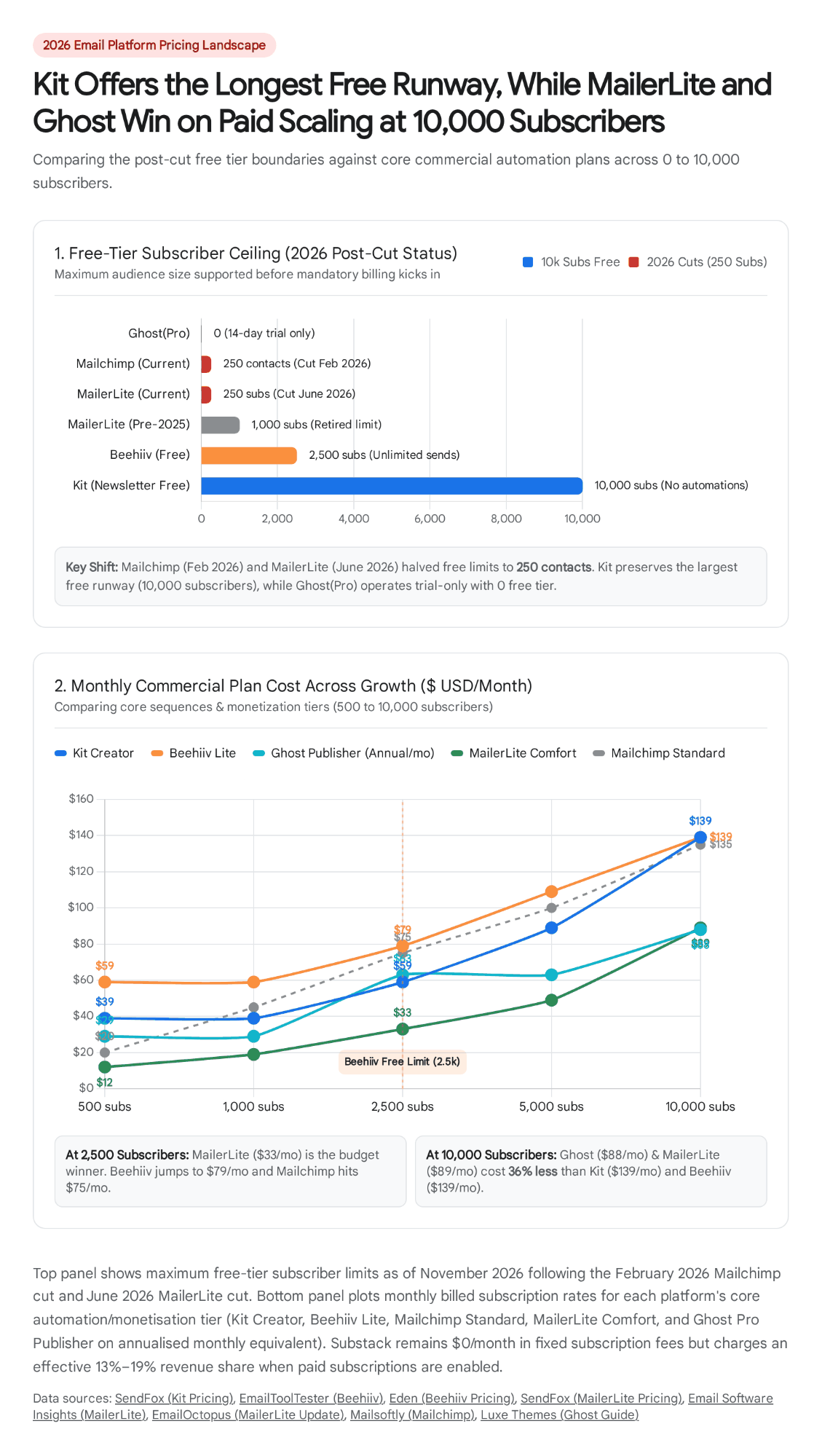
Independent authors evaluating digital infrastructure in 2026 must distinguish between website builders (Squarespace, WordPress.com, WordPress.org, and Carrd), which host static pages, book catalogues, and storefronts but require a separate email service provider (ESP) or paid add-on to manage a mailing list, and newsletter-first platforms (Substack, Ghost, and Beehiiv), where the email list and web archive are unified into a single publishing engine[2]. Beneath the website builders sits the ESP layer (MailerLite, Kit, Beehiiv, and Mailchimp), where aggressive 2025–2026 pricing changes—specifically Mailchimp's February 2026 cut to 250 contacts and MailerLite's June 2026 cut to 250 subscribers—have shifted the cost burden onto growing lists[36]. The table below standardises annual recurring expenditure across all ten platforms at 0, 500, 2,500, and 10,000 subscribers[2].
| Platform / Tool | Category | Effective Cost at 0 Subscribers (Yr 1 / Renewal) | Effective Cost at 500 Subscribers (Annualised) | Effective Cost at 2,500 Subscribers (Annualised) | Effective Cost at 10,000 Subscribers (Annualised) | Crucial Billing & Threshold Mechanics |
|---|---|---|---|---|---|---|
| Squarespace (Site only; needs ESP) | Website Builder | 192–228/yr (Basic annual; domain free Yr 1, +~$12–$20 Yr 2+)[2]. (UK: £144/yr ex VAT)[6]. | 192–228/yr (Basic) or 276–348/yr (Core, required for code injection/pop-ups) + domain renewal[5]. | 276–348/yr (Core annual) + domain renewal (~$12–$20/yr)[2]. | 276–348/yr (Core) or 468–588/yr (Plus for high-volume direct sales) + domain[2]. | Basic ($16/mo pre-July 2026; $19/mo post-July 2026) blocks custom code injection; adding Squarespace Email Campaigns adds $84–$816/yr[5]. |
| WordPress.com (Site only; needs ESP) | Hosted CMS | $0/yr (Free w/ ads & subdomain) or $48/yr (Personal annual, domain free Yr 1)[9]. | $48/yr (Personal) or $96/yr (Premium) or $300/yr (Business, includes MailPoet up to 500 subs) + domain Yr 2+[9]. | 48–96/yr (Personal/Premium + external ESP) or $300/yr (Business) + domain Yr 2+[9]. | 96–300/yr (Premium/Business + external ESP) + domain Yr 2+[9]. | Three-year prepay lowers Personal to $33/yr ($2.75/mo) and Business to $210/yr ($17.50/mo)[9]. |
| WordPress.org (Site only; needs ESP) | Self-Hosted CMS | 48–144/yr (~$4–$12/mo shared hosting + domain)[12]. (UK Floor: £93.59/yr)[13]. | 48–144/yr (Shared hosting + domain; free theme/plugins)[12]. | 75–300/yr (Shared or entry managed hosting + domain)[12]. | 300–720/yr ($25–$60/mo managed hosting for higher traffic + premium plugins)[12]. | Hosting scales with web traffic, not email list size; adding premium plugins adds $200–$400/yr if not using free alternatives[12]. |
| Carrd (Site only; needs ESP) | One-Page Builder | $0/yr (Free subdomain) or $31/yr ($19/yr Pro Standard + ~$12/yr domain)[14]. | $31/yr ($19/yr Pro Standard + ~$12/yr domain)[14]. | $31/yr ($19/yr Pro Standard + ~$12/yr domain)[14]. | $31/yr ($19/yr Pro Standard) or $61/yr ($49/yr Pro Plus for webhooks + ~$12 domain)[14]. | Flat annual fee regardless of traffic or subscriber count; Pro Lite ($9/yr) cannot connect a custom domain or ESP forms[15]. |
| Substack (Site + Newsletter) | Newsletter Platform | $0/yr (Subdomain) or $62 Yr 1 / $12 Yr 2+ ($50 one-time custom domain fee + ~$12/yr registrar)[16]. | $0/yr (Free newsletter) or 13%–19% of gross paid revenue (10% Substack + 2.9% + $0.30 + 0.7% Stripe)[17]. | $0/yr (Free newsletter) or ~$1,560–$2,280/yr per $1,000/mo MRR (~$15,600–$19,920/yr at $10k MRR)[17]. | $0/yr (Free newsletter) or 13%–19% of gross paid revenue[17]. | Zero fixed overhead for free lists of any size; severe percentage tax once paid subscriptions exceed ~$300–$500 MRR[17]. |
| Ghost(Pro) (Site + Newsletter) | Newsletter + CMS | $180/yr ($15/mo Starter annual) or $216/yr ($18/mo) + ~$12/yr domain[17]. | 180–216/yr (Starter, free subs only) or $348/yr ($29/mo Publisher annual, required for paid subs & custom themes)[17]. | $756/yr ($63/mo Publisher annual at up to 5,000 members; $912/yr on monthly billing at $76/mo) + 0% platform fee[19]. | $1,056/yr ($88/mo Publisher annual at 10,000 members; $1,272/yr monthly at $106/mo) + 0% platform fee[19]. | Starter caps at 1,000 free members and blocks monetisation[19]. Publisher bills by total members (free + paid combined), jumping from $29/mo (1k) to $63/mo (5k tier)[37]. |
| Ghost (Self-Hosted) (Site + Newsletter) | Open-Source CMS | ~$180–$204/yr (~$15–$17/mo for 2GB VPS, domain, backups, and Mailgun Free/Basic)[19]. | ~$180–$204/yr (~$15–$17/mo with basic VPS + low send volume)[19]. | ~$468–$660/yr (~$39–$55/mo: VPS + $35/mo Mailgun Foundation for 50k emails + backups)[19]. | ~$576–$1,140/yr (~$48–$95/mo depending on send frequency: Mailgun Foundation $35/mo vs Scale $90/mo)[19]. | December 2025 Mailgun price rise makes Ghost(Pro) Publisher ($29/mo) cheaper than self-hosting ($39–$55/mo) at 1,000 members[19]. |
| MailerLite (Email layer) | ESP | $0/yr (Free up to 250 subscribers and 2,500 monthly emails)[21]. | $129.60/yr ($10.80/mo Comfort annual) or $144/yr ($12/mo monthly) at 500-sub tier; $205.20/yr ($17.10/mo annual) or $228/yr ($19/mo) at 1,000-sub tier[21]. | $356.40/yr ($29.70/mo Comfort annual) or $396/yr ($33/mo monthly)[23]. (Power: $529.20/yr annual or $588/yr monthly)[23]. | $961.20/yr ($80.10/mo Comfort annual) or $1,068/yr ($89/mo monthly)[23]. (Power: $1,393.20/yr annual or $1,548/yr monthly)[23]. | Free plan locks sending immediately upon crossing 250 active subscribers[22]. Comfort caps monthly sends at 10× tier ceiling[21]. |
| Kit (ConvertKit) (Email layer) | Creator ESP | $0/yr (Free Newsletter plan up to 10,000 subscribers)[24]. | $0/yr (Free plan, no sequences) or $390/yr ($33/mo Creator annual; $468/yr at $39/mo monthly, 1k tier) for full automations[24]. | $0/yr (Free plan, no sequences) or $600/yr ($50/mo Creator annual; $708/yr at $59/mo monthly, 3k tier)[24]. | $0/yr (Free ceiling) or $1,392/yr ($116/mo Creator annual; $1,668/yr at $139/mo monthly, 10k tier)[24]. | Below 10,000 subscribers, upgrading to Creator ($390–$1,392/yr) buys multi-step email sequences and branding removal, not list capacity[25]. |
| Beehiiv (Newsletter + Site) | Newsletter Platform | $0/yr (Free tier up to 2,500 subscribers, custom domain included)[30]. | $0/yr (Free tier) or 588–708/yr (Lite: $49/mo pre-Oct 2026; $59/mo post-Oct 2026 at 1k tier)[29]. | $0/yr (At exact 2,500 Free cap) or $948/yr ($79/mo Lite monthly at 2,500 subs for automations/monetisation)[30]. | $1,668/yr ($139/mo Lite monthly at 10,000 subscribers) + 0% platform fee[29]. | Free tier stops at 2,500 subscribers; crossing 2,501 forces an immediate jump to Lite ($79–$109/mo depending on tier bracket)[38]. |
| Mailchimp (Email layer) | Legacy ESP | $0/yr (Free up to 250 contacts and 500 monthly sends)[34]. | ~$156–$240/yr (Essentials/Standard at 500 contacts; required once passing 250 contacts or 500 sends/mo)[34]. | ~$540–$900/yr (Essentials/Standard scaling tiers at 2,500 contacts)[23]. | $1,320/yr ($110/mo Essentials) or $1,620/yr ($135/mo Standard) at 10,000 contacts[23]. | Free plan allows only two full broadcasts per month at 250 contacts (500 sends cap) and lacks all automation[34]. |
Scroll sideways to see all columns →
2. Platform Pairing Matrix: Head-to-Head Decision Analysis
Because no single platform is optimal across all author career stages, platform selection must be evaluated as specific binary trade-offs anchored to subscriber count, monetisation model, and maintenance tolerance[12].
Pairing 1: Squarespace vs WordPress (Hosted Design vs Hosted-or-Self-Hosted Flexibility)
Verdict: Squarespace wins for non-technical authors with one to ten books who want a cohesive, design-led multi-page website without managing updates, whereas WordPress (.com Business or .org self-hosted) wins for prolific indie authors who need complex book-filtering taxonomies, direct WooCommerce storefronts, or total asset portability[39].
| Dimension | Squarespace (Basic / Core) | WordPress (.com Personal–Business / .org Self-Hosted) |
|---|---|---|
| Cost at 0 / 500 / 2,500 / 10,000 Subs | Site fee is fixed at 192–348/yr (£144–£204/yr UK) regardless of list size, plus external ESP cost ($0–$1,068/yr) or Squarespace Email Campaigns ($84–$816/yr)[2]. | WP.com: $48–$300/yr + ESP[28]. WP.org: $48–$144/yr (£93.59/yr UK floor) at 0–2,500 subs, rising to $300–$720/yr for managed hosting at high traffic, plus ESP[13]. |
| Ownership & Export | Proprietary Fluid Engine template lock-in; switching platforms requires manual page rebuilding[3]. | Complete content and database portability; 100% code ownership on .org and paid plugin tiers[9]. |
| Custom Domain | Free for Year 1 on annual billing; renews at ~$10–$20/yr[2]. | Free for Year 1 on WP.com annual plans; ~$10–$20/yr (£9.59/yr .co.uk) on WP.org[13]. |
| Newsletter Built In | Paid add-on ($7–$68/mo); Basic tier blocks custom code injection for external ESP scripts[5]. | Via plugin (MailPoet included up to 500 subs on WP.com Business; Kit/MailerLite plugins on all paid/self-hosted setups)[9]. |
| Maintenance Burden | Near zero; hosting, SSL, and core updates are fully managed[3]. | Low on WP.com (managed)[28]; moderate-to-high on WP.org (author manages plugin updates, backups, and security unless paying $25–$100/mo for managed hosting)[12]. |
Scroll sideways to see all columns →
Choose Squarespace if: The author values visual polish out of the box, has no interest in configuring plugins or server backups, and is willing to pay $23–$29/month (Core) once third-party ESP code injection or 0% physical store fees are needed[5]. Choose WordPress if: The author writes long-running series requiring custom database taxonomies (such as filtering a backlist by trope, heat level, or series order), plans to run a high-volume WooCommerce direct store, or refuses to be locked into a proprietary page builder[7]. 2025–2026 Market Shifts: Squarespace retired its legacy Personal and Business naming in favour of Basic, Core, Plus, and Advanced, and raised US annual prices by up to 26% in July 2026 (Basic from $16 to $19/month; Core from $23 to $29/month)[1]. Meanwhile, WordPress.com unlocked Global Styles and custom CSS across all paid plans in April 2026 and expanded plugin support down to the $4/month Personal tier[9].
Pairing 2: Squarespace vs Carrd (Full Multi-Page Site vs One-Page Minimum)
Verdict: Carrd Pro Standard ($19/year) wins for debut authors, querying writers, and novelists with one to three books whose primary goal is reader-magnet email capture, whereas Squarespace ($192–$348/year) wins only when an author has a multi-series catalogue, an active blog, or an event and media kit that cannot fit on a single scrolling page[2].
| Dimension | Squarespace (Basic / Core) | Carrd (Pro Standard) |
|---|---|---|
| Cost at 0 / 500 / 2,500 / 10,000 Subs | $192–$348/yr for the site alone (10× to 18× Carrd's software fee), plus ESP costs[2]. | $19/yr for up to 10 sites (~$1.58/mo amortised) plus ~$12/yr domain (**~$31/yr total**), plus ESP costs[14]. |
| Ownership & Export | Text exports via XML; visual layout is non-portable[7]. | Static HTML/CSS/JS source download available on Pro Plus ($49/yr); no CMS database[15]. |
| Custom Domain | Included free in Year 1 on annual plans[3]. | Supported on Pro Standard ($19/yr) with free Let's Encrypt SSL; domain purchased separately (~$10–$15/yr)[14]. |
| Newsletter Built In | Requires Core ($276–$348/yr) for custom code injection or $7–$68/mo for native Email Campaigns[5]. | Native API form integration on Pro Standard ($19/yr) with Kit, MailerLite, Beehiiv, Mailchimp, and Ghost[14]. |
| Maintenance Burden | Low, though Fluid Engine requires hours of initial layout adjustment[1]. | Minimal; a complete one-page author site builds in under two hours with zero ongoing maintenance[14]. |
Scroll sideways to see all columns →
Choose Squarespace if: The author requires discrete URLs (/books, /about, /media-kit, /blog) for multi-keyword SEO targeting and backlist browsing[5]. Choose Carrd if: The author wants a high-converting landing page with a book cover, blurb, retail links, bio, and newsletter signup form for $19/year—and potentially up to nine additional standalone landing pages for individual book launches or pen names on the same account[14]. 2025–2026 Market Shifts: With Squarespace Basic rising to $19/month billed annually ($228/year) on US pricing pages in July 2026, a single month of Squarespace Basic now costs exactly the same as an entire year of Carrd Pro Standard ($19/year)[3].
Pairing 3: WordPress.com vs WordPress.org (Hosted Simplicity vs Self-Hosted Control)
Verdict: WordPress.com Personal ($48/year) wins for solo authors who want a low-cost, multi-page blog and website with managed security and zero server administration, whereas WordPress.org ($75–$150/year DIY; £93.59/year UK floor) wins for authors who want full FTP and database control, unrestricted custom themes, and zero transaction fees on payment blocks without jumping to WordPress.com's $300/year Business tier[13].
| Dimension | WordPress.com (Managed Hosted Plans) | WordPress.org (Self-Hosted Open Source) |
|---|---|---|
| Cost at 0 / 500 / 2,500 / 10,000 Subs | Personal: $48/yr($99 for 3 yrs); Premium: $96/yr; Business: $300/yr($630 for 3 yrs)[9]. | 48–144/yr on shared hosting (£93.59/yr UK floor with Krystal + .co.uk domain), scaling only if web traffic demands managed hosting ($300+/yr)[13]. |
| Ownership & Export | Author owns content; SFTP/SSH, WP-CLI, and real-time Jetpack backups are gated to Business ($25/mo annual)[9]. | Full root/cPanel, database, SFTP, and file ownership from day one regardless of hosting price[12]. |
| Custom Domain | Free for Year 1 on annual/multi-year plans; $0 subdomain on Free tier[9]. | Purchased via registrar or host (~$10–$20/yr US; £9.59/yr .co.uk UK)[13]. |
| Newsletter Built In | MailPoet Business included up to 500 subs on Business tier ($300/yr); external ESP plugins on paid tiers[9]. | Connects to any ESP or self-hosted SMTP/Amazon SES plugin without tier restrictions[12]. |
| Maintenance Burden | Zero server maintenance; WordPress.com handles core updates, CDN, and SSL[9]. | High DIY responsibility; author manages core/plugin updates, security hardening, and backups[12]. |
Scroll sideways to see all columns →
Choose WordPress.com if: The author wants a multi-page site for $4/month ($48/year) where hosting, SSL, CDN, and security patches are handled automatically[9]. Choose WordPress.org if: The author needs features that WordPress.com gates behind its $25/month ($300/year) Business plan—such as 0% platform fees on payments (WordPress.com charges 8% on Personal and 4% on Premium), staging environments, and 50 GB+ storage—while paying only ~$7–$10/month on shared hosting[13]. 2025–2026 Market Shifts: In April 2026, WordPress.com unlocked Global Styles, font uploads, and custom CSS on all paid tiers, and current 2026 support documentation permits plugin installation on Personal ($4/month) and Premium ($8/month), narrowing the historical functional gap with WordPress.org for basic brochure sites[9].
Pairing 4: Substack vs Ghost (Network Discovery vs Ownership and 0% Fee)
Verdict: Substack wins for writers starting with zero audience who rely on in-app recommendations and Notes to gain free and early paid subscribers with zero upfront cost, whereas Ghost (Publisher at $29/month annual) wins for authors with an established readership or paid revenue exceeding ~$300–$500/month where Substack's 10% platform cut becomes punitive[17].
| Dimension | Substack | Ghost (Ghost Pro Starter & Publisher / Self-Hosted) |
|---|---|---|
| Cost at 0 / 500 / 2,500 / 10,000 Subs | $0/yr at 0, 500, 2,500, and 10,000 free subs ($50 one-time custom domain). If monetised: 10% + ~3.6% + $0.30/txn (13%–19% effective)[16]. | 0–1,000 subs: $180–$216/yr (Starter, no paid subs) or $348/yr (Publisher)[17]. [5],500 subs: $756/yr ($63/mo Publisher annual)[19]. [8],000 subs: $1,056/yr ($88/mo Publisher annual). 0% platform fee[19]. |
| Ownership & Export | Portable email CSV and Stripe links, but leaving severs the Substack network graph and in-app reader habits[17]. | Open-source MIT software; 100% portable themes, JSON content, custom sending domain (on Publisher+), and direct Stripe account[19]. |
| Custom Domain | $50 one-time setup fee + annual registrar renewal[16]. | Free custom domain mapping on all Ghost(Pro) plans + registrar renewal[18]. |
| Newsletter Built In | Core product; unlimited sends and multi-section newsletters included free[17]. | Core product; unlimited sends on Ghost(Pro) (1 newsletter on Starter, up to 3 on Publisher, 10 on Business)[19]. |
| Maintenance Burden | Zero on Substack[17]. | Zero on Ghost(Pro); high on self-hosted VPS (Linux CLI updates, Mailgun deliverability, backups)[37]. |
Scroll sideways to see all columns →
Choose Substack if: The author is launching a serialised novel, essay column, or behind-the-scenes diary from scratch, has under $300/month in paid subscriptions, and wants Substack's internal recommendation engine to drive early list growth at $0 fixed cost[17]. Choose Ghost if: The author wants a true standalone website with custom themes, structured SEO metadata, and 0% platform fees on paid memberships, or generates more than ~$290–$500/month in reader revenue[17]. 2025–2026 Market Shifts: In July 2025, Ghost raised Starter from ~$9/month to $15/month annual ($18/month monthly) and removed paid subscriptions and custom themes from Starter, raising the true monetisation entry point to Publisher at $29/month annual ($348/year)[17]. Despite this adjustment, a substantial wave of high-earning Substack writers migrated to Ghost in 2025–2026 to escape the "Substack tax"[17].
Pairing 5: Substack vs Beehiiv (Social Network Discovery vs Growth Tooling and 0% Fee)
Verdict: Substack wins for literary, essay, and serialised-fiction writers whose readers congregate inside the Substack app and Notes feed, whereas Beehiiv wins for non-fiction authors and newsletter marketers who want built-in referral programmes, ad-network monetisation, custom web pages, and 0% subscription fees[17].
| Dimension | Substack | Beehiiv (Free & Lite) |
|---|---|---|
| Cost at 0 / 500 / 2,500 / 10,000 Subs | $0/yr fixed cost across all tiers; 13%–19% effective cut on paid subscriptions[17]. | 0 / 500 / 2,500 subs: $0/yr on Free tier[30]. Monetised / >2,500 subs (Lite): $708/yr ($59/mo at 1k), $948/yr ($79/mo at 2.5k), $1,668/yr ($139/mo at 10k) + 0% platform fee[29]. |
| Ownership & Export | Full CSV/HTML export; locked into Substack's minimal visual template[17]. | Full CSV export and direct Stripe ownership; customizable web theme and landing pages[32]. |
| Custom Domain | $50 one-time fee + registrar cost[16]. | Free on all plans (including the Free tier up to 2,500 subscribers) + registrar cost[32]. |
| Newsletter Built In | Yes, with Notes social feed, chat, podcasts, and video[17]. | Yes, with referral rewards, Boosts, ad network, polls, and automations (on Lite+)[31]. |
| Maintenance Burden | Zero[17]. | Low; slightly higher initial setup for custom design and growth funnels[33]. |
Scroll sideways to see all columns →
Choose Substack if: The author writes narrative prose, fiction, or cultural commentary where community comments, Notes, and zero monthly software bills matter more than custom landing pages or ad sponsorships[17]. Choose Beehiiv if: The author has under 2,500 subscribers and wants a free custom domain without paying Substack's $50 fee, or has a growing monetised list where keeping 100% of subscription revenue (minus Stripe) and tapping Beehiiv's Ad Network outweighs a $59–$139/month software bill[29]. 2025–2026 Market Shifts: On October 1, 2026, Beehiiv renamed Launch to Free, Scale to Lite, and Max to Pro, raised Lite's starting price at 1,000 subscribers from $49/month to $59/month ($139/month at 10,000 subscribers), reduced Free from three publications to one, and moved webhooks to the Pro tier[29].
Pairing 6: Ghost vs Beehiiv (Website-Grade Ownership vs Newsletter Growth Engine)
Verdict: Ghost wins for authors who want their publication to look and function like an independent literary magazine or multi-page author website with lower cost at 10,000 subscribers ($88/month annual vs $139/month), whereas Beehiiv wins for authors under 2,500 subscribers who need a free tier or who monetise via newsletter sponsorships and paid recommendations rather than reader subscriptions alone[19].
| Dimension | Ghost (Ghost Pro Publisher / Self-Hosted) | Beehiiv (Free / Lite) |
|---|---|---|
| Cost at 0 / 500 / 2,500 / 10,000 Subs | 0 / 500 subs: $180/yr (Starter) or $348/yr (Publisher). [5],500 subs: $756/yr ($63/mo annual). [8],000 subs: $1,056/yr ($88/mo annual). 0% fee[19]. | 0 / 500 / 2,500 subs: $0/yr (Free tier) or $708–$948/yr (Lite). [8],000 subs: $1,668/yr ($139/mo Lite). 0% fee[29]. |
| Ownership & Export | Open-source MIT licence. Can leave Ghost(Pro) and self-host the exact same site and theme on any server[19]. | Proprietary SaaS; data exports cleanly, but site layout and growth tools cannot be self-hosted[33]. |
| Custom Domain | Included on all Ghost(Pro) plans (custom email sending domain on Publisher+)[19]. | Included on all plans, including Free[32]. |
| Newsletter Built In | Native newsletter + full Node.js website CMS with hundreds of custom themes[18]. | Native newsletter + basic web portal, built-in Ad Network, Boosts, and referral mechanics[31]. |
| Maintenance Burden | Zero on Ghost(Pro); moderate-high if self-hosted[19]. | Zero server maintenance[40]. |
Scroll sideways to see all columns →
Choose Ghost if: The author wants a bespoke website aesthetic (via third-party Ghost themes), clean technical SEO, open-source independence, and a significantly lower software bill at 5,000–10,000 subscribers ($63–$88/month on Ghost Publisher annual vs $109–$139/month on Beehiiv Lite)[19]. Choose Beehiiv if: The author wants to start at $0/month up to 2,500 subscribers with a custom domain included, or relies on automated email sequences, native referral rewards, and newsletter ad placements that Ghost does not build natively[17]. 2025–2026 Market Shifts: Beehiiv's October 1, 2026 price hike ($59/month at 1,000 subscribers, $79/month at 2,500, and $139/month at 10,000) made Ghost(Pro) Publisher ($29/month at 1,000, $63/month at 5,000, and $88/month at 10,000 billed annually) $360 to $612/year cheaper across paid tiers[19].
Pairing 7: Substack vs WordPress.com (Newsletter-First vs Website-First)
Verdict: Substack wins for essayists and serialised writers whose primary output is a regular email dispatch, whereas WordPress.com Personal ($48/year) wins for authors whose primary need is a structured, ad-free website with dedicated book pages, series order guides, and full SEO control[9].
| Dimension | Substack | WordPress.com (Personal / Premium / Business) |
|---|---|---|
| Cost at 0 / 500 / 2,500 / 10,000 Subs | $0/yr fixed ($50 one-time custom domain); 13%–19% effective cut on paid subscriptions[16]. | $48/yr (Personal) to $300/yr (Business) for the site, plus external ESP ($0 on Kit Free up to 10k subs, or $130–$961/yr on MailerLite Comfort)[28]. |
| Ownership & Export | Subscriber CSV and HTML post export; rigid publication layout[17]. | Full WordPress XML/database export and access to thousands of themes and plugins[9]. |
| Custom Domain | $50 one-time fee + annual registrar renewal[16]. | Free for Year 1 on annual paid plans ($48/yr+); renews at registrar rate[9]. |
| Newsletter Built In | Native, unlimited free email delivery[17]. | Basic Jetpack/MailPoet (up to 500 subs on Business); requires external ESP for serious author marketing[9]. |
| Maintenance Burden | Zero[17]. | Near zero on hosted tiers[28]. |
Scroll sideways to see all columns →
Choose Substack if: Writing the newsletter is the primary product, and the author does not want to connect an external ESP or design static web pages[16]. Choose WordPress.com if: Books are the primary product, and the author needs a permanent Entity Home with distinct book pages, retailer buy buttons, and zero revenue share on external book sales (paired with Kit Free or MailerLite for email)[9]. 2025–2026 Market Shifts: WordPress.com's 2026 inclusion of plugins and custom CSS on the $4/month ($48/year) Personal plan allows an author to run a full WordPress site paired with Kit Free (up to 10,000 subscribers) for $48/year total—costing roughly the same in Year 1 as Substack's $50 custom domain fee while providing superior multi-page website architecture[9].
Pairing 8: Carrd vs Squarespace (One-Page Minimum vs Full Multi-Page Site)
Verdict: Carrd Pro Standard ($19/year) is the superior starting architecture for pre-publication and debut authors, while Squarespace ($192–$348/year) only becomes justifiable when an author's backlist exceeds three to five titles or requires integrated e-commerce and multi-page SEO[5].
| Dimension | Carrd (Pro Standard) | Squarespace (Basic / Core) |
|---|---|---|
| Cost at 0 / 500 / 2,500 / 10,000 Subs | $19/yr ($57 over 3 yrs) + ~$12/yr domain (**~$31/yr**; $93 over 3 yrs), plus ESP cost[15]. | 192–348/yr ($600–$1,068 over 3 yrs with Yr 2–3 domains), plus ESP cost[2]. |
| Ownership & Architecture | Single root URL (authorname.com) with client-side JS section toggles; cannot index separate subpages (/book-1, /book-2)[7]. | Full multi-page hierarchy, blog indexing, automatic XML sitemaps, and structured product schema[3]. |
| Custom Domain & SSL | Included on Pro Standard ($19/yr) via CNAME/DNS records[14]. | Included free for Year 1 on annual plans[3]. |
| Newsletter Built In | Native API connection to Kit, MailerLite, Beehiiv, Mailchimp, and Ghost included at $19/yr[14]. | Requires Core ($276–$348/yr) for custom script injection if native blocks do not support the author's ESP[5]. |
| Maintenance Burden | Near zero, though the editor lacks autosave or version history (closing tab discards unsaved drafts)[7]. | Low; full Fluid Engine drag-and-drop with saved drafts, asset library, and mobile layout toggling[3]. |
Scroll sideways to see all columns →
Choose Carrd if: The author is querying, preparing a debut launch, or writing a single series where a tight, distraction-free page converts visitors into newsletter subscribers at less than one-tenth the software cost of Squarespace[15]. Choose Squarespace if: The author has outgrown a single scrolling page and needs dedicated URLs for multiple series, foreign rights, speaking engagements, or direct store checkout[5]. 2025–2026 Market Shifts: Carrd held Pro Standard steady at $19/year through 2026 while Squarespace raised US Basic and Core annual rates in July 2026, widening the three-year savings of starting on Carrd to between $507 and $9754.
Pairing 9: MailerLite vs Kit (Free-Tier Size vs Automation Depth and Paid Cost)
Verdict: Kit (formerly ConvertKit) wins on the free tier—offering 40× the subscriber capacity (10,000 vs 250 subscribers) for authors who only need broadcasts and a single basic automation—whereas MailerLite Comfort wins once an author requires complex multi-step visual automations and wants to pay 35%–70% less per month than Kit Creator[23].
| Dimension | MailerLite (Free & Comfort) | Kit / ConvertKit (Free Newsletter & Creator) |
|---|---|---|
| Cost at 0 / 500 / 2,500 / 10,000 Subs | 0–250 subs: $0. 500 subs: $144/yr ($12/mo; $129.60/yr annual) or $228/yr ($19/mo at 1k tier). [5],500 subs: $396/yr ($33/mo; $356.40/yr annual). [8],000 subs: $1,068/yr ($89/mo; $961.20/yr annual)[21]. | 0 / 500 / 2,500 / 10,000 subs (Free): $0/yr (broadcasts + 1 basic automation)[26]. Creator (Full sequences): $468/yr ($39/mo; $390/yr annual) at 500–1k; $708/yr ($59/mo; $600/yr annual) at 2.5k; $1,668/yr ($139/mo; $1,392/yr annual) at 10k[24]. |
| Free Tier Allowance | 250 active subscribers and [5],500 emails/mo; includes 3 automations (up to 5 steps), 3 forms, 1 landing page, 1 website[21]. | [8],000 active subscribers and unlimited email broadcasts, unlimited forms/landing pages, tagging, 1 basic Visual Automation; no multi-step sequences[27]. |
| Custom Domain | Paid plans only (Comfort from $12/mo) for landing pages/sites[21]. | Included on Free and paid plans for landing pages[41]. |
| Automation & Editor | Drag-and-drop visual email builder; 50 multi-step automations (up to 100 steps) on Comfort[21]. | Text-first email editor; deep tag-based Visual Automations, sequences, and Creator Network recommendations on Creator[24]. |
| Maintenance & Approval | Strict manual account verification required before sending; sending locks immediately at 251 subscribers on Free[22]. | Instant onboarding; seamless tag-based list management[24]. |
Scroll sideways to see all columns →
Choose MailerLite if: The author wants a visual drag-and-drop email builder with multi-step welcome sequences from day one (up to 250 subscribers free) and wants a lower monthly bill between 500 and 10,000 subscribers ($12–$89/month on MailerLite Comfort vs $39–$139/month on Kit Creator)[23]. Choose Kit if: The author wants to build a list from 0 to 10,000 subscribers at $0/month sending regular broadcasts and delivering a reader magnet via an incentive email or single basic automation, or is an established creator who monetises via digital products (3.5% + $0.30) and the Kit Creator Network[25]. 2025–2026 Market Shifts: Two major pricing shocks reshaped this pairing: Kit raised its paid Creator entry price by 34% (from $29/month to $39/month monthly, $33/month annual) in October 2025 while keeping its 10,000-subscriber free tier intact[24], whereas MailerLite slashed its free tier from 500 subscribers and 12,000 emails to 250 subscribers and 2,500 emails on June 16, 2026, renamed Growing Business to Comfort, and raised paid tier prices by 10%–30%[23].
Pairing 10: MailerLite vs Mailchimp (Free-Tier Generosity vs Brand Recognition)
Verdict: MailerLite wins decisively across every subscriber tier and feature dimension for solo authors in 2026, while Mailchimp offers no cost or functional advantage following its February 2026 free-plan reduction[23].
| Dimension | MailerLite (Free & Comfort) | Mailchimp (Free, Essentials & Standard) |
|---|---|---|
| Cost at 0 / 500 / 2,500 / 10,000 Subs | 0–250 subs: $0. 500 subs: $12/mo. [5],500 subs: $33/mo. [4],000 subs: $49/mo. [8],000 subs: $89/mo (Comfort)[23]. | 0–250 contacts: $0. [4],000 contacts: $100/mo (Standard). [8],000 contacts: $110/mo (Essentials) or $135/mo (Standard)[23]. |
| Free Tier Allowance | 250 active subscribers / 2,500 monthly emails (10 emails/sub/mo); includes 3 automations (up to 5 steps), 1 landing page, 1 site[23]. | 250 contacts / 500 monthly sends (250/day cap—only 2 emails/mo to a full list); zero automations, zero AI tools[34]. |
| Subscriber Billing Rules | Bills only for active subscribers; unsubscribed contacts do not inflate the tier bill[21]. | Bills for total "contacts" in an audience (including unsubscribed/non-subscribed unless manually archived)[23]. |
| Automation & Usability | Clean drag-and-drop editor; 50 multi-step automations on Comfort[21]. | Cluttered enterprise CRM interface; multi-step customer journeys locked behind Standard[23]. |
Scroll sideways to see all columns →
Choose MailerLite if: The author wants 5× the monthly email sends on the 250-subscriber free tier (2,500 vs 500 sends), working 5-step automations on Free, and 20%–50% lower paid pricing from 500 to 10,000 subscribers[23]. Choose Mailchimp if: The author has a legacy e-commerce integration that strictly requires Mailchimp and has not yet migrated[23]. 2025–2026 Market Shifts: Mailchimp cut its free plan in February 2026 from 500 contacts and 1,000 sends to 250 contacts and 500 monthly sends with no automation[34]; even after MailerLite cut its own free tier to 250 subscribers in June 2026, MailerLite still provides 2,500 monthly sends and three automations on Free[22].
Pairing 11: Kit vs Beehiiv (Email-First Creator Tools vs Newsletter Growth Engine)
Verdict: Kit wins for fiction and non-fiction authors who use their email list to launch books, segment readers by series or genre via tags, and stay free up to 10,000 subscribers, whereas Beehiiv wins for newsletter-centric writers under 2,500 subscribers who want a built-in website with a free custom domain and ad-network monetisation[24].
| Dimension | Kit (Free Newsletter & Creator) | Beehiiv (Free & Lite) |
|---|---|---|
| Cost at 0 / 500 / 2,500 / 10,000 Subs | Free up to 10,000 subs ($0)[26]. Creator: $39/mo($33/mo annual) at 1k; $59/mo($50/mo annual) at 2.5k (3k tier); $89/mo at 5k; $139/mo ($116/mo annual) at 10k[24]. | Free up to 2,500 subs ($0)[30]. Lite: $59/mo at 1k; $79/mo at 2.5k; $109/mo at 5k; $139/mo at 10k[29]. |
| Paid Revenue Fee | 3.5% + $0.30 inclusive of card processing on Kit Commerce across all plans (including Free)[25]. | 0% platform fee on paid subscriptions (requires Lite at $59–$139/mo + Stripe 2.9% + $0.30)[29]. |
| Custom Domain & Web Presence | Landing pages and Creator Profile included; requires a separate website builder (Carrd/WordPress) for a full author site[27]. | Full web publication archive with free custom domain included on all tiers (including Free)[32]. |
| Segmentation & Funnels | Industry-leading tag-based segmentation, link triggers, and evergreen book-launch sequences (on Creator)[24]. | Built for chronological newsletter publishing, referral rewards, and ad-network sponsorships[31]. |
Scroll sideways to see all columns →
Choose Kit if: The author wants to reach 10,000 subscribers before being forced onto a paid tier, or wants to monetise a small paid newsletter on the Free tier by paying only 3.5% + $0.30 per transaction with a $0 monthly subscription fee[41]. Choose Beehiiv if: The author wants a combined website and newsletter with a free custom domain from 0 to 2,500 subscribers, or runs a high-revenue paid newsletter where a 0% platform fee on Lite beats Kit's 3.5% commerce fee[41]. 2025–2026 Market Shifts: Following Beehiiv's October 1, 2026 price hike, Beehiiv Lite ($59/month at 1,000 subscribers, $79/month at 2,500, and $109/month at 5,000) is $20/month more expensive than Kit Creator ($39/month at 1,000, $59/month at 3,000, and $89/month at 5,000) at every intermediate tier until both converge at $139/month at 10,000 subscribers[27].
Pairing 12: Website Builder vs Newsletter Platform (When Can Substack Replace a Website?)
Verdict: A newsletter platform (Substack, Ghost, or Beehiiv) can completely replace a traditional website builder for debut authors, essayists, and serialised writers with zero to two books, whereas a dedicated website builder (Carrd, WordPress, or Squarespace) becomes mandatory once an author needs a structured multi-series book catalogue, reader-magnet landing funnels by genre, or a direct e-commerce storefront[7].
| Dimension | Traditional Website Builder (Carrd / WP / Squarespace) + ESP | Newsletter-First Platform (Substack / Ghost / Beehiiv) |
|---|---|---|
| Primary Visitor Action | Browse book catalogue, click retail buy links, or download a free novella/reader magnet[16]. | Subscribe to the publication feed and read chronological essays or chapters[17]. |
| Stack Complexity | Two tools required: Website host + ESP connected via API or embed form[2]. | Single unified tool: Web archive, About page, and email delivery live in one dashboard[17]. |
| Three-Year Cost (0–500 Subs) | $93 (Carrd + Kit Free + domain) to $1,000+ (Squarespace + paid ESP)[15]. | 0–86 (Substack Free + $50 domain) or 540–[1],044 (Ghost Starter/Publisher)[16]. |
| Entity Home & SEO Control | High; full control over page hierarchy, Schema markup, and book metadata[18]. | High on Ghost[18]; moderate on Beehiiv[32]; constrained on Substack (especially on .substack.com subdomains)[16]. |
Scroll sideways to see all columns →
Choose a Newsletter Platform as the sole site if: The author has zero to two books, wants to avoid managing two separate software tools, and prefers every visitor to be funnelled into a single subscribe box while using static navigation tabs on Substack or Ghost for "About" and "Books"[16]. Choose a Website Builder + ESP if: The author has three or more books, writes across multiple series or pen names, uses a reader magnet (such as a free novella via BookFunnel) requiring automated delivery sequences, or sells books directly to readers[14]. 2025–2026 Market Shifts: The release of Ghost 6.0 in August 2025 (updated through Ghost 6.71.0 in October 2026) and Substack's customizable publication layouts made the newsletter-as-website model viable for single-title authors, while Carrd ($19/year) paired with Kit Free ($0) remains the lowest-cost two-tool alternative[15].
Pairing 13: Free Option vs Paid Option (When Does the Free Tier Become the Wrong Choice?)
Verdict: Staying on a free tier is the right financial decision for email delivery (via Kit Free up to 10,000 subscribers, Beehiiv Free up to 2,500, or Substack Free for non-monetised lists), but using a free website tier (carrd.co or wordpress.com subdomain with platform ads) is a false economy the moment an author begins querying agents or printing book links[9].
| Dimension | Free Tiers (Carrd Free, WP.com Free, Kit Free, MailerLite Free, Substack Free) | Paid Entry Tiers (Carrd Pro Standard $19/yr, WP.com Personal $48/yr, Kit Creator $390/yr, Ghost $180–$348/yr) |
|---|---|---|
| Domain & Entity Authority | Locked to .carrd.co, .wordpress.com, or .substack.com subdomains (except Beehiiv Free and Kit landing pages); builds SEO authority for the vendor, not the author[9]. | Full custom domain (authorname.com), establishing a permanent, portable Entity Home for Google and AI answer engines[15]. |
| Platform Ads & Branding | Displays WordPress.com visitor ads, "Made with Carrd" badges, or Kit/MailerLite footer logos[9]. | All third-party ads and builder badges removed[9]. |
| Subscriber & Send Cliffs | MailerLite and Mailchimp freeze or block growth at 250 subscribers[22]; Beehiiv caps at [5],500[30]; Kit caps at [8],000[26]. | Scales smoothly with audience size and unlocks multi-step welcome sequences[23]. |
| Revenue Share Trap | Substack is $0 upfront but takes 13%–19% effective of paid subscriptions[17]; Kit Free takes 3.5% + $0.30 on digital sales[41]. | Ghost Publisher ($348/yr) and Beehiiv Lite ($708+/yr) take 0% platform fee[19]. |
Scroll sideways to see all columns →
Choose Free if: The author is using Kit Free (under 10,000 subscribers, sending regular broadcasts without multi-branch sequences), Beehiiv Free (under 2,500 subscribers), or Substack Free (with under ~$300/month in paid subscription revenue)[17]. Upgrade to Paid immediately when: The author needs to connect a custom domain ($19/year on Carrd Pro Standard or $48/year on WordPress.com Personal, as printing a .wordpress.com or .carrd.co subdomain in a book's backmatter undermines professional credibility), passes 250 subscribers on MailerLite or Mailchimp (where sending locks on MailerLite Free), requires an automated multi-email welcome sequence for a reader magnet (requiring MailerLite Comfort at $10.80–$12/month or Kit Creator at $33/month annual), or crosses ~$290–$500/month in paid newsletter revenue on Substack[9]. 2025–2026 Market Shifts: The June 2026 MailerLite cut (to 250 subscribers) and February 2026 Mailchimp cut (to 250 contacts) eliminated the traditional 500-to-1,000 subscriber free tier with full automation, forcing authors to choose between Kit Free (10,000 subscribers without multi-step sequences) or paying $10.80–$12/month on MailerLite Comfort shortly after launch[21].
3. Total Cost Over Three Years: Mathematical Modelling & Break-Even Analysis
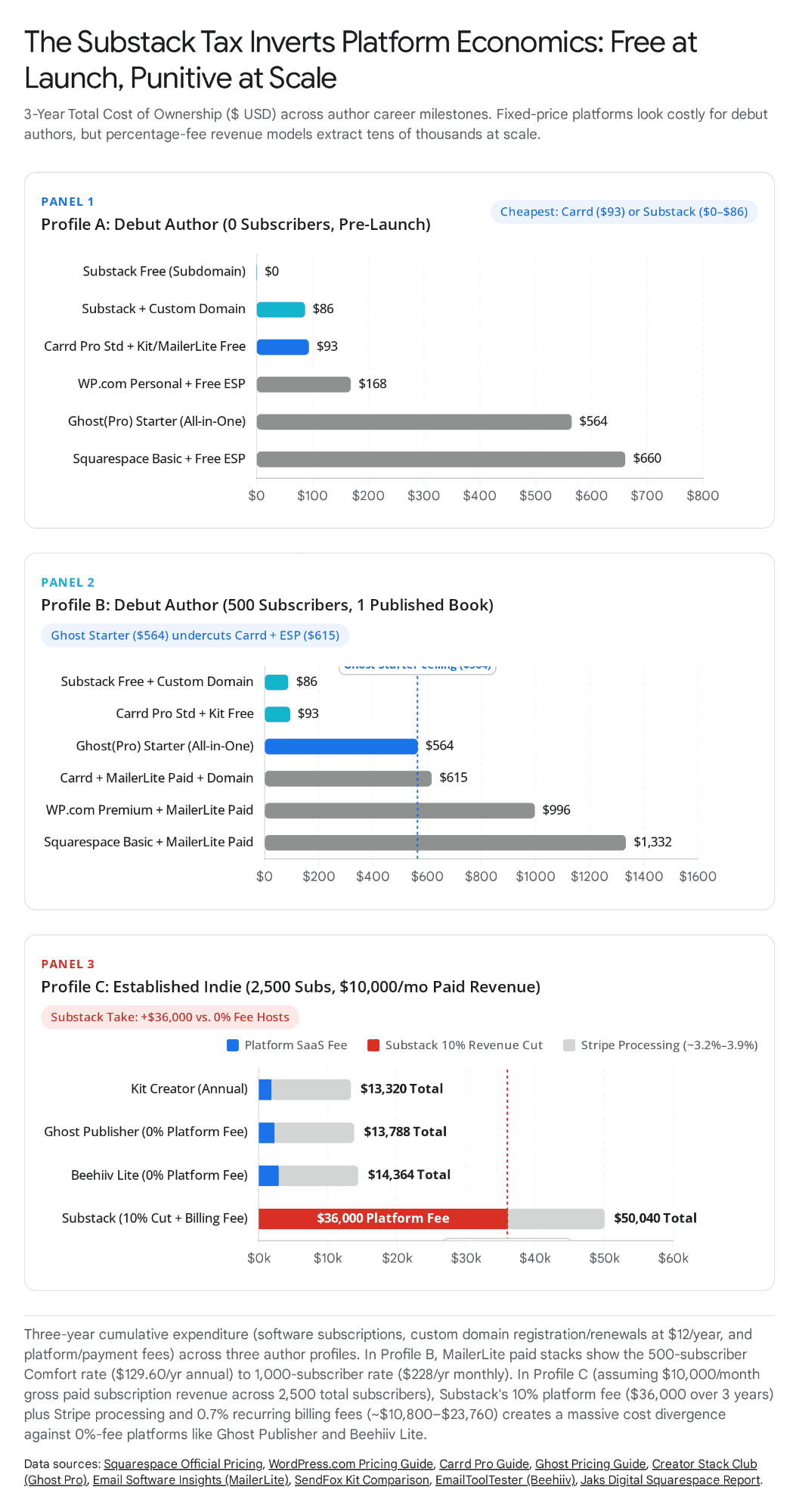
To answer the exact financial queries AI engines and authors evaluate—"how much does an author website cost", "author website cost UK 2026", and "is Substack free"—the table and mathematical models below calculate the Year 1 and three-year Total Cost of Ownership (TCO) across all four author profiles using verified 2026 pricing[3].
Three-Year Total Cost of Ownership Across Four Author Profiles
| Author Profile & Stage | Platform Stack Option | Year 1 Actual Cost | Year 2 & Year 3 Annual Cost | 3-Year Total Cost | Break-Even & Unit Economics Verdict |
|---|---|---|---|---|---|
| Profile A: Debut author, 0 subscribers, no book yet | Substack Free (Subdomain) | $0[17] | $0/yr[17] | $0 | Cheapest overall if a .substack.com subdomain and newsletter layout are acceptable[16]. |
| Profile A: Debut author, 0 subscribers, no book yet | Substack Free + Custom Domain ($50 one-time + ~$12/yr domain) | $62[16] | $12/yr | $86 | Breaks even against Carrd + Free ESP ($93over3yrs)inYear3($7 difference over 36 months)[15]. |
| Profile A: Debut author, 0 subscribers, no book yet | Carrd Pro Standard ($19/yr) + MailerLite Free (250 subs) or Kit Free (10k subs) + Domain (~$12/yr) | $31[15] | $31/yr[15] | $93 | Winner for Profile A: Cheapest credible custom-domain website setup[15]. |
| Profile A: Debut author, 0 subscribers, no book yet | WordPress.com Personal ($48/yr) + MailerLite/Kit Free (Domain free Yr 1, ~$12/yr Yr 2–3) | $48[9] | $60/yr[28] | $168 (or $123 on 3-yr prepay)[42] | Costs $75 more over 3 years than Carrd to unlock multi-page WordPress blogging[28]. |
| Profile A: Debut author, 0 subscribers, no book yet | Ghost(Pro) Starter ($180/yr annual) (Site + newsletter in one; domain ~$12/yr Yr 2–3) | $180[16] | $192/yr | $564 (or $540 ex domain)[16] | Paid from day one; costs 6× Carrd + Free ESP during pre-launch when list size is zero. |
| Profile A: Debut author, 0 subscribers, no book yet | Squarespace Basic ($192/yr pre-July 2026; $228/yr post-July 2026) + Free ESP (Domain free Yr 1) | $192 – $228[2] | $204 – $240/yr[2] | $600 – $708 | Costs 6.5× to 7.6× more than Carrd over 3 years for zero extra email capacity[2]. |
| Profile B: Debut author, 1 book, 500 subscribers | Substack Free (500 subs, paid subscriptions off) | $0 (or $62 w/ domain)[16] | $0/yr (or $12/yr)[17] | $0 (or $86 w/ domain) | Remains free at 500 subscribers if not monetising (10% + Stripe applies if paid subs are turned on)[17]. |
| Profile B: Debut author, 1 book, 500 subscribers | Carrd Pro Standard ($19/yr) + Kit Free (up to 10k subs, broadcasts only) + Domain ($12/yr) | $31[15] | $31/yr[15] | $93 | Lowest cost at 500 subscribers if the author does not require multi-step automated email sequences[15]. |
| Profile B: Debut author, 1 book, 500 subscribers | Ghost(Pro) Starter ($180/yr annual) (Up to 1,000 free members included; 0% fee) | $180[16] | $180 – $192/yr | $540 – $564[16] | Winner for Profile B (All-in-One): Replaces two tools and saves 67/yr(201 over 3 yrs) vs Carrd + MailerLite at the $19/mo tier. |
| Profile B: Debut author, 1 book, 500 subscribers | Carrd Pro Standard ($19/yr) + MailerLite Paid (~$19/mo = $228/yr at 501–1k tier; $12/mo = $144/yr at exact 500 cap) | $247 (or $259 w/ domain; $161–$175 at 500 cap)[15] | $247 – $259/yr[15] | $741 – $777 (or $482–$525 at exact 500 cap) | Crossing 250 subs forces MailerLite paid upgrade; at the $19/mo ($228/yr) rate, Ghost Starter ($180/yr) is cheaper[19]. |
| Profile B: Debut author, 1 book, 500 subscribers | WordPress.com Premium ($96/yr) + MailerLite Paid ($228/yr) | $324[28] | $324 – $336/yr[28] | $972 – $996 | Costs $144/yr more than Ghost Starter while requiring the author to manage two separate platforms[28]. |
| Profile B: Debut author, 1 book, 500 subscribers | Squarespace Basic ($192–$228/yr) + MailerLite Paid ($228/yr) | $420 – $456[2] | $432 – $468/yr[2] | $1,284 – $1,392 | Highest cost stack at 500 subscribers; exceeds $1,280 over 3 years before adding Squarespace Core[2]. |
| Profile C: Established indie, 2,500 subs, paid subscriptions on ($10,000/mo MRR = $120k/yr gross) | Substack (10% platform fee + 2.9% + $0.30 Stripe + 0.7% Billing = 13%–19% effective) | ~$15,600 – $19,920/yr (~$1,300–$1,660/mo total fees; $12,000/yr platform fee)[17] | ~$15,600 – $19,920/yr | ~$46,800 – $59,760 ($36,000 pure Substack fee + Stripe) | The "Substack Tax": Loses ~$1,300+/mo in fees at $10k MRR; uneconomical above **~$300–$500 MRR**[17]. |
| Profile C: Established indie, 2,500 subs, paid subscriptions on ($10,000/mo MRR) | Ghost(Pro) Publisher ($348/yr at 1k members; $756/yr at 2.5k–5k tier) + Stripe (~3.2%–3.5%) | $348 – $756 software (+ ~$3,840 Stripe) | $348 – $756/yr software (+ Stripe) | $1,044 – $2,268 software (~$12,564–$13,788 inc Stripe) | Winner for Profile C: 0% platform fee saves 11, 244–[9],652/yr ($33,732–$34,956 over 3 yrs) vs Substack[17]. |
| Profile C: Established indie, 2,500 subs, paid subscriptions on ($10,000/mo MRR) | Beehiiv Scale / Lite (~$49–$99/mo pre-Oct 2026 = ~$600–$1,200/yr; $79/mo = $948/yr post-Oct 2026 at 2.5k) + Stripe | $600 – $1,200 software (+ ~$3,840 Stripe) | $600 – $1,200/yr software (+ Stripe) | $1,800 – $3,600 software (~$13,320–$15,120 inc Stripe) | 0% platform fee; breaks even against Substack's 10% cut at 490–790/mo MRR[29]. |
| Profile C: Established indie, 2,500 subs, paid subscriptions on ($10,000/mo MRR) | Kit Creator (~$39–$79/mo = $468–$948/yr; $59/mo = $708/yr at 2.5k; $600/yr annual) + Stripe | $468 – $948 software (+ Stripe) | $468 – $948/yr software (+ Stripe) | $1,404 – $2,844 software (+ Stripe) | Competitive if paired with direct Stripe checkout; native Kit Commerce charges 3.5% + $0.30 inclusive of Stripe[25]. |
| Profile D: Querying writer, no published book | Option 1: Skip Website / Free Amazon Author Central (+ optional ~$12/yr parked domain) | $0 (or $12 domain)[43] | $0/yr (or $12/yr)[43] | $0 (or $36 domain insurance) | Honest Verdict: Skipping the website costs nothing while querying with no list and no Book 263. |
| Profile D: Querying writer, no published book | Option 2: Minimum Viable Setup — Carrd Pro Standard ($19/yr) + Kit Free (10k subs) + Domain ($12/yr) | $31[15] | $31/yr[15] | $93 | Best minimum viable live setup if the querying writer wants an online bio and agent contact page[15]. |
Scroll sideways to see all columns →
Mathematical Break-Even Progression Across Profiles A, B, C, and D
In Profile A (0 subscribers, no book yet), an author
needs only domain reservation, a basic web page, and an email form under
the 250-subscriber
cap[15].
Pairing Carrd Pro Standard ($19/year) with
MailerLite Free (up to 250 subscribers) or Kit
Free (up to 10,000 subscribers) plus a .com domain (~$12/year)
costs 31/year(93
over 3
years)[15].
Substack Free costs $0 on a
.substack.com subdomain, or $50 one-time plus ~$12/year
domain registration ($62 in Year 1; $86 over 3 years),
reaching near break-even with Carrd ($86 vs $93) at Month 3427. By
contrast, WordPress.com Personal ($48/year) plus
MailerLite Free costs $48 in Year 1 and $168 over 3
years with domain renewals (or $123 on a 3-year prepay at
$2.75/month), Ghost(Pro) Starter ($180/year) costs
540–564 over 3 years,
and Squarespace Basic ($192/year pre-July 2026; $228/year
post-July 2026) plus MailerLite Free costs 600–708 over 3
years[2].
Thus, Carrd + free MailerLite/Kit is the cheapest credible standalone
website setup, while Substack is the cheapest if a subdomain is
acceptable[15].
In Profile B (1 book, 500 subscribers), crossing
MailerLite's June 2026 free cap of 250 subscribers forces the author
onto a paid ESP plan unless using Kit Free, Beehiiv Free, or Substack
Free[17].
On MailerLite, the Comfort plan costs 12/month(144/year;
$129.60/year annual) at the exact 500-subscriber limit and
jumps to 19/month(228/year;
$205.20/year annual) at 501–1,000
subscribers[21].
Using the ~$19/month ($228/year) paid rate, Carrd Pro Standard
($19/year) + MailerLite Paid ($228/year) reaches **~$247/year**
($259/year with domain renewal, or 741–777 over 3 years),
WordPress.com Premium ($96/year) + MailerLite Paid
($228/year) reaches **~$324/year ($972–$996 over 3 years)**,
and Squarespace Basic ($192–$228/year) + MailerLite Paid
($228/year) reaches **~$420–$456/year ($1,284–$1,392 over 3
years)**[2].
At this stage, Ghost(Pro) Starter ($180/year) becomes
67/year(201
over 3 years) cheaper than Carrd + MailerLite Paid at $247/year
while consolidating the website and newsletter into a single tool,
whereas Substack Free ($0) and Carrd + Kit Free
($31/year) remain the lowest-cost options if the author is not
monetising or running multi-step
sequences[15].
In Profile C (2,500 subscribers, paid subscriptions
on), percentage revenue share eclipses fixed software
bills[17].
Answering the query "is Substack free?" directly:
Substack is free to publish, but takes 10% of paid subscription
revenue plus Stripe processing (2.9% + $0.30 per transaction, plus a
0.7% Stripe Billing fee on recurring subscriptions), producing an
effective rate of roughly 13%–19%, not the headline
10%[17].
For an established indie author generating 10, 000/monthingrosssubscriptionrevenue(120,000/year),
Substack's platform and processing fees extract ~$1,300 to
$1,660/month (~$15,600 to $19,920/year, or $46,800 to $59,760 over 3
years)—the "Substack
tax"[17].
Moving to Ghost(Pro) Publisher ($348/year at 1,000
members; $756/year at 2,500 members on annual billing), Beehiiv
Scale/Lite (~$49–$99/month = ~$600–$1,200/year; $79/month =
$948/year post-October 2026 at 2,500 subscribers), or Kit
Creator (~$39–$79/month = ~$468–$948/year) reduces platform
fees to 0% (leaving only ~3% Stripe
processing)[19][27][29][38].
Defining R as monthly gross paid subscription revenue and
Cfixed as the monthly software cost of a 0%-fee platform
against Substack's net 10%–10.7% fee differential (Δf ≈ 0.10), the exact
monthly break-even revenue R* is:
R* = Cfixed ÷ Δf
Against Ghost Publisher at 1,000 members ($29/month
annual), break-even occurs at $290/month MRR
($271/month including the 0.7% Stripe Billing fee); against
Ghost Publisher at 2,500 members ($63/month annual),
break-even occurs at $630/month MRR; and against
Beehiiv Scale/Lite ($49–$79/month), break-even occurs
at 490–790/month
MRR[17].
Thus, above roughly $500/month in paid revenue, Ghost
and Beehiiv win decisively on unit
economics[17].
In Profile D (Querying writer with no published book),
the honest mathematical answer is that an author may not need a website
yet: a free Amazon Author Central page ($0) performs
the core discoverability jobs for a debut author with one book and no
mailing list, and skipping the website while querying with no second
book in progress, no list, and no direct sales plan costs
$0[43].
If the writer chooses to build a live site anyway, Carrd Pro
Standard ($19/year) + Kit Free ($0 up to 10,000 subscribers) + Domain
($12/year) = $31/year($93 over 3 years) is the minimum viable
setup[15].
UK Author Website Cost Floor and Ceiling (Verified GBP Benchmarks)
For UK authors evaluating "author website cost UK 2026", verified data from September to November 2026 establishes a DIY floor of £93.59/year and a DIY ceiling of £298.55/year once domain renewals, 20% VAT, and business email (hello@authorname.co.uk) are included[4].
| UK Benchmark Tier | Platform & Infrastructure Stack | Year 1 Total (GBP inc VAT) | Year 2+ Annual Renewal (GBP inc VAT) | 3-Year Total Cost (GBP inc VAT) | Line-Item Cost Breakdown & Source Verification |
|---|---|---|---|---|---|
| UK Micro-Budget One-Pager | Carrd Pro Standard + .co.uk Domain + Kit Free | ~£24.60 | ~£24.60/yr | ~£73.80 | Carrd Pro Standard ($19/yr ≈ £15.00) + flat-rate .co.uk domain (£9.59/yr inc VAT at Krystal) + Kit Free (£0 up to 10,000 subs)[13]. (Excludes dedicated mailbox). |
| UK DIY Full-Site Floor (£93.59/yr) | Self-Hosted WordPress.org on UK Host (Krystal Amethyst) | £93.59 | £93.59/yr | £280.77 | Hosting: Krystal Amethyst shared plan at £84.00/yr (£70 ex VAT / £8.40/mo inc VAT billed annually). Domain: One .co.uk domain at £9.59/yr (£7.99 ex VAT flat rate). Business Email: £0.00 (mailboxes bundled free with Krystal hosting)[13]. |
| UK Squarespace Basic (No Mailbox) | Squarespace Basic (UK Annual) + .co.uk Domain | £172.80 (£144 ex VAT) | £182.39/yr (inc domain) | £537.58 | Plan: £12/mo annual = £144/yr ex VAT + £28.80 VAT = £172.80/yr (domain free Yr 1)[4]. Yr 2–3 Domain: £9.59/yr external .co.uk renewal[13]. |
| UK DIY Full-Site Ceiling (£298.55/yr in Yr 2+) | Squarespace Core (UK Annual) + .co.uk Domain + Google Workspace | £204.00 (ex VAT; £244.80 inc VAT) | £298.55/yr (£339.35 if VAT added to plan) | £801.10 – £923.50 | Year 2+ Ceiling Breakdown: Squarespace Core subscription at £204.00/yr (£17/mo annual; +£40.80 if 20% VAT applied at checkout) + .co.uk domain renewal at £9.59/yr + Google Workspace Business Starter mailbox at £84.96/yr (£5.90/mo ex VAT / £7.08/mo inc VAT after free Year 1 promo ends) = £298.55/yr[4]. |
Scroll sideways to see all columns →
4. Pre-Publication Decision Analysis: "Do I Need a Website Before I'm Published?"
Verdict for "do I need a website before I'm
published?": Not always—register the author-name domain now
($10–$20/year), skip the full website while querying with no mailing
list and no second book in progress, and build the one-page minimum when
the second book or the mailing list
arrives[13].
Although generic writing blogs routinely answer "do I need an author
website before I'm published?" with a blanket "yes," industry evidence
does not support that
claim[43].
As Kirkus Reviews notes, an unpublished creative writer does
not necessarily need a website yet: when querying literary agents, the
only asset the agent evaluates to offer representation is the manuscript
itself, and short story writers submitting to magazines need only a
concise cover-letter paragraph listing prior publication
credits[43].
Even for a debut author who has one book out, no second book in
progress, no mailing list, and no plans to sell direct, a free
Amazon Author Central page handles the core bio and retail
lookup jobs, and nothing bad happens if the standalone website is
skipped for
now[43].
Conversely, the case for building early rests on asset ownership and
search indexing lead
times[44].
A website is the only piece of an author's platform that the author
actually owns, acting as a permanent home base that Amazon, Goodreads,
and social networks cannot algorithmically restrict or shut
down[44].
Securing the author's name as a domain early (YourName.com at
~$11–$12/year US or .co.uk at £9.59/year UK) is cheap insurance—one
documented author registered her domain 18 months before her first
release to prevent cybersquatting and avoid being forced into a clumsy
fallback URL like
JohnSmithTheWriterInMontanaWithTheBlueGlasses.com[13].
Buying the domain does not require attaching a website
immediately[43].
However, once a book launch is scheduled, the common platform-building
mistake is launching the site too late: six months before
launch, the website should be live, indexed by search engines,
and capturing reader emails via a reader
magnet[44].
The decision rule is therefore explicit: build a one-page site
at the author-name domain when any of the following exist—a second book
in progress, a mailing list the author intends to grow, a reader magnet,
a desire to sell direct, or a query letter that explicitly points agents
to prior publications or media bio; skip the full site while querying
with no list and no second book, but still register the domain
today[44].
| Author Career Stage & Asset State | Register Domain Now? (~$12/yr / £9.59/yr) | Build One-Page Minimum Site? (Carrd $19/yr + Kit Free) | Build Full Multi-Page Site? (WP / Squarespace / Ghost) | Strategic Rationale |
|---|---|---|---|---|
| Drafting Book 1 or Querying Agents (No list, no reader magnet, no Book 2) | Yes (Mandatory)[43] | No (Wait)[43] | No[43] | Agents read the manuscript, not the website; park the domain for $10–$20/yr as name insurance[43]. |
| Querying with Strong Short-Story Credits or Non-Fiction Platform | Yes[43] | Yes ($19/yr Carrd)[15] | No[45] | Gives querying agents who Google the writer's name a clean bio, publication links, and contact form[45]. |
| [1] Book Out, No Book 2 in Progress, No Mailing List | Yes (Forward to Amazon)[46] | Optional[43] | No[43] | A free Amazon Author Central page covers basic reader lookup; redirect the owned domain until Book 2 begins[47]. |
| 6–18 Months Before Indie Debut OR Book 2 in Progress + Reader Magnet | Yes[43] | Yes (Minimum Viable)[15] | Optional[44] | Site must be live and indexed 6 months pre-launch to capture ARC/newsletter signups and establish the Entity Home[48]. |
| 3+ Books Published, Multiple Series, or Selling Direct to Readers | Yes[44] | Outgrown[7] | Yes (Upgrade)[7] | Requires multi-page series reading orders, backlist filtering, and direct checkout infrastructure[7]. |
Scroll sideways to see all columns →
5. Author Website Essentials: Priority Hierarchy & Technical Baseline
Verdict for "what should be on an author website?": Five pages (Home, Books, About, Newsletter, Contact), one reader magnet, and one email form—everything else is optional until it has a job[16].
The Five Essential Pages Ordered by Priority
| Priority Rank | Page / Section | Core Functional Job | Essential Elements Required | Common Author Mistakes to Avoid |
|---|---|---|---|---|
| [1] (Highest) | Home (Above the Fold) | Orient the visitor in under 3 seconds: state genre/brand promise, feature the latest or flagship book, and capture the reader's email[16]. | Author name, genre tagline, primary email CTA (reader magnet offer), and latest release cover + retail buy button[16]. | Putting a generic welcome message or blog feed above the fold instead of the email capture and book hook[44]. |
| 2 | Newsletter (The Reader Magnet Page) | Convert casual browsers and back-of-book clickers into owned email subscribers[44]. | 3D mockup cover of the Reader Magnet (free prequel story, novella, or sample chapters), 2-sentence hook, and direct ESP signup form[14]. | Asking visitors to "Sign up for my newsletter for updates"—readers sign up for a free story or sample chapters, not generic updates[44]. |
| 3 | Books (Catalogue & Series Order) | Guide readers seamlessly from one book to the next and drive retail or direct conversions[44]. | High-res cover art, tropes/synopsis, explicit Series Reading Order, retail buttons (Amazon, Apple, Kobo, Bookshop, Audio), and 1–2 short review quotes[44]. | Forcing readers to guess which book is Book 1 in a series, or omitting universal retailer links[44]. |
| 4 | About (The Entity Home) | Establish human connection with readers while serving as the canonical Entity Home for Google and AI search engines[48]. | Third-person canonical bio (name, genre, notable titles, awards/associations), professional author headshot, and consistent identity links[48]. | Writing an unfocused personal diary or using inconsistent pen name variations that confuse search engine entity graphs[49]. |
| 5 | Contact | Provide a frictionless channel for literary agents, foreign rights buyers, podcasters, librarians, and readers[44]. | Simple contact form (or dedicated domain email hello@authorname.com), agent representation details (if agented), and social links[13]. | Hiding contact details behind social media DMs that agents and event organisers do not use[44]. |
Scroll sideways to see all columns →
The Minimum Viable Version, the Reader Magnet, Optional Additions, and Technical Baseline
For a debut or single-book author, the minimum viable
version of an author website compresses all five essentials
onto a single scrolling page—such as a $19/year Carrd Pro Standard
site—containing the author's name, the book cover and synopsis with an
Amazon buy link, a concise bio with headshot, and an embedded email
signup form anchored by a reader magnet
offer[14].
The reader magnet—a free short story, prequel novella,
bonus epilogue, or sample chapters delivered automatically upon
signup—is the specific conversion asset that justifies the newsletter
page's existence, transforming passive backmatter clicks into owned
subscribers who will buy the next release on launch
day[44].
Every other feature commonly seen on senior author sites—specifically
a blog, a downloadable media/press kit, an events calendar, and
extended reader testimonials—is strictly optional from day
one[44].
An unmaintained blog with posts from two years ago signals an inactive
career, and an events page or media kit is dead weight until the author
is actively booking festivals, school visits, or podcast
interviews[44].
Technically, regardless of which platform is chosen, the site must
satisfy four non-negotiable operational requirements: it must load fast
without script bloat, render mobile-first for smartphone readers
clicking from social media or Kindle backmatter, display a visible email
capture form above the fold without scrolling, and use the exact author
name consistently in the <title> tag, <h1> header, and root
URL[3].
6. SEO and AI-Discovery (GEO) Basics for Authors in 2026
Verdict for "how do I SEO my author website?": Fix
the About page first so it serves as the canonical Entity Home, make the
author name, book titles, and series metadata 100% consistent across
every platform on the web, and stop optimising for keywords before
fixing the
entity[48].
In 2026, discoverability for writers operates across two distinct
layers: traditional Search Engine Optimisation (SEO),
which ranks web pages in search results, and Generative Engine
Optimisation (GEO)—the tactical subset of Answer Engine
Optimisation (AEO), a framework coined by Jason Barnard between
2017 and 2018—which trains AI models such as ChatGPT, Gemini, Claude,
Perplexity, and Google AI Overviews to recognise the author as a
verified entity and cite the author's official site inside generated
answers[49].
The About Page as the "Entity Home" and the Algorithmic Trinity
Coined by Jason Barnard in 2021, the Entity Home is the single, authoritative webpage on a domain controlled by the subject that algorithms designate as the primary source of truth to define an entity[48]. For a writer, the About page (or the root homepage on a one-page site) is the Entity Home[49]. Crucially, Barnard's research demonstrates that Google checks the official About page first when reconciling identity, making the owned author website—not Amazon Author Central or Goodreads—the foundational asset for ranking for the author's name and controlling knowledge panels[48]. This architecture is governed by Barnard's Algorithmic Trinity of Understandability (clarity of identity in the Knowledge Graph via Person and Book JSON-LD Schema markup), Credibility (corroboration of N-E-E-A-T-T: Notability, Experience, Expertise, Authoritativeness, Trustworthiness, and Transparency across external sites), and Deliverability (formatting content into extractable answer units for search and AI engines)[49].
Metadata Consistency, Disambiguation, Reader-Intent Keywords, and GEO Levers
Barnard likens machine-learning search and AI systems to a child
thirsty for knowledge that lacks the capacity to judge truth
independently and becomes easily confused by contradictory
facts[49].
Consequently, consistency across the corroboration ring is the
primary ranking and citation
signal[49].
If an author's name, pen name initials, series title, or contributor
roles differ even slightly between the official About page, Amazon
Author Central, Goodreads, BookBub, ISBN library registries, and trade
reviews (Kirkus, Publishers Weekly), the algorithm
splits its confidence score into separate, weaker
entities[49].
Maintaining character-for-character identical metadata across every
external profile—and linking from the About page out to those profiles
and back—closes the reconciliation
loop[49].
Within this entity-first framework, HTML meta titles and meta
descriptions still matter in 2026, but their primary job is
entity disambiguation (distinguishing [Author Name],
Fantasy Novelist and Author of [Series Title] from namesakes in other
professions) rather than click-through rate
copywriting[50].
Similarly, keyword research for authors is reader-intent
research, not search-volume
chasing[51].
Rather than targeting impossible head terms like "best mystery books",
each page should target three to five specific reader-intent
phrases—such as [Author Name] books in order, [Series Title]
reading order, or comp-author and trope queries like "WWII historical
fiction for readers of Paula Munier"—with the primary intent stated
clearly in the first paragraph within the first 150
words[44].
Finally, while 2026 GEO studies show that 84% of AI citations
originate from third-party sources (reviews, media mentions,
and comparison lists), AI engines verify those external mentions against
the structured facts, visible update dates, and canonical bio on the
author's Entity Home—making consistency, a structured About page, and
clean metadata far more powerful than keyword
density[49].
7. The Newsletter Platform Decision Layer
Because website hosting can be compressed to $19–$48/year via Carrd or WordPress.com Personal, the newsletter and mailing-list layer is where the largest multi-year cost divergence occurs[28].
Newsletter and Email Layer Master Comparison Table (2026)
| Platform | Free Tier Cap & Send Limit | Paid Entry Price (2026 Verified) | Platform Fee on Paid Subscriptions / Sales | Core Architectural Strength & Best For | Last Verified & Primary Source |
|---|---|---|---|---|---|
| Substack | Free to publish, any size; unlimited sends[16]. | 10% of paid revenue + Stripe ($0/mo fixed; $50 one-time custom domain)[16]. | 10% + ~3.6% + $0.30/txn (13%–19% effective)[17]. | Fastest start, network discovery (Notes & Recommendations), tech-averse beginners[17]. | [9] Jun – Oct 2026 https://substack.com[16] |
| Ghost | None (14-day trial) on Ghost(Pro); open-source software is free to self-host[17]. | $15/mo annual ($18/mo monthly) for Starter; $29/mo annual ($35/mo monthly) for Publisher (1,000 members; $63/mo at 5k; $88/mo at 10k)[19]. | 0% on Publisher+ (Stripe ~2.9% + $0.30 only; Starter disables paid subscriptions)[17]. | Ownership, 0% fee above ~$300–$500 MRR, established paid subscriber base, unified site + newsletter[17]. | 1–19 Oct 2026 https://ghost.org/pricing/28 |
| Beehiiv | [5],500 subscribers; unlimited sends, custom domain included (1 publication)[30]. | ~$49/mo (pre-Oct 2026 Scale) / $59/mo (post-Oct 1, 2026 Lite at 1k subs; $79/mo at 2.5k; $139/mo at 10k)[29]. | 0% on paid subscriptions (Stripe fees only)[31]. | Growth tooling (referrals, Boosts), ad-network monetisation, modern UX[31]. | 1–20 Oct 2026 https://www.beehiiv.com/blog/beehiiv-pricing-2026[29] |
| Kit (ConvertKit) | [8],000 active subscribers; unlimited email broadcasts, forms, landing pages, 1 basic automation[26]. | ~$39/mo monthly ($33/mo annual, $390/yr) for Creator at 1,000 subs; $59/mo at 3k; $139/mo at 10k[24]. | 0% monthly commerce fee; 3.5% + $0.30 total transaction fee (inclusive of Stripe) on digital sales[25]. | Email-first creators, automation depth on Creator, most generous free tier (10,000 subs)[24]. | [28] Aug – 20 Oct 2026 https://kit.com/pricing[24] |
| MailerLite | 250 active subscribers / 2,500 monthly emails (after 16 June 2026 cut); 3 automations (5 steps)[23]. | ~$19/mo ($17.10/mo annual) at 1,000 subs ($12/mo / $10.80/mo annual at 500 subs on Comfort; $33/mo at 2.5k; $89/mo at 10k)[21]. | 0% platform fee on Comfort/Power (Stripe fees only)[21]. | Budget-conscious authors, solid visual drag-and-drop automation at lower paid tiers than Kit[23]. | 20–28 Oct 2026 https://www.mailerlite.com/pricing[21] |
| Mailchimp | 250 contacts / 500 monthly sends (250/day cap after Feb 2026 cut); no automations[34]. | Varies by contact count (~$13–$20/mo at 500 contacts; $100/mo Standard at 5,000; 110–135/mo at 10,000 contacts)[23]. | 0% platform fee (Stripe fees only)[34]. | Brand recognition and legacy integrations, not value for solo authors[23]. | Oct 2026 https://mailchimp.com/pricing/marketing/38 |
Scroll sideways to see all columns →
Direct Verdicts for Core Newsletter Queries
| Common Author Search Query | Direct Answer-First Verdict |
|---|---|
| "Is Substack free?" | Free to publish, but 10% + Stripe on paid subscriptions (effective 13%–19%). Publishing free posts and emailing any number of free subscribers costs $0/month, with an optional $50 one-time custom domain fee; however, paid subscriptions incur a 10% Substack fee plus 2.9% + $0.30 Stripe processing and a 0.7% Stripe Billing fee[16]. |
| "Substack vs Ghost?" | Substack for the network and zero setup; Ghost for ownership and unit economics above ~$300–$500 MRR. Substack costs $0 upfront and drives organic reader discovery via Notes and Recommendations, whereas Ghost(Pro) Publisher ($29/month annual at 1,000 members) provides a full open-source website and 0% platform fee that saves thousands annually once paid revenue scales[17]. |
| "Substack vs Beehiiv?" | Substack for discovery; Beehiiv for growth tooling and 0% fee. Substack wins for literary community engagement and in-app reading, whereas Beehiiv offers a free custom domain up to 2,500 subscribers, native referral rewards, an integrated Ad Network, and 0% platform fees on paid subscriptions (Lite from $59/month post-October 2026; $49/month pre-October 2026)[17]. |
| "MailerLite vs Kit?" | Kit's free tier is 40× larger; MailerLite is cheaper once paying for automations. After MailerLite cut its free tier to 250 subscribers on June 16, 2026, Kit's 10,000-subscriber free plan wins for broadcast-only lists, but once an author needs multi-step automated sequences, MailerLite Comfort ($12/month at 500 subs; $19/month at 1,000; $89/month at 10,000) costs 35%–70% less than Kit Creator ($39/month at 1,000; $139/month at 10,000)[23]. |
| "Can I use Substack as my author website?" | Yes, if a separate multi-page catalogue site is not needed. A Substack publication functions as both the website and newsletter archive, with static pages for "About" and "Books," and connecting a custom domain (authorname.com) costs a $50 one-time fee plus annual domain renewal[16]. |
Scroll sideways to see all columns →
8. "Best For X" Modular Verdict Angles
Best Website Platform for a Debut Author on a Budget
Carrd Pro Standard ($19/year) paired with Kit Free ($0 up to 10,000 subscribers) is the best budget setup for a debut author, costing ~$31/year total including a custom domain[15]. It delivers a fast, mobile-responsive page with native email capture at one-tenth the cost of full builders[14]. Runner-up: WordPress.com Personal ($48/year annual) for multi-page sites[9].
Best Website Platform for an Author Who Wants a Full Site
Squarespace (Basic at $16–$19/month annual; Core at $23–$29/month annual; £12–£17/month UK) wins for authors wanting a polished, design-led multi-page website without technical maintenance[2]. Runner-up: WordPress.com (Personal at $4/month annual; Business at $25/month annual), which provides deeper blogging and plugin flexibility at a lower entry price[9]. Authors who would rather describe the site they want and have a first version generated can also compare an AI website builder.
Best Website Platform for an Author Who Wants to Own Everything
Self-hosted WordPress.org (~$4–$12/month on shared hosting; £93.59/year UK floor with Krystal and a .co.uk domain) wins for total asset ownership[13]. The author controls 100% of the code, database, themes, and 60,000+ plugins with zero platform lock-in[12]. Runner-up: Self-hosted Ghost (~$15–$50/month) for open-source MIT-licensed newsletter and web publishing[52].
Best One-Page Site for a Querying Writer
Carrd Pro Standard ($19/year, ~$1.58/month amortised) is the best one-page builder for a querying writer who wants a clean bio, publication credits, and agent contact form on a custom domain[15]. It builds in under two hours with zero ongoing maintenance[45]. Runner-up: Substack Free ($0 subdomain; $50 one-time custom domain) for writers publishing essays[16].
Best Newsletter Platform for a Writer Starting From Zero
Substack ($0/month to publish) is the best newsletter platform for a writer starting with zero subscribers because its internal recommendation network and Notes feed actively generate early readers without paid ads or technical setup[17]. Runner-up: Beehiiv Free ($0 up to 2,500 subscribers), which includes a free custom domain and recommendation tools[30].
Best Newsletter Platform for an Author With a Paid Subscriber Base
Ghost(Pro) Publisher ($29/month annual at 1,000 members; $63/month at 5,000; $88/month at 10,000) wins for authors with an established paid subscriber base because it charges a 0% platform fee, saving thousands of dollars annually above ~$300–$500 MRR compared to Substack's 10% cut[17]. Runner-up: Beehiiv Lite ($59–$139/month), which also takes 0% of paid subscriptions[29].
Best Newsletter Platform for Growth and Monetisation
Beehiiv (Free up to 2,500 subscribers; Lite from $59/month post-October 2026, formerly Scale from $49/month) wins for aggressive list growth and diversified monetisation, combining 0%-fee paid subscriptions with a native Ad Network, paid Boosts, and referral programmes[29]. Runner-up: Kit Creator ($33–$39/month at 1,000 subscribers) for creator recommendations and digital product funnels[24].
Best Free Mailing-List Tool
Kit (formerly ConvertKit) Newsletter Free ($0 up to 10,000 active subscribers) is the best free mailing-list tool in 2026, providing unlimited email broadcasts, unlimited landing pages, subscriber tagging, and digital product sales (at 3.5% + $0.30)[26]. Runner-up: Beehiiv Free ($0 up to 2,500 subscribers) for newsletter-first publishers wanting a free custom domain[30].
Best Cheap Mailing-List Tool Once Outgrowing Free
MailerLite Comfort ($12/month monthly or $10.80/month annual at 500 subscribers; $19/month at 1,000; $89/month at 10,000) is the best low-cost paid mailing-list tool once an author needs multi-step visual automations, undercutting Kit Creator ($39/month at 1,000; $139/month at 10,000) across every tier[21]. Runner-up: Ghost(Pro) Starter ($15/month annual) for basic broadcast lists up to 1,000 members[19].
Best All-in-One Site and Newsletter for an Author
Ghost(Pro) ($15/month Starter for free lists; $29/month Publisher for custom themes and 0%-fee paid subscriptions) is the best all-in-one platform, uniting a fast Node.js website CMS with native email delivery[18]. Runner-up: Substack ($0/month + $50 one-time custom domain) for authors wanting a combined publication site and newsletter with zero fixed monthly bill[16].
Best Platform for an Author Who Hates Maintenance
Squarespace ($16–$29/month annual; £12–£17/month UK) for full multi-page websites and Substack ($0/month) for newsletter-first publications tie as the best zero-maintenance platforms, as both eliminate server updates, plugin conflicts, and backup management[2]. Runner-up: Carrd Pro Standard ($19/year) for a set-and-forget single-page site[45].
Best Setup for an Author Who Wants to Sell Direct
Self-hosted WordPress.org (~$4–$12/month shared hosting) with WooCommerce is the best setup for selling books directly to readers at scale, offering 0% platform transaction fees and full checkout control[12]. Runner-up: Carrd Pro Standard ($19/year) or WordPress.com Personal ($48/year) paired with Payhip or Gumroad buttons for zero-maintenance direct sales[9].
Best Total Cost Over Three Years at 2,500 Subscribers
For a paid newsletter at 2,500 subscribers, Ghost(Pro) Publisher ($756/year annual; $2,268 over 3 years) and Beehiiv Lite ($948/year; $2,844 over 3 years) win on total three-year cost by charging 0% platform fees, saving tens of thousands of dollars over Substack's 10% cut. For a free list, Carrd ($19/year) + Kit Free ($0) costs $93 over 3 years[15].
9. Search & AI Answer-Engine Query-Matching Map
| Target Dossier Cluster | Primary Platform / Decision Node | Exact High-Intent Search Queries & AI Prompts Mapped |
|---|---|---|
| Pre-Publication Timing & Strategy (Section 4) | Pre-publication website necessity, domain parking, querying agent norms | "Do I need an author website before I'm published", "Author website before book deal", "Do querying writers need a website", "When should an author build a website", "Is Amazon Author Central enough for a debut author"[43] |
| Website Builder Comparisons (Section 2 & 10) | Squarespace vs WordPress vs Carrd | "Best website builder for authors 2026", "Squarespace vs WordPress for authors", "Squarespace vs Carrd", "Carrd vs Squarespace for writers", "Is Squarespace worth it for a writer", "Squarespace Basic vs Core 2026", "WordPress.com vs WordPress.org for authors", "Carrd Pro Lite vs Pro Standard custom domain"[5] |
| Newsletter-First Platforms & Substack Economics (Section 2, 3, 7 & 10) | Substack, Ghost, Beehiiv, Newsletter-as-Website | "Best newsletter platform for authors", "Is Substack free", "Substack 10% fee worth it", "Substack tax calculator", "Substack vs Ghost for writers", "Ghost vs Substack cost", "Substack vs Beehiiv 2026", "Ghost vs Beehiiv", "Can I use Substack as my website", "Substack vs WordPress.com", "Real cost of self-hosting Ghost 2026"[16] |
| Mailing-List & ESP Layer (Section 1, 2, 7 & 10) | MailerLite, Kit (ConvertKit), Beehiiv, Mailchimp | "MailerLite vs Kit for authors", "ConvertKit vs MailerLite 2026", "MailerLite free plan 2026", "MailerLite 250 subscribers cut", "MailerLite Comfort vs Power", "Kit free plan 10,000 subscribers", "Does Kit free plan include automations", "Mailchimp free plan 250 contacts", "MailerLite vs Mailchimp 2026", "Beehiiv free plan 2,500", "Beehiiv Lite vs Scale pricing 2026"[23] |
| Three-Year Cost & Regional Pricing (Section 1 & 3) | TCO math, UK GBP floor/ceiling, US USD tiers | "How much does an author website cost", "Author website cost UK 2026", "Cheapest way to build an author website", "Squarespace UK pricing 2026 VAT"[4] |
| Website Essentials & Architecture (Section 5) | Page structure, reader magnets, one-page minimum | "Author website essentials", "What pages should an author website have", "One page author website examples", "How to set up a reader magnet on author website"[14] |
| Author SEO & AI Discovery / GEO (Section 6) | Entity Home, About page schema, GEO citations | "SEO for author websites 2026", "Generative engine optimization for authors", "Jason Barnard Entity Home author website", "How to get cited by ChatGPT as an author"[48] |
Scroll sideways to see all columns →
10. "Is X Worth It?" Decision Case Studies
Case Study 1: Is Squarespace Worth It for an Author in 2026?
Verdict: Squarespace is worth $16–$29/month
($192–$348/year US; £144–£204/year UK) only for authors who need a
polished, multi-page website with an active blog or direct storefront
and refuse to manage technical maintenance; for single-book debuts or
newsletter-focused writers, Carrd ($19/year) or WordPress.com Personal
($48/year) delivers the same reader conversion at a fraction of the
cost[5].
In 2026, Squarespace retired its legacy Personal and Business tiers in
favour of Basic ($16/month annual pre-July 2026; $19/month
annual or $25/month monthly post-July 2026; £12/month UK) and
Core ($23/month annual pre-July 2026; $29/month annual or
$39/month monthly post-July 2026; £17/month
UK)[1].
The decisive friction point for authors sits between Basic and Core:
Basic disables custom CSS and JavaScript code
injection, which is required to embed many third-party ESP
pop-up scripts (such as MailerLite or Kit slide-ins), and imposes a
2% transaction fee on physical store sales plus a 7% fee on
digital products on top of 2.9% + $0.30 card
processing[5].
Consequently, authors who want clean third-party email pop-ups or who
sell more than $3,000/year (£3,000/year UK) in direct books are pushed
onto Core ($276–$348/year; £298.55/year in UK Year 2+ once
domain renewal and Google Workspace email are
added)[5].
An author with four or more books, multiple series pages, a media kit,
and a speaking schedule extracts genuine value from Squarespace's Fluid
Engine templates and zero-maintenance
hosting[3].
Conversely, a debut novelist whose site only needs to display one book
cover, a bio, and a reader-magnet signup form is overpaying by
~$170–$315 every year compared to Carrd Pro Standard
($19/year) or WordPress.com Personal
($48/year)[28].
Case Study 2: WordPress.com Personal ($48/Year) vs Self-Hosted WordPress.org ($4–$12/Month)
Verdict: WordPress.com Personal ($48/year billed
annually, or $2.75/month on a 3-year prepay) is the smarter choice for
authors who want a hands-off multi-page website and blog on a custom
domain, whereas self-hosted WordPress.org (~$4–$12/month US; £93.59/year
UK floor) is worth the maintenance burden only for authors who need
unrestricted WooCommerce stores, custom database plugins, or 0% platform
payment fees without paying $300/year for WordPress.com
Business[13].
Historically, the dividing line between WordPress.com and WordPress.org
was rigid: WordPress.com blocked plugins and custom CSS below its 25/month(300/year)
Business
tier[53].
In 2026, that calculus shifted: WordPress.com unlocked Global Styles,
font uploads, and custom CSS across all paid tiers in April 2026, and
current 2026 documentation allows plugin installation on
Personal ($4/month annual / $48/year, with 6 GB storage and a
free Year 1 domain) and Premium ($8/month annual /
$96/year, 13 GB
storage)[9].
However, WordPress.com Personal still levies an 8% transaction
fee on native payment blocks (4% on Premium; 2% on Business)
and withholds SFTP/SSH access, staging sites, real-time Jetpack backups,
and WooCommerce store tooling until the 25/month(300/year)
Business or 45/month(540/year)
Commerce
tier[9].
Self-hosted WordPress.org eliminates all platform
feature gates and transaction fees for 75–150/year on shared
hosting (£93.59/year in the UK on Krystal Amethyst with a .co.uk domain
and free bundled
mailboxes)[13].
The trade-off is operational labour: on WordPress.org, the author is the
systems administrator responsible for plugin conflicts, PHP updates,
security firewalls, and backups (unless paying $25–$100/month for
managed
hosting)[12].
Choose WordPress.com Personal ($48/year) for a
zero-maintenance multi-page site; choose WordPress.org
when building a direct-sales indie
catalogue[9].
Case Study 3: Is Substack Worth the 10% Fee, or Should an Author Move to Ghost or Beehiiv?
Verdict: Substack is worth using for free ($0/month)
when an author is building an audience from zero or keeping all content
free, but once paid subscription revenue exceeds ~$300–$500/month (MRR),
Substack's 10% platform fee becomes the most expensive hosting bill in
publishing and justifies migrating to Ghost Publisher ($29/month annual)
or Beehiiv Lite
($59/month)[17].
Substack's core value proposition is zero friction and network
discovery: a writer can launch a publication in ten minutes for
$0 (plus an optional $50 one-time custom domain
fee) and tap into Substack Notes and cross-recommendations to
acquire free and paid readers
organically[16].
For a writer earning $0 to $250/month in paid subscriptions, paying 10%
to Substack ($0 to $25/month) is cheaper than paying a fixed monthly
software bill on Ghost or
Beehiiv[17].
The unit economics invert rapidly once paid readership
scales[17].
Because Substack stacks its 10% platform fee on top of
Stripe's 2.9% + $0.30 transaction fee and a
0.7% Stripe Billing recurring fee, the effective
deduction is 13% to 19% of gross
revenue[17].
At $1,000/month MRR, Substack's 10% cut alone costs
$1,200/year—more than triple Ghost(Pro)
Publisher ($348/year at 1,000 members) and more than
Beehiiv Lite ($708–$948/year), both of which charge
0% platform
fees[17].
At $10,000/month MRR, the "Substack tax" extracts
**~$15,600 to $19,920/year** in combined fees ($12,000/year to Substack
alone). Authors should launch on Substack when starting from zero to
leverage the discovery network, build their list, and migrate their CSV
and Stripe subscriptions to Ghost or Beehiiv once monthly reader revenue
reliably clears $500
MRR[17].
Case Study 4: Ghost(Pro) ($15–$29/Month) vs Self-Hosted Ghost vs Substack
Verdict: Ghost(Pro) Publisher ($29/month billed
annually) is worth the investment for monetising authors who want an
owned website and newsletter in one with 0% platform fees; Ghost(Pro)
Starter ($15/month annual) fits non-monetised authors who want a fast
blog and newsletter without server upkeep, while self-hosting Ghost
(~$15–$50/month) only beats Ghost(Pro) financially above 10,000–25,000
members[19].
Following Ghost's July 2025 pricing overhaul (verified through October
2026), Ghost(Pro) Starter ($15/month annual / $180/year;
$18/month monthly) supports up to 1,000 free members and
includes a custom domain and unlimited email sends, but strips
out paid subscriptions, custom themes, custom sending domains, and
Zapier
integrations[19].
Therefore, any author who wants to sell paid memberships or install a
custom book-showcase theme must start on Ghost(Pro) Publisher at
$29/month annual ($348/year; $35/month monthly) for up to 1,000
members, scaling to 63/month(756/year)
at 5,000 members and 88/month(,056/year)[1]
at 10,000
members[19].
Many technical writers assume they can bypass Ghost(Pro) by self-hosting
the free MIT-licensed Ghost software on a "$6
VPS"[19].
In practice, once a 2GB Linux server ($6–$12/month), automated backups,
monitoring, and Mailgun email delivery (which rose in
December 2025 to $15/month for Basic 10k emails and
$35/month for Foundation 50k emails) are combined,
self-hosting Ghost realistically costs **~$15–$17/month for a small
site** and ~$48–$50/month ($39–$55/month) for a growing
newsletter of 1,000–5,000
subscribers[19].
At 1,000 members, Ghost(Pro) Publisher ($29/month) is
actually cheaper than self-hosting with Mailgun Foundation
($39–$55/month) and requires zero Linux
administration[19].
Self-hosting only becomes cheaper than Ghost(Pro) above
[8],000
to 25,000
members[19].
Case Study 5: Is Carrd Pro Standard ($19/Year) Worth It Over Carrd Free or Pro Lite ($9/Year)?
Verdict: Carrd Pro Standard ($19/year, ~$1.58/month
amortised) is the single highest-ROI purchase in the author toolstack;
both Carrd Free ($0) and Pro Lite ($9/year) are false economies for a
public author platform because neither allows a custom domain or an
email signup
form[14].
Carrd's pricing page lists four tiers—Free ($0),
Pro Lite ($9/year), Pro Standard
($19/year), and Pro Plus ($49/year)—all billed
annually upfront with no monthly billing
option[7].
A common mistake among debut writers is purchasing Pro Lite
($9/year) assuming it upgrades a .carrd.co test site into a
professional author
website[15].
It does not: Pro Lite removes the "Made with Carrd" corner
badge and raises image upload limits to 16 MB, but still locks
the author to a .carrd.co subdomain and blocks all contact forms, ESP
signup forms, third-party embeds, and Google
Analytics[15].
Paying the additional $10/year for Pro Standard
($19/year) unlocks the four foundational capabilities an author
website actually requires: custom domain connection with free Let's
Encrypt SSL (authorname.com), native email signup forms connected via
API to Kit, MailerLite, Beehiiv, Mailchimp, or Ghost, custom widget
embeds for BookFunnel, Gumroad, Payhip, or Stripe, and up to 10
separate sites included on the same $19/year
account[14].
Having 10 sites allows an author to host their main author site on slot
one, a standalone landing page for a boxset launch on slot two, and a
second pen name on slot three at zero extra software
cost[14].
Pro Plus ($49/year, 25 sites) is only needed if the
author requires raw HTML/CSS source downloads or advanced Zapier form
webhooks[15].
Case Study 6: Kit Free (10,000 Subscribers) vs MailerLite Paid ($12–$19/Month)
Verdict: Kit's Free Newsletter plan ($0 up to 10,000
subscribers) is the best starting choice for authors who only need
regular newsletter broadcasts, landing pages, and a single basic
automation, whereas MailerLite Comfort ($12/month at 500 subscribers;
$19/month at 1,000 subscribers) is worth paying for as soon as an author
needs multi-step welcome sequences and visual drag-and-drop email
templates without paying Kit Creator's $39–$139/month price
tag[23].
The pricing architectures of Kit and
MailerLite operate as mirror opposites in
2026[23].
Following its October 2024 rebrand and October 2025 paid price hike, Kit
offers the largest free ceiling in the
category—[8],000
active subscribers for $0/month with unlimited broadcasts,
unlimited landing pages and forms, subscriber tagging, one basic Visual
Automation, and digital product sales at 3.5% +
$0.30[24].
However, below 10,000 subscribers, Kit's paid Creator plan
($39/month monthly / $33/month annual at 1,000 subscribers, rising to
$59/month at 3,000, $89/month at 5,000, and $139/month at
10,000) is not selling list capacity—it is selling
multi-email automated sequences, full Visual
Automations, and removal of the Kit footer
badge[27].
Conversely, after MailerLite slashed its free tier on June 16, 2026 to
just 250 subscribers and 2,500 monthly emails, authors
are forced onto a paid plan almost
immediately[22].
Yet once an author is paying for multi-step automations (such as a
5-email automated onboarding sequence pitching a backlist series to
every new reader-magnet subscriber), MailerLite Comfort
costs 12/month(10.80/month
annual) at 500 subscribers, 19/month(17.10/month
annual) at 1,000 subscribers, $33/month at
2,500 subscribers, and $89/month at 10,000
subscribers37—saving the author $240 to $600/year
compared to Kit
Creator[23].
Start on Kit Free if sending live broadcasts; choose
MailerLite Comfort once multi-email automated funnels
become
essential[23].
11. 2025–2026 Platform Shifts, Price Rises, Free-Tier Cuts & Consolidated Verification Log
To ensure accuracy across all price, fee, and subscriber-cap claims, the consolidated verification log below documents every 2025–2026 pricing shift, free-tier contraction, plan renaming, and source discrepancy with verification dates and primary source URLs.
| Platform / Benchmark | 2025–2026 Change Type | Pre-Change / Legacy Figure | Current 2026 Verified Figure & Discrepancy Notes | Effective Date of Change | Verification Date & Primary Source URL |
|---|---|---|---|---|---|
| Squarespace | Plan Renaming & Up to 26% Price Rise | Plans named Personal, Business, Commerce Basic, Commerce Advanced. Early 2026 US pages listed Basic at $16/mo annual ($192/yr) or $25/mo monthly, and Core at $23/mo annual ($276/yr) or $36/mo monthly[1]. | Renamed to Basic, Core, Plus, Advanced[1]. Live US pricing (squarespace.com/pricing) rose to Basic $19/mo annual ($228/yr) or $25/mo; Core $29/mo annual ($348/yr) or $39/mo; Plus $49/mo annual ($65/mo); Advanced $99/mo annual ($139/mo)[3]. UK annual pricing remains Basic £12/mo (£144/yr ex VAT), Core £17/mo (£204/yr ex VAT), Plus £29/mo, Advanced £79/mo[5]. | July 2026 (US price rise; plan renaming rolled out 2025–2026)[1] | Verified 8 Nov 2026 https://www.squarespace.com/pricing[3] https://support.squarespace.com/hc/en-us/articles/206536797-Choose-the-right-Squarespace-plan[8] |
| MailerLite | Free-Tier Cut (50% Sub Cut / 79% Send Cut), Plan Renaming & 10%–30% Paid Hike | Original Free plan was 1,000 subs / 12,000 emails (cut to 500 subs / 12,000 emails in Sep 2025)[36]. Paid plans named Growing Business ($10/mo at 500; $15/mo at 1k; $39/mo at 5k) and Advanced ($20/mo at 500; $30/mo at 1k)[23]. | Free plan cut to 250 active subscribers and 2,500 monthly emails (3 automations, 3 forms, 1 landing page, 1 site of 5 pages)[23]. Paid plans renamed Comfort ($12/mo monthly / $10.80/mo annual at 500 subs; $19/mo at 1,000; $33/mo at 2,500; $49/mo at 5,000; $89/mo at 10,000) and Power ($25/mo at 500; $39/mo at 1,000; $49/mo at 2,500; $129/mo at 10,000)[21]. | 16–18 June 2026 (announced mid-June 2026; enforced 1 July 2026)[22] | Verified 20–28 Oct 2026 https://www.mailerlite.com/pricing[21] |
| Mailchimp | Free-Tier Cut (50% Contact & Send Cut) | Free plan allowed 500 contacts and 1,000 monthly sends (500 daily send limit)[34]. | Free plan cut to 250 contacts and 500 monthly sends (capped at 250 sends/day), 1 seat, 1 audience, with zero automations and zero AI tools[34]. | February 2026[34] | Verified Oct 2026 https://mailchimp.com/pricing/marketing/55 |
| Beehiiv | October 2026 Plan Repackaging & Paid Price Hike | Plans named Launch (Free up to 2,500 subs, 3 publications), Scale (from $49/mo at 1,000 subs, webhooks included), and Max[29]. | Plans renamed Free (up to 2,500 subs, 1 publication, custom domain included), Lite (formerly Scale, raised to $59/mo at 1,000 subs, $79/mo at 2,500 subs, $109/mo at 5,000 subs, and $139/mo at 10,000 subs), and Pro (formerly Max; webhooks moved to Pro)[29]. 0% fee on paid subscriptions retained[31]. | [1] October 2026[29] | Verified Oct 2026 https://www.beehiiv.com/blog/beehiiv-pricing-2026[29] |
| Ghost (Ghost Pro & Self-Hosted) | Starter Price Hike, Feature Gating & Mailgun Self-Host Cost Rise | Legacy Starter was ~$9/mo (500 members) and permitted paid subscriptions[18]. Mailgun offered cheaper entry tiers prior to Dec 2025[19]. | Starter raised to $15/mo annual ($180/yr) / $18/mo monthly (up to 1,000 free members; some Oct 2026 checks log $18/mo annual / $216/yr) and paid subscriptions + custom themes were removed from Starter[17]. Publisher ($29/mo annual / $35/mo monthly at 1k members) is now required for 0%-fee paid subscriptions and custom themes[19]. Self-hosting realistically costs 15–17/mo (small site) to 48–50/mo (growing newsletter with $35/mo Mailgun Foundation)[19]. | July 2025 (Ghost Pro update); Dec 2025 (Mailgun price hike); Aug 2025 – Oct 2026 (Ghost 6.0 to 6.71.0)[19] | Verified 1–19 Oct 2026 https://ghost.org/pricing/28 https://www.magicpages.co/blog/the-real-cost-of-self-hosting-ghost-in-2026/34 |
| Kit (ConvertKit) | Rebrand to Kit, 10k Free Tier & 34% Paid Price Increase | Rebranded from ConvertKit to Kit (Oct 2024); Creator previously started at $29/mo and Creator Pro at $59/mo[24]. | Free (Newsletter) plan holds at 10,000 active subscribers ($0/mo, unlimited broadcasts, 1 basic automation, 3.5% + $0.30 commerce fee)[24]. Creator raised to $39/mo monthly ($33/mo annual, $390/yr) at 1k subs, $59/mo at 3k, $89/mo at 5k, $139/mo at 10k; Creator Pro raised to $79/mo($66/mo annual) at 1k[24]. | [54] October 2025 (paid price increase; 8 Sep 2025 for new signups)[24] | Verified 14 Aug – 20 Oct 2026 https://kit.com/pricing[24] |
| WordPress.com | CSS & Plugin Access Expansion + Multi-Year Prepay Tiers | Custom CSS and plugin installation were historically locked behind the Business tier ($25/mo annual)[9]. | Personal ($4/mo annual, $9/mo monthly, $2.75/mo 3-yr), Premium ($8/mo annual, $18/mo monthly, $5.50/mo 3-yr), Business ($25/mo annual, $40/mo monthly, $17.50/mo 3-yr), Commerce ($45/mo annual, $70/mo monthly, $31.50/mo 3-yr)[9]. Global Styles/CSS added to all paid plans in April 2026; plugin installation supported across paid tiers in 2026 docs (SFTP, staging, 50 GB storage, and 0% WooCommerce fee still require Business)[9]. | April 2026 (CSS/Global Styles update)[9] | Verified 25 Sep – Oct 2026 https://wordpress.com/pricing/11 https://wordpress.com/support/plan-features/15 |
| Substack | "Substack Tax" Backlash & Outbound Creator Migration | Headline 10% fee often quoted without Stripe's 0.7% recurring billing surcharge[17]. | Free to publish ($0/mo) + $50 one-time custom domain fee[16]. Paid subscriptions incur 10% Substack fee + 2.9% + $0.30 Stripe fee + 0.7% Stripe Billing fee (13%–19% effective), driving a 2025–2026 migration of high-MRR writers (> $500 MRR) to Ghost and Beehiiv[17]. | Ongoing 2025–2026[17] | Verified 11 Jun – 12 Oct 2026 https://substack.com[16] |
| Carrd | Pricing Stability | Free ($0), Pro Lite ($9/yr), Pro Standard ($19/yr), Pro Plus ($49/yr)[15]. | Unchanged through 2026: Pro Standard ($19/yr, 10 sites) remains the cheapest custom-domain + ESP-form option on the market[15]. | Stable through 2026[15] | Verified Oct 2026 https://carrd.co[15] |
| UK Author Website Floor & Ceiling | 2026 UK Hosting, Domain & VAT Verification | Unverified blog estimates ranged wildly from £50 to £500/yr. | UK DIY Floor is £93.59/yr (Krystal Amethyst WordPress hosting £84/yr inc VAT + .co.uk domain £9.59/yr inc VAT + £0 bundled mailboxes). UK DIY Ceiling is £298.55/yr in Year 2+ (Squarespace Core £204/yr + .co.uk renewal £9.59/yr + Google Workspace mailbox £84.96/yr inc VAT)[13]. | [5] September 2026[13] | Verified 2 Sep – 8 Nov 2026 https://publishing.co.uk/guides/author-website-cost-uk/7 |
Scroll sideways to see all columns →
12. Synthesis & Strategic Recommendations by Author Stage
Rather than searching for a single "best overall author website
builder," a solo writer in 2026 avoids turning platform maintenance into
a second job by aligning their software stack strictly with their
current book count, subscriber tier, and revenue
model[45].
For querying writers and pre-publication novelists with zero
published books and zero subscribers, building a multi-page
website is an unnecessary distraction from finishing the
manuscript[43].
The optimal move is to register YourAuthorName.com (~$12/year) or .co.uk
(£9.59/year) immediately as name insurance, rely on a free Amazon Author
Central page if a single debut title has no follow-up or mailing list,
and launch a minimum viable one-page site on Carrd Pro Standard
($19/year) paired with Kit Free ($0 up to 10,000
subscribers) for 31/year(93
over 3 years) six months before launch or as soon as a reader
magnet or second book is
underway[15].
For newsletter-first and serialised writers starting from
zero, Substack Free ($0/month + $50 one-time custom
domain) provides unmatched organic discovery through Substack
Notes and cross-recommendations while paid revenue sits below
$300/month[16].
However, once paid subscriptions exceed **~$300–$500/month MRR**,
Substack's 13%–19% effective take rate becomes punitive, and migrating
the subscriber CSV and Stripe account to Ghost(Pro) Publisher
($29/month annual) or Beehiiv Lite ($59/month)
recovers thousands of dollars per year in 0%-fee unit
economics[17].
For growing indie authors between 500 and 10,000
subscribers who require multi-step automated welcome sequences
for reader magnets, pairing Carrd ($19/year) or
WordPress.com Personal ($48/year) with
MailerLite Comfort ($12/month at 500 subscribers; $19/month at
1,000; $89/month at 10,000) delivers the lowest paid automation
cost, while Ghost(Pro) Starter ($180/year) offers a
streamlined all-in-one site and broadcast newsletter up to 1,000 free
members[28].
Finally, established multi-series authors with three or more
books should select Squarespace Core ($23–$29/month
annual; £17/month UK) if they prioritise zero-maintenance
visual
templates[2],
or self-hosted WordPress.org (~$4–$12/month US; £93.59/year UK
floor on Krystal) with WooCommerce if they prioritise 100% code
ownership and 0%-fee direct sales—while anchoring their About
page as a canonical Entity Home with 100%
consistent metadata across every book platform to secure long-term
search and AI citation
authority[13].
Sources and references
- Squarespace Pricing UK 2026: Real Monthly Cost - Page Forge. pageforge.co.uk. ↩
- Every Plan, What's Included, and What It Actually Costs (2026). jaksdigital.com. ↩
- Squarespace Pricing Plans & Features. squarespace.com. ↩
- Squarespace pricing 2026: what Core really costs with VAT - bernard. bernardmoves.com. ↩
- Squarespace Pricing UK (2026): Plans in £, Fees and Real Costs. spaceworks.studio. ↩
- Squarespace pricing UK: plans, fees and renewals | ContractorUK. contractoruk.com. ↩
- Best Carrd Alternatives in 2026: Features, Migration & Real Costs. clonepartner.com. ↩
- Choose the right Squarespace plan. support.squarespace.com. ↩
- WordPress.com Plans and Pricing (October 2026) - eSEOspace. eseospace.com. ↩
- WordPress Review 2026: Pricing, Features & Plans - The Business Kit. thebusinesskit.co.uk. ↩
- Carrd 2026 Pricing Explained - One Page Love. onepagelove.com. ↩
- How much does a WordPress site cost? 2026 pricing guide | Freshy. freshysites.com. ↩
- What an author website really costs in the UK — the 2026 numbers. publishing.co.uk. ↩
- Carrd Review (2026): Pricing, Features & Verdict - CreatorStackClub. creatorstackclub.com. ↩
- Carrd Pricing 2026: Why $9 Pro Lite Has No Custom Domain - DevBio. devbio.me. ↩
- Best Website Platforms for Authors and Self-Published Novelists in. medium.com. ↩
- Ghost review: pricing, self-hosting and limits - CreatorStackClub. creatorstackclub.com. ↩
- Ghost | What Does a Website Cost?. brisbanecity.online. ↩
- Ghost Pricing 2026: Every Plan & Hidden Costs - Luxe Themes. luxethemes.com. ↩
- WordPress.com Premium plan features | WordPress.com Support. wordpress.com. ↩
- Simple, Transparent Pricing - MailerLite. mailerlite.com. ↩
- MailerLite Review 2026: Pricing, Features, Pros & Cons - Mailercloud. mailercloud.com. ↩
- MailerLite Pricing (October 2026): What Changed & What You'll Pay. emailsoftwareinsights.com. ↩
- ConvertKit Pricing 2026: Plans, Costs & Value. justpricing.com. ↩
- Kit Pricing: Free, Creator and Pro Plans (Formerly ConvertKit). lilachbullock.com. ↩
- Flexible Pricing Plans for Every Stage of Your Creator Business - Kit. kit.com. ↩
- Kit pricing 2026: what Free, Creator and Pro cost - SendFox. sendfox.com. ↩
- WordPress pricing: WordPress.com plans and the cost of self-hosting. we.inc. ↩
- beehiiv pricing in 2026: the October price increase, plan by plan. eden.so. ↩
- Beehiiv Pricing (November 2026): All Plans & True Costs Compared. emailsoftwareinsights.com. ↩
- beehiiv Pricing 2026: Plans, Costs & Real Numbers. checkthat.ai. ↩
- Beehiiv review 2026: pricing, features and who it's for | Niusleters. niusleters.com. ↩
- The Beehiiv 2026 price rise and the best alternatives | EmailOctopus. emailoctopus.com. ↩
- Mailchimp Pricing Explained (2026) | Mailsoftly Blog. mailsoftly.com. ↩
- MailerLite pricing 2026: what every plan costs per month - SendFox. sendfox.com. ↩
- MailerLite pricing update (free tier limits updated) - EmailOctopus. emailoctopus.com. ↩
- Ghost Blog Platform Review: An Honest Look at What It Costs and. outrank.so. ↩
- Beehiiv Pricing (2026): Is it the best value for newsletter creators?. emailtooltester.com. ↩
- Squarespace Pricing in 2026: Plans and Monthly Costs - Startups. startups.co.uk. ↩
- Beehiiv Review 2026: Is It Worth It for Creators?. builtbyfoundry.io. ↩
- Kit Review 2026: Is the Free Plan Really Free? - built by foundry. builtbyfoundry.io. ↩
- WordPress.com Pricing | Find the Perfect Plan for Your Site. wordpress.com. ↩
- Does a Writer Need a Website? - Kirkus Reviews. kirkusreviews.com. ↩
- Bylinekeep: Author Website Design for Indie & Children's Book. bylinekeep.com. ↩
- Start Building Your Carrd Website: Free, No Code or AI, Live in 10. startwith.carrd.co. ↩
- Do I need an author website? - SGA Books. sgabooks.com. ↩
- Author website examples: 12 UK authors' sites, pulled apart. publishing.co.uk. ↩
- Entity Home — The Certify Page for an Entity - Kalicube Pro. kalicube.pro. ↩
- The Architecture of Algorithmic Authority: A Comprehensive Analysis. thebrandserpguy.com. ↩
- Carrd Pricing 2026: Free vs Pro Plans Compared. nocode.mba. ↩
- GEO (Generative Engine Optimization): the complete guide. shpivak.co.il. ↩
- Ghost Org Plans Pricing - APIs.io. apis.io. ↩
- WordPress pricing: Which plan is right for you? (2026) - Liquid Web. liquidweb.com. ↩
- Choose a WordPress.com plan | WordPress.com Support. wordpress.com. ↩
- WordPress Pricing Plans Guide - Advisor - Forbes. forbes.com.
- Ghost CMS Cost in 2026 [Real Pricing Data] - Project Cost Estimator. projectcostestimator.com.
- Ghost(Pro) - Official managed hosting for Ghost. ghost.org.
- The real cost of self-hosting Ghost in 2026 - Magic Pages. magicpages.co.
- Ghost Pricing Strategy Teardown - IdeaProof. ideaproof.io.
- Ghost pricing in 2026: Ghost(Pro) plans vs. self-hosting | blitz.cloud. blitz.cloud.
- beehiiv Launches New Plans and Pricing (October 2026). beehiiv.com.
- Mailchimp Pricing Plans | Get Started Today. mailchimp.com.
- MailerLite pricing 2026: plans and real costs - Lumail. lumail.io.
- Kit pricing 2026: plans and real costs - Lumail. lumail.io.
- Ghost VPS vs Ghost(Pro): RAM Tested, Cost at 1k-50k Members. rscomputers-ks.com.
- What is Generative Engine Optimization (GEO)? Complete Guide. loamly.ai.
- Entity Home Archives - Jason BARNARD. jasonbarnard.com.
- Entity Home - AI Search & GEO Glossary - Promptwatch. promptwatch.com.
- Google Knowledge Panel for an Actor: How to Get, Manage and. jasonbarnard.com.
- The entity home: The page that shapes how search, AI, and users. searchengineland.com.
- Sophie Clara Bennett | Book Discovery & Marketing Strategist. sophieclarabennett.github.io.
- Squarespace Pricing 2026: Every Plan and What It Actually Costs. ecommerceparadise.com.
- MailerLite Free Plan Changes 2026: New Limits Explained - Mailsoftly. mailsoftly.com.
- ghost.org Citations in Marketing Automation and Email Marketing. llmauthorityindex.com.
Generated by Gemini 4 Argon, Deep Research


