

Checked 7 November 2026. This full report compares model engines, dedicated fiction workspaces, editing workflows and costs. The recommendations are editorial judgements based on published specifications and cited evaluations; they are not the results of a new, controlled TexFaber writing trial. Benchmark results belong to the exact model named, not automatically to its successor or a third-party fine-tune.
All dollar prices are USD unless another currency is shown, before tax. API prices are per million tokens; consumer subscriptions, API access and writing-platform credits are different purchases. Token-to-word and manuscript-page equivalents are rough planning estimates, not storage guarantees. Providers use different tokenisers, and context must also accommodate instructions, notes, conversation history and output.
Watermarking is particularly time-sensitive. Anthropic has documented its SynthID-Text approach; OpenAI announced textGrain in October; and Grok's API documentation introduces default watermarking for supported models today, 7 November. See section 5 for the different scopes and limitations. [1][2][3]
1. Architectural Taxonomy and Structured Specifications: Engines vs. Wrappers
Evaluating artificial intelligence for long-form fiction in 2026 requires an immediate structural distinction between engines and wrappers. Engines—comprising closed-source frontier models (Anthropic's Claude 5.5 and Fable 5.1 series, OpenAI's GPT-6 and GPT-5.6 series, Google's Gemini 4 series, and xAI's Grok 4.7/4.3) and open-weight foundation or specialist models (Moonshot AI's Kimi K3, Z.ai's GLM-5.3, DeepSeek-V4.1-Flash, Alibaba's Qwen3.8/3.6, DeepReinforce's Ornith-1.0/1.5, and Hemmingway AI's Hemmingway-1.5)—perform the underlying token probability calculation, reasoning, and prose synthesis. Wrappers—such as Novelcrafter and Sudowrite—are dedicated software environments that manage story bibles, scene beats, chapter spines, and prompt orchestration before routing context payloads to an underlying engine. NovelAI occupies a hybrid position, operating both a continuation workspace and its own fine-tuned open-architecture engines (Xialong, Erato, and Kayra). Treating a wrapper and an engine as direct equivalents obscures two critical operational realities: wrapper subscriptions either exclude AI compute entirely (requiring Bring-Your-Own-Key API billing) or bundle compute in credit tiers, and a wrapper's prose quality is strictly bounded by whichever engine it calls.
A. Frontier General-Purpose Engines
| Model | Chat / API pricing | Published context and output | Creative-writing evidence | Useful tasks | Content constraints | Style evidence | Watermark status | Access | Checked sources |
|---|---|---|---|---|---|---|---|---|---|
| Claude Fable 5.1 | Pro $20/month or $200/year; Fable on Pro uses usage credits. API $10 input / $50 output, $0.25 cache hits; batch $5/$25. | 1M context, 128K maximum output. | EQ-Bench v3: 2155.3 Elo; 81.35 rubric. | Literary prose, dialogue alternatives, close editing. | Provider safeguards apply; distinguish analysis of existing adult text from fresh explicit generation. | 1.1 slop / 3.6 repetition on the cited test. | Anthropic documents a keyed statistical watermark; it does not identify the user. | Claude products subject to plan entitlements; API and supported cloud partners. | 7 Nov 2026. [4][5][6][7][1] |
| Claude Opus 5.5 | API $4/$20, $0.20 cache hits; 5-minute writes $5; batch $2/$10. Chat plan limits are separate. | 1M context, 128K output; 300K output is a batch beta, not the standard limit. | 2050.9 Elo; 79.90 rubric. | Outlining, structured feedback and continuity ledgers. | Anthropic safeguards apply; no universal fiction refusal rate established here. | 1.4 slop / 3.8 repetition. | Anthropic statistical watermark; proofreading may leave too little signal to detect. | Claude products, API, listed cloud platforms. | 7 Nov 2026. [8][5][7][1] |
| Claude Sonnet 5.5 | API $2/$10, $0.10 cache hits; batch $1/$5. Check current free/paid availability. | 1M context, 128K maximum output. | No Sonnet 5.5 result in the checked v3 table. Sonnet 5 scored 1797.9/76.30. | Economical scene experiments, line-edit suggestions and summaries. | Provider safeguards apply. | Sonnet 5 baseline 1.6 slop / 4.6 repetition is not a Sonnet 5.5 measurement. | Anthropic documents watermarking; exact deployment status follows its current product notices. | Claude products, API and listed partners. | 7 Nov 2026. [4][5][7][1] |
| Claude Haiku 5.5 | At prompts ≤100K: $0.10/$0.50, $0.01 hits; >100K: $0.50/$2.50, $0.05 hits. | 1M context, 128K maximum output. The whole prompt determines the price tier, including cached tokens. | No Haiku 5.5 result in the checked v3 table. Haiku 3.5 scored 1143.8/54.10. | Low-cost extraction, scene summaries and indexing; evaluate prose separately. | Provider safeguards apply. | Older Haiku repetition scores do not establish the quality of Haiku 5.5. | Anthropic watermark documentation applies; no detector guarantee follows from a model size. | API and supported Claude/cloud products. | 7 Nov 2026. [9][7] |
| GPT-6 Astra | API $10/$50, $1 cache hits, $12.50 default cache writes. Chat access depends on current plan; Plus is not a promise of Astra access. | 1,050,000 total context; 922,000 maximum input; 128,000 output. Long-prompt pricing applies above 272K input tokens. | 2176.9 Elo; 79.70 rubric in the checked v3 snapshot. | Premise development, alternative structures and analytical feedback. | OpenAI safeguards apply; no measured universal refusal rate in this report. | 1.2 slop / 3.5 repetition, not a guarantee of originality or voice preservation. | textGrain: eligible ChatGPT/Codex output in the EU rollout; select API models opt in, off by default. | OpenAI API; ChatGPT model entitlements vary. | 7 Nov 2026. [10][11][2][7] |
| GPT-6.1 Sol; earlier GPT-6 Sol | 6.1 Sol API $2/$10, $0.10 hits, $2.50 default writes. Do not assume every earlier Sol has identical pricing. | 6.1 Sol: 1,050,000 total; 922,000 input; 128,000 output. | The GPT-6 Sol row scores 2126.0/80.25. It is not a measurement of 6.1 Sol. | Lower-cost structural and editing experiments. | Safeguards and product prompts affect results; user complaints are not a controlled regression test. | 6 Sol: 1.2 slop / 3.6 repetition; no transfer to 6.1. | OpenAI textGrain scope depends on product, location, model and API opt-in. | OpenAI API and eligible ChatGPT products. | 7 Nov 2026. [12][11][2][7] |
| GPT-5.6 Sol | API $4/$20, $0.40 cached input; pricing page flags a promotion ending 30 November 2026. | 1,050,000 total; 922,000 maximum input; 128,000 output. Above 272K input, the model card lists higher input/output rates. | 1973.5 Elo; 80.85 rubric. | A useful older baseline when comparing your own scenes across versions. | OpenAI safeguards apply; older does not mean unrestricted. | 1.6 slop / 3.4 repetition on v3. | Check eligibility and API settings under OpenAI’s textGrain announcement. | OpenAI API while available; third-party routing has separate terms. | 7 Nov 2026. [13][11][7][2] |
| Gemini 4 family / 3.8 Flash | Consumer plans and API billing are separate; API rates vary by exact model, context and processing mode. | Gemini 4 Argon is listed with 1M context. Check each model’s input/output limits; do not assume 2M across the family. | Argon 1757.8/77.80; 3.8 Flash 1744.4/78.00. Carbon’s scores on other tests are not v3 writing scores. | Long-document experiments, research-grounded ideation and summaries. | API safety settings are configurable for some categories; this does not remove all safeguards. | Argon 3.2 slop / 4.2 repetition; Flash 3.1 / 3.1 on v3. | Google confirms SynthID text in the Gemini app/web experience; check API product documentation separately. | Gemini, AI Studio, Vertex and supported hosts. | 7 Nov 2026. [14][15][16][7] |
| Grok 4.7 | Below 200K prompt: $2/$6, $0.50 hits; at ≥200K: $4/$12, $1 hits. This is long-context pricing, not a “fast tier”. | 500K context; use the endpoint’s documented output limits. “No output limit” is not established. | 2012.2 Elo; 79.75 rubric. | Voice and genre experiments; compare real scene outputs. | Provider policies still apply. It is not established that safeguards concern only cyber/bio misuse. | 1.2 slop / 3.5 repetition. | Default API watermark from 7 Nov 2026, with per-model team opt-out; response header reports status. | Grok products and API; product subscriptions differ. | 7 Nov 2026. [17][18][3][7] |
| Grok 4.3 | Below 200K: $1.25/$2.50, $0.20 hits; at ≥200K: $2.50/$5, $0.40 hits. | 1M context, double Grok 4.7’s listed context. | Arena/general reasoning results are different tests; no v3 fiction rank is assigned here. | Budget reference-heavy outlining and continuity experiments. | Check provider rules and actual manuscript behaviour. | Reasoning overhead and output usage affect cost; no new fiction score established here. | Included in the 7 Nov default API watermark rollout. | xAI/SpaceXSI API and supported hosts; inspect the actual route. | 7 Nov 2026. [18][3] |
Scroll sideways to see all columns →
B. Open-Weight and Specialist Models
| Model | Chat / API pricing | Published context and output | Creative-writing evidence | Useful tasks | Content constraints | Style evidence | Watermark status | Access | Checked sources |
|---|---|---|---|---|---|---|---|---|---|
| Hemmingway-1.5 | CC BY-NC 4.0; commercial model use by agreement. Hosted API $0.72 input / $2.70 output, $0.072 hits. Local hardware/power costs remain. [19] | 27B; 262,144 context. | The Hemmingway-1 v3 row scores 1907.4/77.25, not 1.5. Developer reports 90% detector passes for 1.5 in its own test. | Contemporary dialogue and first-person experiments. | Do not transfer the separate Hemmingway-1-Unlocked adapter’s “uncensored” description to every release. | 1.1 slop / 3.7 repetition belongs to Hemmingway-1. | No watermark implementation established by this model card; a detector pass is not proof of human authorship. | Downloadable weights, hosted app/API and compatible local runtimes. | 7 Nov 2026. [20][7] |
| Ornith-1.0-35B / 1.5-35B-A3B | MIT model cards. Local inference has no hosted token fee. Hosted prices depend on provider. | 35B-class MoE, about 3B active; 262K native context. Total weights and context memory still need to fit. | Not in the checked v3 table. One Strix Halo tester reports 22/30 for 1.5 and second place behind a human reference in a separate small prose test. | Local drafting trials, structured extraction and automation. | Open weights do not guarantee zero refusals. The models are primarily trained for coding/agents. | Inspect reasoning output and use the model’s own chat template; coding scores do not prove fiction quality. | Self-hosting gives control of the inference pipeline; hosted providers may add their own processing or provenance. | Local compatible GGUF/vLLM runtimes. A roughly 18–21GB Q4 file cannot fit wholly into 16GB memory before overhead. | 7 Nov 2026. [21][22][23] |
| Kimi K3 / K3.1 Pro | K3 uses the custom Kimi K3 Licence, not plain MIT. Direct K3 rates $3/$15, $0.30 hits; standard K3.1 Pro $2/$10, $0.20 hits; writes vary with TTL. | K3: 2.8T total / 104B active, 1,048,576 context. K3.1 Pro is a separate release; provider limits may differ. | K3 2083.3/81.75; K3.1 Pro 2172.6/83.15. | Long-context drafting and comparison against book-level notes. | Host policies and model behaviour apply; no zero-refusal guarantee. | Both v3 rows show 1.3 slop / 3.7 repetition. | No universal absence of marking can be inferred from open weights or a model name; distinguish local implementation from hosted service. | Kimi products, direct API, inference partners; not a consumer-laptop model at full size. | 7 Nov 2026. [24][25][26][7] |
| Kimi K2.6 | Check the exact release licence and provider rate; older third-party prices are not a universal current offer. | Endpoint limits differ from the K3 family. | Current v3 row 1721.0 Elo; 74.65 rubric. Historical 20-point scores are a different snapshot. | An older baseline where available at a suitable price. | No refusal-free promise. | 1.8 slop / 3.8 repetition on v3. | Check local implementation or hosted-provider notices. | Supported APIs and self-hosting at appropriate scale. | 7 Nov 2026. [7] |
| GLM-5.3 / 5.2 | GLM-5.3 uses its own licence, including a large Model-as-a-Service business condition. Z.ai standard 5.3 API $1.40/$4.40, $0.26 hits; cache storage currently a limited-time free offer. | Official 5.3 API: 1M context; 128K output. Always-on reasoning, effort low/high/max. | 5.3 2076.4/82.20; 5.2 1759.2/76.60. | Structured scene generation and lower-repetition prose experiments. | Modified “abliterated” weights are separate products; base scores do not validate their safety behaviour or quality. | 5.3: 1.2 slop / 3.2 repetition. The current control is reasoning_effort, not a required clear_thinking flag. | Open weights alone do not certify that every serving endpoint is unwatermarked. | Z.ai API, partners or large-scale self-hosting. | 7 Nov 2026. [27][28][29][30][7] |
| DeepSeek-V4.1-Flash / V4-Pro | V4.1 weights MIT. Direct Flash off-peak $0.15/$0.60, hits $0.003; peak $0.30/$1.20, hits $0.006. | V4.1 card: 552B backbone, plus separate Engram memory; 8B prefill / 16B decode active. 1M context. Do not combine parameter categories into an unsupported total. | V4-Pro 1552.6/74.95; V4.1-Flash 1539.9/70.25. | Low-cost extraction, lore indexing and structural experiments. | MIT licensing does not establish unfiltered behaviour. Modified variants need their own evidence. | V4.1-Flash 3.1 slop / 5.2 repetition; V4-Pro 2.7 / 3.2. | Check implementation and host provenance notices. | Direct Flash endpoint is deepseek-flash, currently served by V4.1-Flash-1017; partners differ. | 7 Nov 2026. [31][32][7] |
| Qwen3.8 family / Qwen3.6-35B-A3B | Exact model licences and hosted fees must be checked separately; Qwen3.6-35B-A3B card is Apache 2.0. | The 35B MoE still stores all experts. Context, quantisation and memory budgets vary by model/runtime. | Qwen3.8-2.4T-A95B 1843.8/76.45; Qwen3.8-27B 1670.5/64.80. | Local planning, model experiments and tool-assisted organisation. | Local control does not mean every prompt is answered. | Both named base v3 rows have 1.7 slop. The separate 27B-antislop row is 2.9 slop, 5.5 repetition. | No blanket no-watermark or no-telemetry guarantee from the licence. | Ollama, LM Studio and other compatible runtimes; cloud services billed separately. | 7 Nov 2026. [33][7] |
| Mistral Medium 3.1 / Large 3 / Small Creative | Check each release and hosted price: licences differ across proprietary services and downloadable models. | Model-specific limits; a family name does not establish one shared context size. | Medium 3.1 1475.5/66.25; Large 3 675B 1412.6/62.30; Small Creative 1369.8/60.90. | Multilingual and local scene experiments, subject to the actual model. | No universal uncensored guarantee. | The cited rows have higher slop/repetition than the leading v3 entries; this is a test-specific result. | Inspect the exact release and serving pipeline. | La Plateforme, supported hosts or local weights where released. | 7 Nov 2026. [34][7] |
Scroll sideways to see all columns →
C. Dedicated Novel-Writing Platforms (Wrappers and Hybrid Environments)
| Model | Chat / API pricing | Published context and output | Creative-writing evidence | Useful tasks | Content constraints | Style evidence | Watermark status | Access | Checked sources |
|---|---|---|---|---|---|---|---|---|---|
| Novelcrafter | Scribe $4/month / $40/year; Hobbyist $8/$80; Artisan $14/$140; Specialist $20/$200. 21-day trial. AI provider charges are separate; Scribe lacks AI integration. | Codex stores characters, locations, lore and progressions; relevant context is assembled for prompts. Chosen model and settings bound capacity. | User-selected supported providers/local endpoints. A wrapper has no single model benchmark score. | Plotters, worldbuilding and multi-book organisation. | Connected model and provider rules apply; changing routes does not guarantee no refusals. | Engine, prompts, context selection and author revision all matter. | Follows the actual engine/host, including any watermark; a wrapper does not remove it. | Web workspace plus configured API/local provider. | 7 Nov 2026. [35] |
| Sudowrite | Annual equivalents $10/$22/$44 monthly ($120/$264/$528 yearly); month-to-month $19/$29/$59. Credits 225K / 1M / 2M; Max rollover, Feedback on Professional/Max. Credits are not tokens or words. | Story Bible guides planning through synopsis, characters, worldbuilding, outline and scenes; review context settings and saliency. | Muse and other supported prose modes/models. muse-wonder v3 score 2007.0/81.10 must not be assigned to every Muse release. | Guided planning, drafting and sensory rewrite tools. | Sudowrite advertises Muse as unfiltered and supportive of adult themes; this is a vendor description, not an independently measured zero-refusal rate. | muse-wonder: 1.2 slop / 3.4 repetition on v3. | No blanket absence of watermarking is established here for every mode. Third-party models retain their own processing rules. | Hosted application with bundled, credit-limited model use. | 7 Nov 2026. [36][37][7] |
| NovelAI | Tablet $10, Scroll $15, Opus $25 per 30-day renewal. Paid tiers include unlimited text/TTS; image allowances differ. Paper trial includes 50 text and 30 image generations for an email-verified account. | Memory, Author’s Note and Lorebook steer continuation. Opus Xialong: 28,672 tokens, growing up to 36,864 with rollover before trimming; notes consume context too. | Xialong is a 355B GLM-4.6 fine-tune; Erato is based on Llama 3 70B; Kayra is 13B. Do not transfer base-model benchmark scores to fine-tunes. | Discovery writing and line-by-line story continuation. | Vendor describes creative freedom, subject to service terms; no universal outcome guarantee. | Trainings target story continuation; repeat generations still require editing. | Encrypted story storage is separate from watermarking. The passage sent for generation is processed in readable form on servers. | Hosted web editor; story/JSON exports are distinct from an EPUB production workflow. | 7 Nov 2026. [38][39][40] |
Scroll sideways to see all columns →
D. EQ-Bench Creative Writing v3 Leaderboard: Elo, Rubric, Slop, and Repetition Divergence
Creative writers frequently assume that the highest-scoring general intelligence model automatically produces the cleanest literary prose. The EQ-Bench Creative Writing v3 snapshot illustrates why different measures should be read separately. Elo is based on model-judged comparisons; the rubric grades the benchmark’s writing criteria; slop measures matches against a list of overused words and phrases; repetition measures frequent words and n-grams. None is a percentage of “bad writing”, a plagiarism test, a detector probability or a whole-novel continuity score. [7][41]
In the checked table, GPT-6 Astra leads Elo at 2176.9, while Kimi K3.1 Pro’s rubric is 83.15 and GLM-5.3’s is 82.20. Fable 5.1 scores 81.35 with 1.1 slop; the older Opus 5 has 0.9 slop but 4.3 repetition. Opus 5.5’s base input/output prices are 20% below Opus 5’s; that is not a measured 40% reduction for every writing workload. Configuration, sample length and evaluator preferences can change results. Small score differences do not establish a universal winner. The selected rows below were checked on 7 November 2026; ranks are a dated snapshot. [7][5]
| Snapshot rank | Exact model | Elo | Rubric /100 | Slop | Repetition | Mean output characters |
|---|---|---|---|---|---|---|
| 1 | gpt-6-astra | 2176.9 | 79.70 | 1.2 | 3.5 | 6191 |
| 2 | kimi-k3.1-pro | 2172.6 | 83.15 | 1.3 | 3.7 | 5825 |
| 3 | claude-fable-5-1 | 2155.3 | 81.35 | 1.1 | 3.6 | 5841 |
| 4 | claude-opus-5 | 2135.0 | 81.30 | 0.9 | 4.3 | 6003 |
| 5 | gpt-6-sol | 2126.0 | 80.25 | 1.2 | 3.6 | 6182 |
| 6 | kimi-k3 | 2083.3 | 81.75 | 1.3 | 3.7 | 5488 |
| 7 | GLM-5.3 | 2076.4 | 82.20 | 1.2 | 3.2 | 5913 |
| 8 | claude-opus-5-5 | 2050.9 | 79.90 | 1.4 | 3.8 | 6041 |
| 9 | grok-4.7 | 2012.2 | 79.75 | 1.2 | 3.5 | 6282 |
| 10 | muse-wonder | 2007.0 | 81.10 | 1.2 | 3.4 | 7790 |
| 12 | gpt-5.6-sol | 1973.5 | 80.85 | 1.6 | 3.4 | 8548 |
| 17 | Hemmingway-1 | 1907.4 | 77.25 | 1.1 | 3.7 | 5754 |
| 21 | Qwen3.8-2.4T-A95B | 1843.8 | 76.45 | 1.7 | 3.5 | 6046 |
| 31 | GLM-5.2 | 1759.2 | 76.60 | 1.8 | 3.9 | 6104 |
| 32 | gemini-4-argon | 1757.8 | 77.80 | 3.2 | 4.2 | 7087 |
| 34 | Kimi-K2.6 | 1721.0 | 74.65 | 1.8 | 3.8 | 8333 |
| 61 | DeepSeek-V4-Pro | 1552.6 | 74.95 | 2.7 | 3.2 | 7444 |
| 62 | deepseek-v4.1-flash | 1539.9 | 70.25 | 3.1 | 5.2 | 6121 |
Scroll sideways to see all columns →
Verification of Key 2026 Model Claims
Hemmingway-1.5 is a 27B successor to Hemmingway-1, itself based on Qwen3.8-27B, with 262,144-token context. Its developer reports testing 1,848 generated texts across 13 writing categories and four thinking levels, once each, against GPTZero, Pangram and four open detectors. It reports 90% passes overall, compared with 86% for its set of 1,670 human texts. These are developer-reported results on that sample, not an independent accuracy rate for all detectors or all fiction. The 14% human failure rate describes that test’s aggregation, not a universal false-positive rate. The v3 row and the often-quoted CommunicationBench results concern Hemmingway-1; they cannot be silently relabelled 1.5. [20][7]
The model card explicitly says commercial model use needs a separate agreement. Do not confuse permission to use weights, hosted-service output terms, and whether a finished work has copyright protection: those are different questions. Nor should the separate Hemmingway-1-Unlocked adapter’s description be treated as a promise about standard 1.5. Its strengths in everyday writing remain a reason to trial it on dialogue, not proof that it will sustain a novel’s plot. [20][42]
Ornith-1.0-35B and Ornith-1.5-35B-A3B are primarily coding/agent models. Their family includes Qwen- and Gemma-derived sizes, but the 35B MoE is Qwen3.5-derived, not a fusion of both base models. The cards publish MIT terms and native 262K context. A Strix Halo community tester reports 22/30 for 1.5’s creative writing and second place behind a human reference in a separate prose comparison. That limited test is useful evidence to inspect, not a representative public novelist trial. Its measured speed depends on the specific hardware, quantisation, reasoning and task. [21][22][23]
A roughly 18–21GB quantised weight file alone exceeds 16GB; the operating system, runtime and context cache need additional memory. Plan around a suitable 24GB GPU with carefully bounded context or a machine with more unified memory, and verify the actual build before purchase. The number of active experts affects computation, not how many weights must be stored. Use the documented template and inspect whether reasoning is separated from visible prose rather than applying one generic sampling recipe to both releases. [21][22]
Kimi K3 has a documented 2.8T-total/104B-active architecture and 1,048,576-token context. K3.1 Pro is a separate release with its own card, price and benchmark row. In the current v3 table K2.6 is 1721.0/74.65, K3 is 2083.3/81.75 and K3.1 Pro is 2172.6/83.15. A historical result on a different rubric scale is not a direct before/after experiment. Large context makes full drafts easier to provide, but does not prove reliable retrieval of every fact or consistent long-form drafting. Direct K3.1 Pro rates are currently lower than K3’s; host-specific prices must name their provider. [24][25][7]
2. Task-Specific Pairing Matrix
No single published score decides every phase of novel production. Outlining, dialogue, close editing and continuity checking impose different demands, and a long context window is a capacity specification rather than a memory test. The following shortlists are editorial recommendations to trial, not experimentally established task champions. Run the same brief and representative scenes through candidates, then compare character intent, factual consistency, voice and the amount of revision required. Keep model IDs, settings and date with your notes. [41][43]
Task-table output costs use the same rough 1,333 tokens per 1,000 words conversion. They cover the visible prose allowance only: input, reasoning, retries, long-context surcharges and workspace fees can materially increase the total.
Summary Task-Pairing Matrix
| Writing task | First setup to trial | Alternative | Reason to compare | Key pairing |
|---|---|---|---|---|
| Outlining and plotting | Claude Opus 5.5 + Novelcrafter | GPT-6 Astra | Codex organisation versus a direct model conversation | Claude / ChatGPT; Novelcrafter / Sudowrite |
| Naturalistic dialogue | Hemmingway-1.5, subject to licence | Claude Fable 5.1 | Specialist writing model versus a strong v3 frontier entry; test subtext yourself | Hemmingway / Claude / GPT |
| Line editing | Claude Fable 5.1 | Kimi K3.1 Pro | Compare precise, reversible edits against the same style sheet | Claude / ChatGPT |
| Brainstorming | GPT-6 Astra | GLM-5.3 | A strong v3 entry versus a cheaper open-weight option | Claude / ChatGPT; GLM / DeepSeek |
| Continuity | fiction-forge ledger workflow + a capable model | Kimi K3 or Book Check Genie | Explicit state tracking versus whole-book prompts or a dedicated service | Kimi / Claude |
| Long-form drafting | Kimi K3 or K3.1 Pro | GLM-5.3 + Novelcrafter | Long context versus selective scene context; both require revision | Kimi / Claude; Novelcrafter / Sudowrite |
| Adult and dark fiction | Sudowrite Muse | NovelAI Xialong | Vendor-supported creative workflows; policies and actual outputs still matter | Sudowrite / NovelAI; local / cloud |
Scroll sideways to see all columns →
Task 1: Outlining and Plotting
Verdict: Claude Opus 5.5 with Novelcrafter’s Codex is a useful first trial for multi-thread plotting; GPT-6 Astra is an alternative for direct brainstorming and beat-sheet conversations. This is a workflow recommendation, not a finding that one model wins every plotting test. [35][8][7]
| Dimension | Claude Opus 5.5 + Novelcrafter | GPT-6 Astra | Kimi K3 / K3.1 Pro |
|---|---|---|---|
| Writing evidence | Opus 5.5: 2050.9 Elo / 79.90 rubric | Astra: 2176.9 / 79.70 | K3: 2083.3 / 81.75; K3.1 Pro: 2172.6 / 83.15 |
| Output-only cost per 1,000 words | About $0.027 + input/reasoning + workspace | About $0.067 + input/reasoning | K3 about $0.020; Pro about $0.013 + input/reasoning |
| Context | 1M API context; Codex assembly is configurable | 1.05M total / 922K maximum input | K3 native 1,048,576; host limits vary |
| Practical constraint | Codex maintenance, subscription and API charges | Current product access and prompt preparation | Separate licence, provider and caching settings |
| Style evidence | 1.4 slop / 3.8 repetition | 1.2 / 3.5 | 1.3 / 3.7 for both v3 rows |
Scroll sideways to see all columns →
Decision Guidance (Choose X if / Choose Y if) and 2025–2026 Shifts: Choose Opus 5.5 + Novelcrafter if you use persistent character entries, world rules and subplot beats and want those selected for scene prompts. Choose GPT-6 Astra directly if a conversation about alternative structures suits your process and you do not need a dedicated fiction workspace. Codex entries are contextual notes, not guaranteed database queries executed by the model. Prompt caching discounts an unchanged reusable prefix only when the provider’s requirements are met; edits to early material, expiry and routing changes can prevent hits. [35][8]
Opus 5.5’s documented 22 September release brought base rates of $4/$20 versus Opus 5’s $5/$25: a 20% base token reduction, with cache hits down from $0.50 to $0.20. That is distinct from any claim about prose quality. Claims that every late-October GPT-6 conversation regressed are not established by the cited v3 table: it tests different outputs under a particular protocol. Keep a small set of your own outlining prompts to compare releases. [8][5][41]
Task 2: Dialogue That Sounds Human
Verdict: Hemmingway-1.5 deserves a trial for contemporary dialogue, with Claude Fable 5.1 a strong frontier alternative. Hemmingway’s everyday-writing and detector claims do not establish that it is the best at dramatic dialogue. Ask characters to pursue conflicting goals and compare what is implied, rather than just whether the sentences sound casual. [20][7]
| Dimension | Hemmingway-1.5 | Claude Fable 5.1 | GPT-5.6 Sol |
|---|---|---|---|
| Writing evidence | Developer reports 90% detector passes; Hemmingway-1, not 1.5, has v3 1907.4 / 77.25 | V3 2155.3 / 81.35 | V3 1973.5 / 80.85 |
| Output-only cost per 1,000 words | Hosted API output-only about $0.0036; input/reasoning extra. Local hardware costs remain. [19] | About $0.067 + input/reasoning | About $0.027 + input/reasoning |
| Context | 262,144 tokens | 1M API context | 1.05M total; 922K input; 128K output |
| Practical constraint | CC BY-NC 4.0 model terms; commercial use by agreement | Current plan, usage credits and provider safeguards | Older model availability and current safeguards |
| Voice test | Try interrupted speech, implication and disagreement | Compare manipulation, status and distinct character voices | Compare the same passages; no universal regression conclusion |
Scroll sideways to see all columns →
Decision Guidance (Choose X if / Choose Y if) and 2025–2026 Shifts: Choose Hemmingway-1.5 for a specialist-model experiment after checking the model or hosted-service terms for your intended use. Choose Fable 5.1 or GPT-5.6 Sol if you prefer those providers’ workflows and want to compare extended scene choreography. Paying a commercial service does not by itself clear copyright or certify original output. Test implication, deception and changes of status with the same scene brief, then remove any dialogue that sounds like advice to the reader. [20][42]
The important version change is that Hemmingway’s developer reports a large detector-pass improvement for 1.5, whereas widely repeated v3 and CommunicationBench figures are for 1. Those tests answer different questions. Anecdotal complaints about a later GPT release’s literalness are a reason to retain an older baseline where available, not evidence of a quantified regression for every user or genre. [20][7]
Task 3: Line Editing and Prose Polish
Verdict: Trial Claude Fable 5.1 against Kimi K3.1 Pro on the same marked-up passages. Their v3 results justify a shortlist, but the benchmark does not measure faithful editing of your manuscript. Require proposed changes, reasons and a preserved original so voice changes can be rejected. [7]
| Dimension | Claude Fable 5.1 | Kimi K3.1 Pro / K3 | Sudowrite Muse |
|---|---|---|---|
| Writing evidence | V3 81.35 rubric / 2155.3 Elo | Pro 83.15 / 2172.6; K3 81.75 / 2083.3 | muse-wonder 81.10 / 2007.0; other modes are distinct |
| Output-only cost per 1,000 words | About $0.067; batch base output $25/M | Pro about $0.013; K3 $0.020, plus input/reasoning | Credit use depends on chosen mode and feature |
| Context | 1M API context | K3 1,048,576; consult Pro and host limits | Scene/chapter plus selected Story Bible context |
| Safeguards | Analysis and transformation of supplied text differ from fresh generation | No model/host is guaranteed to accept every passage | Muse is advertised for adult themes; other engines have their own rules |
| Watermarks | Anthropic documents keyed statistical marking | Check the serving implementation; open weights do not certify every API | No blanket watermark claim for every prose mode |
Scroll sideways to see all columns →
Decision Guidance (Choose X if / Choose Y if) and 2025–2026 Shifts: Choose Fable 5.1, or lower-priced Sonnet 5.5, if the provider follows your editing constraints well. Choose Kimi K3.1 Pro or a suitable Sudowrite mode if their results preserve your voice more reliably on the passages you actually write. Supply a short style sheet and ask for the smallest sufficient change; a whole-chapter rewrite is a different task from correcting a comma. One-fifth the base API rate does not imply equal quality or exactly one-fifth the total bill. [5][25][37]
The 2026 provenance changes matter, but the EU rule does not mandate SynthID as the only technology or make all lightly edited human prose detectably AI-written. Anthropic says marking attaches to choices made by Claude and may be too sparse to register during light proofreading. OpenAI and Grok have different product scopes and defaults. Do not select an editor on an unsupported promise of “zero watermark”. [1][2][3][44]
Task 4: Brainstorming and Ideation
Verdict: GPT-6 Astra is a reasonable first trial for high-concept brainstorming, with GLM-5.3 as a lower-cost alternative. A writing Elo or science-question score cannot prove that an idea is original, plausible or legally cleared. Compare several candidates and research the factual elements of any premise. [7][11][30]
| Dimension | GPT-6 Astra | GLM-5.3 | Grok 4.7 |
|---|---|---|---|
| Writing evidence | V3 2176.9 Elo / 79.70 rubric | 2076.4 / 82.20 | 2012.2 / 79.75 |
| Output-only cost per 1,000 words | About $0.067 + input/reasoning | About $0.0059 at Z.ai standard output rate, plus input/reasoning | About $0.008 below 200K prompt; doubles at the long-context tier |
| Context | 1.05M total; 922K input | 1M | 500K |
| Policy and originality | Safeguards apply; high reasoning scores do not prove non-derivative premises | Modified variants need separate evaluation | Safeguards still apply; permissive reputation is not a guarantee |
| Style evidence | 1.2 slop / 3.5 repetition | 1.2 / 3.2 | 1.2 / 3.5 |
Scroll sideways to see all columns →
Decision Guidance (Choose X if / Choose Y if) and 2025–2026 Shifts: Choose Astra if its concept alternatives, reasoning and follow-up questions help you develop the story. Choose GLM-5.3 or Grok 4.7 if their costs, access and actual genre outputs suit you better. Horror and crime are not categorically prohibited by all frontier models; explicit sexual generation, graphic content and transformations of supplied text have different policy treatment. Compare the intended work rather than assuming a refusal from a genre label.
GLM-5.3’s card says it uses the same base as 5.2 with improvements from post-training. Its v3 score is higher, and repetition lower, in the checked snapshot. This does not demonstrate that its architecture is uniquely responsible for better fictional premises. A low slop score measures tracked phrases, not whether the plot repeats familiar tropes. [27][7]
Task 5: Continuity and Plot-Hole Checking
Verdict: fiction-forge’s ledger-based cold-read workflow, used with a capable model such as Claude Opus 5.5, provides a concrete way to structure continuity checking. Kimi K3 offers large-context analysis, and Book Check Genie offers a dedicated upload-and-review service. No shared independent accuracy test establishes which catches the most novel-length errors. [45][24][46]
| Dimension | fiction-forge + Claude Opus 5.5 | Kimi K3 | Book Check Genie |
|---|---|---|---|
| Mechanism | Sequential cold read with clock, knowledge, promise and prop ledgers | Whole-book prompts or bounded chapter analysis | Hosted manuscript findings with evidence passages and series canon |
| Cost | Toolkit MIT/free; actual model usage and number of passes determine the bill | Depends on total input/output, host, cache hits and reasoning | One free sample up to 3,000 words; £19 single full check up to 120K words |
| Coverage | Ledgers reduce reliance on raw conversational recall; they can contain mistakes | Large context helps provide material, not guarantee retrieval | Vendor says it can miss problems and flag acceptable passages |
| Data handling | Claude-based reading still sends selected content to the model provider | Hosted provider processes the supplied context | Cloud upload; API processors described in privacy/confidentiality pages |
| Author control | Review supporting quotations before accepting any issue | Require chapter and passage evidence for each alleged contradiction | Resolve, dismiss or mark findings as intended; does not rewrite prose |
Scroll sideways to see all columns →
Decision Guidance (Choose X if / Choose Y if) and 2025–2026 Shifts: Choose fiction-forge if you are comfortable preparing chapter files and keeping explicit ledgers. Its useful distinction is between deterministic pattern counts and a model-assisted cold read: the counts can be repeatable, while interpretation of a character’s knowledge can still be wrong. Choose Book Check Genie for a no-code service, or Kimi K3 for your own large-context prompts, after reviewing data handling and sample findings. Ask every checker to cite the conflicting passages. [45][46][24]
The fiction-forge README dates its v2 cold-read approach to July 2026 and reports that a ledger-carrying read found problems earlier automated passes missed. That is the project’s case study, not proof it solves all long-context failures. Book Check Genie currently offers a one-off sample and paid checks; a directory listing date is not a verified product launch date. [45][47]
Task 6: Long-Form Drafting (80k+ Words)
Verdict: Kimi K3 / K3.1 Pro and GLM-5.3 inside a workspace such as Novelcrafter are sensible long-form candidates to trial. Their published context and benchmark scores do not demonstrate autonomous, coherent 80,000-word drafting. Human scene planning, canon updates and revision remain the basis of this recommendation. [24][25][28][35][7]
| Dimension | Kimi K3 / K3.1 Pro | GLM-5.3 + Novelcrafter | Claude Opus 5.5 |
|---|---|---|---|
| Writing evidence | K3 81.75 rubric; Pro 83.15 | 82.20 rubric | 79.90 rubric; these are short benchmark outputs |
| Draft cost | No universal $43/book estimate: retries, context and reasoning determine usage | Hobbyist $8 or Artisan $14/month + API; Z.ai $1.40/$4.40 base rates | API $4/$20, with $0.20 hits and separately billed cache writes |
| Context | K3 native 1,048,576; inspect actual route | 1M model context; Codex can supply selected scene facts | 1M API context; no universal 128K quality cliff established |
| Long-form control | Keep an outline, chapter summaries and canon even when the draft fits | Update the Codex and explicit state ledgers as scenes change | Keep issue logs and confirm quotations against the manuscript |
| Style evidence | 1.3 slop / 3.7 repetition | 1.2 / 3.2 | 1.4 / 3.8 |
Scroll sideways to see all columns →
Decision Guidance (Choose X if / Choose Y if) and 2025–2026 Shifts: Choose Kimi if retaining substantial draft material in context helps your revisions, and compare K3 with Pro rather than treating them as one release. Choose GLM-5.3 + Novelcrafter if you prefer scene beats and selective Codex context. A large window can reduce the need to compress notes, but does not eliminate forgotten facts, changing voices or summarisation errors. [24][25][28][35]
Do not infer a universal 128K-token failure threshold or an 80K-word “coherence wall” from context specifications. Long-context research has documented positional weaknesses under particular tasks and models; it does not establish a fixed limit for every 2026 system. Require a chapter plan, preserve approved canon, and verify references in developmental feedback against the actual text. [43]
Task 7: Adult and Dark Fiction (Content Policies)
Verdict: Sudowrite Muse is the first hosted workflow to trial if adult themes are central to the project; NovelAI Opus / Xialong is an alternative for continuation-led writing. Sudowrite explicitly advertises Muse for adult themes. That vendor promise, a model licence and a third-party “abliterated” label are not interchangeable evidence of a measured zero-refusal rate. [37][39]
| Dimension | Sudowrite Muse | NovelAI Opus / Xialong | GLM-5.3 or a modified variant |
|---|---|---|---|
| Writing evidence | muse-wonder: 2007.0 Elo / 81.10 rubric | Xialong is a GLM-4.6 fine-tune; base scores are not its scores | Base 5.3: 2076.4 / 82.20; do not assign this to an abliteration |
| Pricing | Annual equivalents $10/$22/$44/month; credit-capped | $25 per 30-day renewal, unlimited paid text generation | Workspace fee if used; official base API $1.40/$4.40; variant/host rates differ |
| Content and privacy | Muse advertised as unfiltered/adult-friendly; hosted processing | Encrypted storage; selected generation context is readable to the inference service | Licence, host rules and model behaviour remain relevant |
| Context | Configured scene context and Story Bible | 28,672, growing up to 36,864 with rollover | Official base 5.3 1M; variant service may impose a smaller limit |
| Trade-off | Guided drafting and rewrite tools | Continuation and Lorebook steering | More configuration; modified weights require their own testing |
Scroll sideways to see all columns →
Decision Guidance (Choose X if / Choose Y if) and 2025–2026 Shifts: Choose Sudowrite for its guided planning, drafting and rewrite tools and its stated Muse support for adult themes. Choose NovelAI if you prefer continuous story development steered by Memory, Author’s Note and Lorebook. Choose a local or modified model with a separate workspace only after checking that particular licence, quantisation, behaviour and route; a base-model leaderboard score does not test an altered model. [37][39][29]
NovelAI’s 31 March 2026 Xialong release documents the GLM-4.6 basis and extended context with rollover. The muse-wonder row is a distinct benchmark entry, not proof that Muse 1.5, Ballad and every Sudowrite setting are equivalent. Encryption of stored NovelAI stories is valuable, but generation still processes selected text on servers; it is not an air-gapped workflow. [48][7][40]
High-Priority Search Pairing Verdicts and Low-Volume Pairing Matrix
These six head-to-head comparisons address common decisions; no search-volume study is claimed here.
Claude vs. ChatGPT for fiction: Fable 5.1’s v3 rubric is higher than Astra’s, while Astra’s Elo is higher. That supports comparing both on your prose, not declaring that Claude always wins dialogue or ChatGPT only wins brainstorming. Exact version, product instructions, context and settings matter; GPT-6 Sol scores cannot be assigned to 6.1 Sol. Neither a small review nor forum complaints establish a universal late-October regression. Both providers now publish text-provenance information with different product scope. [7][1][2]
Sudowrite vs. Novelcrafter: Sudowrite bundles hosted model usage into credits and offers guided Story Bible work. Novelcrafter separates the workspace bill from model usage and gives writers more control of supported model routes. For AI integration it starts at Hobbyist, not the $4 Scribe plan. The useful decision is whether bundled convenience or model/context control saves you more time. A $15–$50 API bill is a scenario to budget, not a documented typical cost for every author. [36][35]
NovelAI vs. Sudowrite: NovelAI centres story continuation, Lorebook and configurable context; Sudowrite provides a more guided outline-to-scenes workflow. NovelAI’s text allowance can suit frequent continuation, but it is inaccurate to say it has “zero” ways to plan a story. It is not the same kind of chapter-production and export workspace. Compare the actual editor, project organisation and exports before choosing. [39][37]
Hemmingway-1.5 vs. GPT models: The developer’s detector tests favour Hemmingway on that sample. They do not establish human authorship, literary superiority or future undetectability. Keep the 1.5 detector result separate from Hemmingway-1’s writing benchmarks, and distinguish non-commercial weight terms from hosted-service terms and copyright. [20][42]
Kimi vs. Claude for long manuscripts: K3’s native context and Claude’s current 1M API context both allow substantial book material to be supplied. K3.1 Pro is another candidate with a separate price and score. Neither raw context nor prompt caching proves reliable story memory; use explicit canon and passage-backed findings. Check the selected endpoint and product provenance rules rather than labelling all open-weight hosts unwatermarked. [24][25][8][1]
Local Qwen/Ornith vs. cloud: Local inference can keep prompts on your own machine if the entire route is local and telemetry, plugins, sync and backups are controlled. It is not automatically “100% air-gapped”. A 35B Q4 weight file is too large to load wholly into 16GB before overhead; active parameter count does not remove that storage requirement. No cloud API token bill does not mean zero ownership cost. [21][22][33]
| Smaller pairing | Analytical verdict |
|---|---|
| GLM-5.3 vs. DeepSeek-V4.1-Flash | GLM’s v3 row has higher rubric/Elo and lower tracked slop/repetition. DeepSeek’s very low direct rates justify testing it for extraction and indexing; a lower writing score does not mean it is useful only for that. [7][30][32] |
| Ornith-35B vs. Qwen3.6-35B-A3B | Both deserve local trials on suitable memory. Strix Halo’s reported speed and prose results are specific to its builds and tasks, not a universal 3× speed guarantee or broad preference for editing existing files. [23][22][33] |
| Grok 4.7 vs. Grok 4.3 | 4.7 has the cited writing result and 500K context; 4.3 lists 1M. Prompts at ≥200K use higher rates in both. A prompt over 500K exceeds 4.7’s listed capacity; it does not qualify for 4.3’s $0.20 short-context cache price. Both are in today’s API watermark rollout. [18][3][7] |
| Mistral vs. Hemmingway | Hemmingway-1’s v3 result is above the selected Mistral rows, but that does not directly measure 1.5 or all multilingual/editorial tasks. Test a sample and check each model’s licence and practical memory budget. [7][20][34] |
Scroll sideways to see all columns →
3. Price-Tier and Access-Model Economic Analysis
A novelist’s bill depends on both the workspace and how much model computation the workflow consumes. The most easily missed distinction is BYOK: paying for Novelcrafter buys its organisation and interface, with AI provider charges on top. That separation is disclosed in the plans; it is not a hidden fee. Conversely, a bundled service’s credits are not interchangeable with API tokens, and a consumer chat subscription does not buy the same controls or limits as the API. [35][36][49]
A large Codex does not necessarily go into every request. Novelcrafter provides AI-context controls for entries and details. Sending only relevant facts can reduce input usage, while long prompts, repeated generations, reasoning and an expanding conversation can increase it. Neither “$15–$50 typical” nor “$100 inevitable” is established by a vendor’s token price. Measure actual usage on a few chapters before choosing a long commitment. [50][51]
Access-Tier Cost Comparison and Three-Year Total Cost of Ownership (TCO)
The totals below are illustrations at unchanged list prices, assuming three annual bills or 36 monthly bills, excluding tax, discounts, optional purchases and hardware. They are not a measured average author’s bill or an assurance that different plans deliver equivalent work. NovelAI renews every 30 days, so 36 renewals cover 1,080 days rather than exactly three calendar years. [38]
| Access tier | Base fee | Variable computation | Limits and practical bottlenecks | Illustrative cost | Fee comparison |
|---|---|---|---|---|---|
| Consumer chat | Claude Pro $20/month or $200/year; ChatGPT Plus $20/month | Included product use is subject to plan limits; API generally separate on these plans | Limits vary by model, file and conversation length. No fixed “3–6 turns per novel” established. Projects/memory are not a fiction Codex. | Pro: $600 for three annual bills or $720 for 36 monthly bills; Plus $720 for 36 bills | Against $14/month Artisan, the base-fee difference is $6/month, before API and feature differences. [6][49] |
| Direct API | Generally no separate writing-workspace subscription | Actual input, cache, reasoning and output usage; tools/storage can add charges | Rate, spending and concurrency limits still apply; APIs are not “uncapped” | Assumed $10/month usage → $360; $30 → $1,080; $43 → $1,548 | At an assumed $20/month bill, fees equal a $20 chat plan; work delivered and limits can differ. [5][11][32] |
| BYOK workspace | Novelcrafter Scribe $4/$40 yearly; Hobbyist $8/$80; Artisan $14/$140; Specialist $20/$200 | Connected-provider usage; local routing can avoid hosted token charges | AI requires Hobbyist or above; Artisan adds chat. Budget depends on selected model and context | Hobbyist annual + assumed $20/month API: $960. Artisan annual + $30/month: $1,500. Artisan monthly + $30/month: $1,584 | Worth the workspace fee if its organisation saves enough time. “Two hours” is a personal threshold, not a measured break-even. [35] |
| Bundled fiction platforms | Sudowrite annual equivalents $10/$22/$44; monthly $19/$29/$59. NovelAI $10/$15/$25 per 30 days | Credits/allowances included; top-ups or upgrades can add cost | Sudowrite credits vary by model/feature; NovelAI text is unlimited while context/model access differs | Three Sudowrite annual Hobby/Pro/Max bills: $360 / $792 / $1,584. 36 NovelAI Tablet/Opus renewals: $360 / $900 | Sudowrite Pro annual equivalent $22 exceeds Artisan monthly $14 by $8; using Artisan annual $140/year makes the gap $10.33/month. These are fee-only comparisons. [36][38] |
| Local/open-weight | Free runtimes exist; paid workspaces are optional | No hosted API token bill when the whole inference route is local | Hardware, electricity, maintenance, memory and setup remain costs; local context can be much smaller than a card’s theoretical maximum | Existing equipment: incremental software fee can be $0; new equipment needs an actual quote | No general 1.8-month payback: include hardware and the value of setup time. A weight file over 18GB does not fit fully into 16GB. [21][22][33] |
Scroll sideways to see all columns →
Other bundled products should be priced from their own pages. PlotForge currently lists a free tier, Starter $12/month and Pro $24/month, with annual options and different word/project allowances. Its current web pricing does not substantiate a universal $79 lifetime desktop purchase. Inkfluence lists annual Creator $89 and Premium $179 offers alongside monthly pricing; chapters and AI-assist allowances differ. “No watermark” in a document-export plan is not automatically a technical statement about every underlying model’s statistical text provenance. BookBud.ai currently lists Starter $19/month or $190/year, Basic $49/$490 and Pro $99/$990, plus a free 25,000-credit starting allowance. An old sponsored $99 lifetime deal is not its standard current tariff. [52][53][54]
Exact API Cost Calculation: Editing and Auditing a 100k-Word Manuscript
The arithmetic can be exact for stated token counts, while the counts themselves remain a scenario. Using roughly 1.333 tokens per English word gives about 133,333 tokens for 100,000 words; this example rounds to 135,000 with headers. Different tokenisers, prose and formatting change that. These figures assume all billable output, including any reasoning, fits within the output allowance used below; extra reasoning or retries increase the bill. They exclude tools, storage, tax and workspace fees.
Workflow A: uncached sequential editing. Divide the draft into 25 chapters of 4,000 words, approximated as 5,400 tokens each. Each request includes a 10,000-token story bible/style sheet, 5,400 tokens of prior context and the 5,400-token active chapter: 20,800 input tokens. Output is budgeted at 5,400 chapter tokens + 1,000 note tokens = 6,400 tokens. Across 25 chapters that is 0.52M input / 0.16M output per pass; three passes are 1.56M / 0.48M. The prior-context allowance for chapter one can be used for setup; it is a fixed budget, not an assertion that a preceding chapter exists.
Workflow B: ten independent whole-book audit questions. Keep a fixed prefix containing the 135,000-token manuscript + 15,000-token bible = 150,000 tokens. Cache it once, then assume nine full hits: 0.15M write + 1.35M reads. Allow 2,000 fresh input tokens per question, or 0.02M total, and 5,000 billed output tokens per answer, or 0.05M total. This assumes the prefix remains identical, requests satisfy cache rules and TTL, and earlier answers are not repeatedly re-sent. An ordinary growing chat may cost more. Cache writes and reads are mutually exclusive input categories; do not charge the same token as both a normal input and a write. [5][10][25]
Total cost = (uncached input × input price + cache-write tokens × write price + cache-read tokens × hit price + output tokens × output price) ÷ 1,000,000.
For providers without a separate write premium, the initial prefix is billed as ordinary input. The following uses default short-context/standard service rates where applicable. Haiku’s 152K audit prompt uses its higher >100K tier even on cache hits. Grok’s 152K audit prompt is below its 200K long-context boundary; GPT’s is below 272K. OpenAI cache writes below use the documented 1.25× input rate. Kimi uses its five-minute write option. Z.ai cache storage is currently a limited-time free offer. [9][18][10][12][13][25][30]
| Exact model / service | A input / output per 1M | B cache hit / initial write per 1M | A one pass | A three passes | B ten-turn audit | Rate source |
|---|---|---|---|---|---|---|
| Claude Haiku 5.5 | $0.1 / $0.5 | $0.05 / $0.625 | $0.13 | $0.40 | $0.30 | [5] |
| DeepSeek-V4.1-Flash (off-peak) | $0.15 / $0.6 | $0.003 / $0.15 | $0.17 | $0.52 | $0.06 | [32] |
| DeepSeek-V4.1-Flash (peak) | $0.3 / $1.2 | $0.006 / $0.3 | $0.35 | $1.04 | $0.12 | [32] |
| Grok 4.3 (<200K) | $1.25 / $2.5 | $0.2 / $1.25 | $1.05 | $3.15 | $0.61 | [18] |
| Grok 4.7 (<200K) | $2 / $6 | $0.5 / $2 | $2.00 | $6.00 | $1.32 | [18] |
| Claude Sonnet 5.5 | $2 / $10 | $0.1 / $2.5 | $2.64 | $7.92 | $1.05 | [5] |
| GPT-6.1 Sol | $2 / $10 | $0.1 / $2.5 | $2.64 | $7.92 | $1.05 | [12] |
| GLM-5.3 (Z.ai base) | $1.4 / $4.4 | $0.26 / $1.4 | $1.43 | $4.30 | $0.81 | [30] |
| Kimi K3.1 Pro (standard) | $2 / $10 | $0.2 / $2 | $2.64 | $7.92 | $1.11 | [25] |
| Kimi K3 (direct) | $3 / $15 | $0.3 / $3 | $3.96 | $11.88 | $1.67 | [25] |
| Claude Opus 5.5 | $4 / $20 | $0.2 / $5 | $5.28 | $15.84 | $2.10 | [5] |
| GPT-5.6 Sol (promotion) | $4 / $20 | $0.4 / $5 | $5.28 | $15.84 | $2.37 | [13] |
| Claude Fable 5.1 | $10 / $50 | $0.25 / $12.5 | $13.20 | $39.60 | $4.91 | [5] |
| GPT-6 Astra | $10 / $50 | $1 / $12.5 | $13.20 | $39.60 | $5.93 | [10] |
Scroll sideways to see all columns →
Figures round to the nearest cent; the ranges for DeepSeek are off-peak to peak, not a single input discount with unchanged output prices. At the checked direct rates, both input and output halve off-peak, as does the cache-hit rate. These results are small because the scenario assumes bounded output and efficient prefix reuse; they are not a quote for an entire editing project. [32]
Sensitivity check: if all nine hoped-for cache hits in Workflow B miss and every request is charged as ordinary uncached input instead, the token budget is 1.52M input + 0.05M output. Whether a provider also creates new caches, and charges write premiums, depends on the request settings. Compare that ordinary-input baseline below with the successful-cache column above; it demonstrates why context handling matters.
| API at stated standard rate | Workflow B ordinary-input baseline with no cache creation |
|---|---|
| Claude Haiku 5.5 (>100K tier) | $0.89 |
| Claude Sonnet 5.5 | $3.54 |
| GPT-6.1 Sol | $3.54 |
| GLM-5.3 (Z.ai) | $2.35 |
| Kimi K3.1 Pro (standard) | $3.54 |
| Kimi K3 (direct) | $5.31 |
| Claude Opus 5.5 | $7.08 |
| GPT-5.6 Sol | $7.08 |
| Claude Fable 5.1 | $17.70 |
| GPT-6 Astra | $17.70 |
Scroll sideways to see all columns →
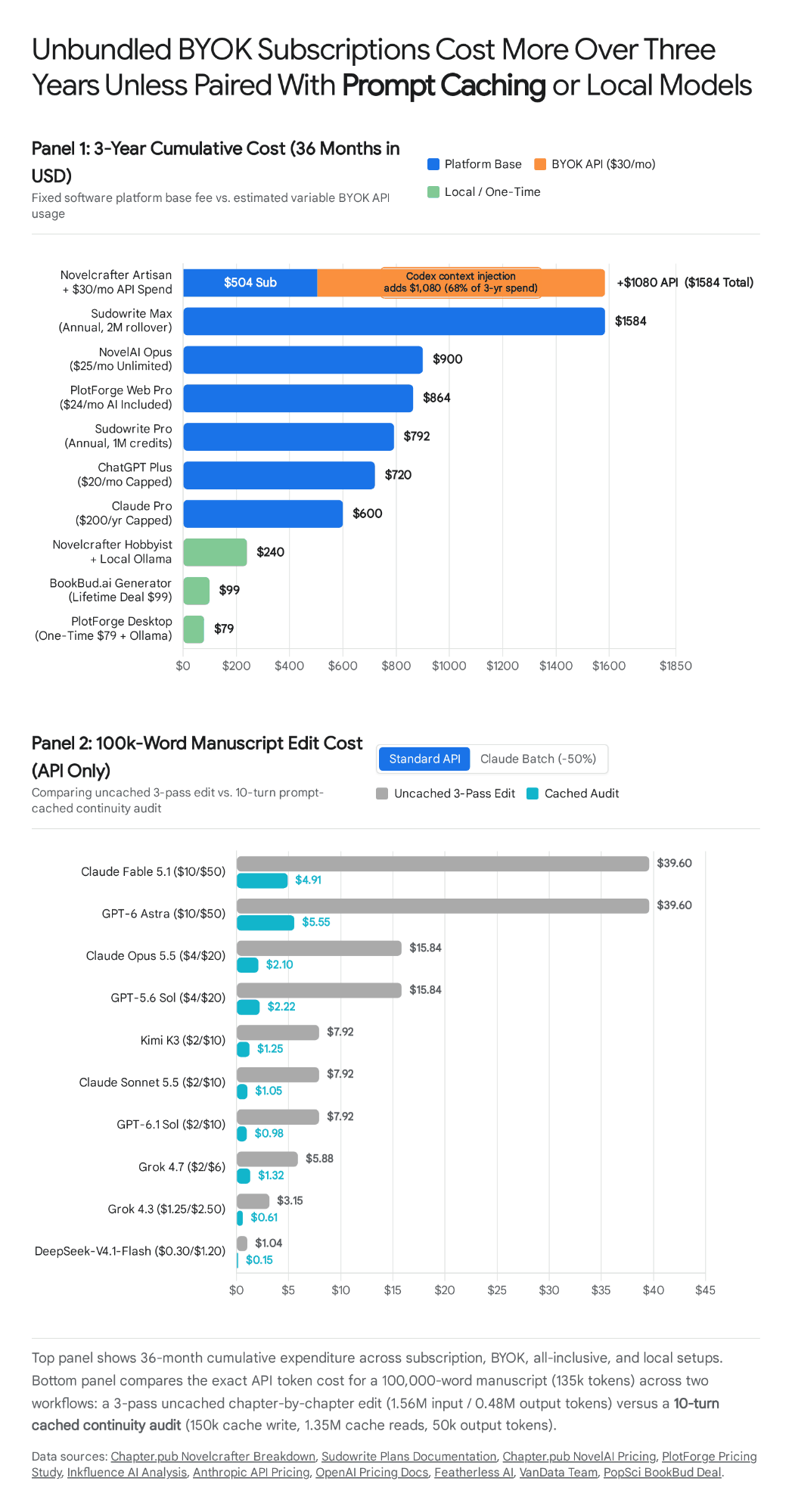
Direct Verdict: "Is Novelcrafter (or any BYOK tool) worth it if the writer still has to pay for the model?"
Yes if its organisation and context controls justify the extra workspace fee for you. The fee buys manuscript structure, Codex and workflow features; AI usage is a different bill. That is particularly useful for authors maintaining characters and world rules across books. A writer who mainly asks occasional questions about short passages may prefer a direct chat product, an inexpensive API interface or the workspace without AI. Neither choice is inherently a trap. [35][50]
For a concrete budget, Artisan annual billing costs $140/year, or about $11.67 per month, before AI. If your measured provider usage is $10/month, the annualised total is about $21.67/month. If usage is $50/month, it is about $61.67/month. Hobbyist has a lower workspace fee but not the same chat features. Local inference can eliminate hosted token charges, while keeping any workspace subscription and local ownership costs. A forecast under $25 all-in is an assumption about usage, not a universal consequence of choosing Sonnet, Kimi or GLM. [35]
Use a representative month to compare the time saved and the bill actually paid. An unchanged prompt prefix can be cheap to reuse; a huge, constantly changing bible repeatedly sent uncached can be expensive. Bundled credits can simplify budgeting, but their value depends on model choice and the number of usable scenes rather than raw credit totals. [5][25][36]
4. The Overlooked Use Case: AI as Manuscript Editor and Continuity Checker
A novelist can use AI for diagnostic manuscript analysis while continuing to write the published prose personally. This changes the task from generating scenes to locating possible inconsistencies and explaining them with evidence. The model may produce an issue log, a timeline or a proposed character-state ledger; the author still decides whether the apparent conflict is a mistake, intentional ambiguity or unreliable narration. A service’s feature list does not establish how reliably it will make that distinction. [45][46]
Capabilities vs. The Unsolved "Coherence Wall"
There are five useful audit categories. Character knowledge-state auditing asks when a character learns a secret and whether an earlier action wrongly assumes that knowledge. Timeline checks compare dates, durations, travel times, seasons and ages. Prop custody and spatial tracking trace objects, injuries and locations across scenes. Foreshadowing and promise registers connect setups with later resolutions. Lexical/pattern linting counts repeated phrases, filter words and similar openings. The first four require interpretation and can be wrong; the last can use deterministic counts, although deciding whether a pattern damages the prose remains editorial. [45][46][55]
A large context window helps provide more manuscript material. It does not guarantee that every part receives equally effective attention or that all story facts are retrieved correctly. The Lost in the Middle research demonstrates positional weaknesses in its evaluated retrieval tasks and models, not a universal 128K-token cliff for every current system. Nor does it establish that all 100K-word novels fail specifically in chapters 10–16. A whole-book pass can be useful, but should be combined with focused questions, chapter references and a maintained canon rather than treated as complete verification. [43]
A sequential cold read can reduce the amount that must be remembered implicitly. Carry forward an explicit clock, knowledge map, promise register and prop list, then check the ledger against quotations before relying on it. This does not “solve” coherence automatically: a mistaken extracted fact can propagate through the ledger. A second pass from another direction, and a human read of the full story, can expose omissions that a local scan misses. [45]
Specialist Manuscript Continuity and Analysis Tools (2026)
| Tool | Architecture | Diagnostic scope | Manuscript handling | Current access / pricing |
|---|---|---|---|---|
| fiction-forge | MIT toolkit, story-bible MCP context server, prose/repetition scanners and cold-read protocol | Timeline-scoped character context, chapter context, bible search, continuity and foreshadowing tools; rolling state ledgers plus deterministic pattern counts | Reads chapter files and reference material. A Claude-assisted workflow still transmits selected content to Claude; “local files” does not imply local model processing | Toolkit free; model/product use is separate. No universal per-book API quote. README v2 is dated July 2026. [45][55] |
| Book Check Genie | Hosted manuscript checker with series canon, revision tracking and evidence passages | Character facts, timeline, numbers, physical/plot state, lore, point of view and voice; vendor acknowledges misses and false flags | Upload DOCX/PDF/EPUB/RTF/TXT/MD. Private account storage, with checks by AI providers under their API terms | One sample up to 3,000 words; £19 full pass up to 120,000 words; £22/month for 3 checks, £49/month for 10. Prices are GBP. [46][47] |
| BookBud.ai | Guided book creation, editing, covers and ebook export | Current page documents AI-assisted drafting/editing. It does not establish a separately benchmarked continuity-audit engine matching fiction-forge | Hosted project workflow; review its import, privacy and export features before treating it as a checker for an existing novel | Free starting credits; Starter $19/month / $190/year, Basic $49/$490, Pro $99/$990. Old sponsored lifetime deals are not current standard plans. [54] |
| Sudowrite Feedback / Novelcrafter Review | Integrated workspace review features | Developmental feedback and review tools, with features varying by plan; not interchangeable with a measured whole-series factual audit | Works on material supplied to the workspace/selected provider | Feedback: Sudowrite Professional/Max. Novelcrafter basic review starts on Scribe; advanced review/chat on Artisan, with connected AI charges where used. [36][35] |
Scroll sideways to see all columns →
Mathematical Precision in Prose Linting: How fiction-forge Quantifies Stylistic Drift
The scanner’s arithmetic is more precise than a general impression, but it remains a configured style heuristic, not an authorship detector. Its README describes 24 pattern checks and configurable literary/genre presets. The current implementation normalises matches by chapter word count:
Pattern density = match count ÷ word count × 1,000. [55]
For each pattern above its target, the scanner adds the excess density multiplied by that pattern’s weight, then adds 1.5 per detected cluster and 1.0 per repeated opening. The sum includes positive excess only, so below-target patterns do not cancel over-target ones:
Severity = sum[max(0, density − target) × weight] + 1.5 × clusters + repeated openings. [55]
The code defaults are LOW below 3, MEDIUM from 3 to below 6, HIGH from 6 to below 12, and CRITICAL at 12 or above. They can be changed in the project configuration. Clusters and repeated openings have their own detection rules; a count is not simply every possible overlapping 150-word window. Pattern weights and acceptable densities belong to the selected preset, so do not assume one published example is correct for every release or genre. [56][55]
A low severity score means the text contains fewer of those configured patterns. It does not mean the story is well written, free of AI influence, or guaranteed to pass an external classifier. The project itself warns that generic “de-AI” editing can move prose away from a chosen voice. Use a measured style profile and judge passages in context; do not delete every simile or dash to optimise a number. [45]
Verdict: "Can AI find plot holes in a novel?"
Sometimes, particularly when it can show the conflicting passages. Dates, knowledge leaks, missing props and conflicting ages are good targets for an evidence-led review. A model may also notice thematic or motivational problems, but that does not make its interpretation authoritative. There is no shared controlled evaluation here establishing fiction-forge, Kimi or Book Check Genie as the most accurate. Try a sample containing known issues and some intentionally ambiguous passages, then inspect both misses and false alarms. [45][46][43]
For a technical workflow, the ledger approach gives the author inspectable state. For a no-code workflow, a dedicated service may save setup. In either case, require a chapter reference, the exact quoted evidence and a reason for each proposed contradiction. Correct the canon when a finding exposes a real error; mark intentional exceptions so later passes do not repeatedly “fix” them.
Verdict: "Should a novelist use AI to write a novel or to edit and analyse it?"
Analysis-only use is a sensible option when retaining your own prose is the priority. Keep the generated reports separate and revise the manuscript yourself. That avoids introducing generated replacement sentences by accident, while still providing another set of suggestions about structure and consistency. It does not create immunity from false-positive detectors, and watermark tests do not establish copyright or ownership. The US Copyright Office distinguishes human authorship from AI-generated expression; model-use permission and a finished work’s protection remain separate questions. [42][1][2]
If you use generated drafting, decide what role it serves and review the result for factual continuity, original expression and voice. If you use analysis, review the analysis too. Neither workflow removes the need for an author to make the final editorial decisions.
5. AI Detection, Watermarking, and Stylistic "Tells" in 2026
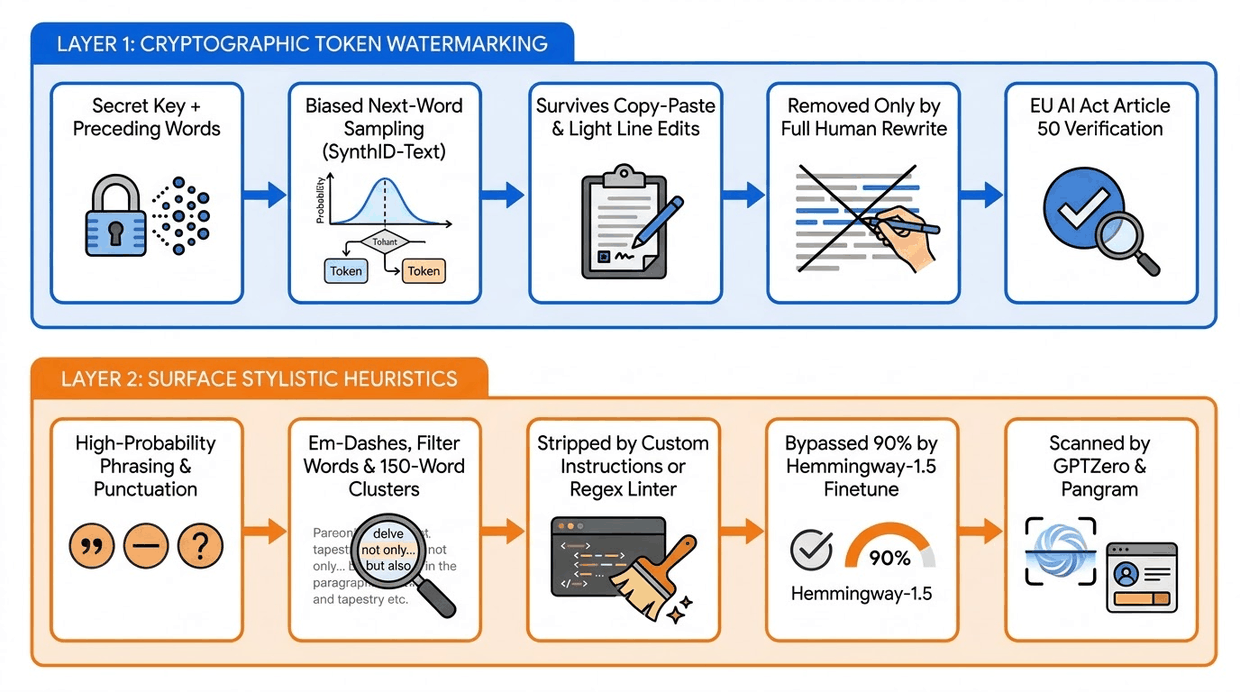
Two distinct systems are often confused: provider watermark detection, which tests for a known statistical pattern inserted during generation, and general AI-text classification, which estimates authorship from learned or stylistic features. A prose linter is a third thing: it counts selected patterns without establishing origin. A text can lack obvious clichés and still contain a provider watermark; a human text can be incorrectly flagged by a classifier. [1][2][55]
| Mechanism | What it tests | What it can indicate | What it cannot establish |
|---|---|---|---|
| Keyed text watermark | A statistical signal shaped during token selection | Evidence that a participating system generated or processed some text, with uncertainty | The user, prompt, truth, ownership, proportion of human contribution, or absence of all AI when no signal is detected |
| General AI classifier | Features learned from human/generated training samples | A model-specific prediction with false positives and false negatives | A reliable certificate of human authorship or proof that a passage is watermarked |
| Style/pattern scanner | Explicit words, regex patterns, density and repetition | Where configured tics occur | Whether the author is human, whether the prose is good, or whether another detector will pass it |
Scroll sideways to see all columns →
Layer 1: Statistical Text Watermarking and the EU AI Act
The European Commission says Article 50 transparency rules apply from 2 August 2026, including machine-readable marking and detectability of synthetic outputs. It describes an exception for standard assistive editing or changes that do not substantially alter the input or its semantics, and a grace period until December 2026 for systems placed on the market before 2 August. This is not a rule that every provider must use SynthID, and the current factsheet does not justify attaching a precise 2 December retrofit date to every model. Provider marking duties and the separate disclosure rules for certain published content must not be collapsed into a blanket rule for every novel. [44]
Anthropic: its 14 August announcement, updated 1 September, describes a version of SynthID-Text, using keyed randomness in word selection rather than hidden Unicode characters. It says the launch applies globally, with older pre-August models to be updated, and offers a detection API in private preview for eligible organisations. The watermark carries no identifying user information. Detection is statistical, less effective on short or constrained text, and may be too sparse to register when Claude only proofreads human wording. A provider’s general rollout statement should not be turned into an independently tested per-endpoint deployment ledger. [1]
Google: DeepMind confirms SynthID watermarking for text generated by the Gemini app and web experience. SynthID is a family of provenance methods across media; a statement about that consumer experience does not by itself establish the settings for every AI Studio, Vertex, partner or self-hosted endpoint. Check the actual product documentation rather than inferring a universal watermark from the model family. [16]
OpenAI: on 5 October 2026, OpenAI published its textGrain approach. It announced opt-in watermarking globally for select API models, off by default, and a rollout to eligible ChatGPT and Codex text in the EU over the following weeks. Detector access initially goes to approved researchers and expert organisations. That directly replaces the claim that OpenAI has no public technical disclosure. OpenAI also says editing can weaken the signal and that a watermark does not establish ownership, accuracy, user identity or the amount of human contribution. [2]
Grok / xAI API: the current documentation states that, starting 7 November 2026, supported Grok models—including 4.7 and 4.3—have text watermarking on by default across API endpoints, with per-model team opt-out. The API’s x-watermark response header identifies whether that particular response was marked. This is a provider setting, not an inference from a heuristic detector score. It makes the draft’s earlier “no documented watermark” description out of date on publication day. [3]
Open weights and fiction platforms: downloadable weights can let an operator inspect and control inference, but a model’s licence alone does not certify the absence of all provenance mechanisms. Hosted providers may add processing, and proprietary Muse/Xialong services should not be labelled “zero watermark” without a current primary disclosure supporting that exact claim. Encryption protects stored content in a different way and does not answer whether a generated passage carries a signal. [26][29][40]
Copying text into Word does not normally change its words, so it does not inherently remove a word-choice watermark. Conversely, it is too strong to say that only rewriting virtually every word can weaken every implementation. Providers describe probabilistic detection and limitations under editing; strength depends on the method, text and changes. Removing dashes or hidden characters is not a universal provenance test. Judge editing by whether it improves the work, and keep a record of your actual drafting and revisions. [1][2]
Layer 2: Stylistic "AI Tells" and Heuristic Detectors
Readers may associate repeated phrases, generic emotional explanations, stock contrasts and uniform rhythm with machine-written prose. Those are useful editing observations when they occur in a manuscript; none proves origin. Em dashes, curly quotation marks and the rule of three also occur in ordinary human writing. A style request can reduce a habit without making every output comply, and a lower slop score cannot certify that an external classifier will accept the text. [7][45]
| Pattern category | Examples to review | Editorial interpretation |
|---|---|---|
| Punctuation and cadence | Frequent em dashes, uniform sentence lengths, repeated three-part lists | Look for monotonous rhythm. Retain punctuation that serves dialogue and meaning. |
| Formulaic contrasts and hedging | Repeated “not X, but Y” structures; stacks of seemed/felt/appeared | Count recurrence and revise where it blurs the intended voice. A scanner’s cluster penalty is a configured heuristic. |
| Show-then-explain and voice drift | A gesture immediately followed by an explanation of its meaning; generic retrospective foreshadowing | Assess point of view and subtext in context. A counted pattern may be intentional. |
| Overused vocabulary and formatting debris | Clichés, habitual adjectives, accidental zero-width spaces or pasted formatting | Clean genuine debris and repetition. Curly quotes and individual vocabulary choices are not evidence of AI authorship. |
Scroll sideways to see all columns →
Hemmingway AI reports 90% overall detector passes for 1.5 on its 1,848-text evaluation, versus 86% for its human comparison corpus. Its separate same-80-asks comparison reports 92% for Hemmingway-1.5, not the identical test behind the 90% figure. These are the developer’s results, and detector versions, categories and sample mix matter. Passing a classifier does not turn AI-generated text into human-authored text, and failing one does not prove that human work was generated. [20]
Verdict: "How does a writer make AI writing undetectable in 2026?"
There is no dependable “undetectable” guarantee. Provider watermark tests, general classifiers and pattern scanners answer different questions and can miss or misclassify text. A local model, a model marketed as a humaniser and a low scanner score do not establish how a future detector will behave. The useful writing goal is specific, coherent prose in the intended voice, with an honest record of how it was produced. [20][1][2]
If you prefer to keep generated sentences out of the book, use analysis-only reports and write the revisions yourself. If you use generated prose, review it carefully and follow the disclosure terms that apply to the actual publisher or platform. No universal legal or authorship conclusion follows from a detector’s result. [42]
6. "Best for X" Reader-Profile Verdicts
These are starting points for a trial, not measured universal rankings. Use the same brief, manuscript excerpt and style constraints when comparing them, and account for editing time as well as subscription price.
Best AI for Outlining a Novel
Start with Claude Opus 5.5 + Novelcrafter if you actively maintain a Codex and want a dedicated fiction workspace. GPT-6 Astra is a useful direct-model alternative for generating and challenging beat sheets. Opus’s $0.20 cache-hit price applies only to reusable cached input; it does not mean the workspace queries a perfect 1M-token story database on every turn. Validate causes, stakes and character choices in the outline rather than using an Elo as a plotting verdict. [8][35][7]
Best AI for Dialogue That Sounds Human
Trial Hemmingway-1.5 against Fable 5.1 on a scene where characters want different things and do not say them directly. The often-quoted 1026 CommunicationBench score concerns Hemmingway-1, according to its developer’s model card, not an independently established 1.5 dialogue ranking. The developer’s 1.5 detector result is a separate test. Check commercial model/service terms before adopting a workflow. [57][20]
Best AI for Editing an Existing Manuscript
Fable 5.1 and Kimi K3.1 Pro make a reasonable shortlist from the published writing results. Compare small, explained edits with a preserved original; neither a rubric nor a slop score measures how faithfully a model preserves your own voice. Sonnet 5.5 offers lower base API prices if it performs adequately on the same passages. Light proofreading and a substantial rewrite have different provenance implications. [7][5][1]
Best AI for Brainstorming Story Ideas
Start with GPT-6 Astra, then compare GLM-5.3 or Grok 4.7 if price, access or genre behaviour suit you. Their v3 results do not prove that premises are original or scientifically correct. Ask for several meaningfully different alternatives, challenge the obvious twist and research factual elements independently. A low slop score is not a measure of trope novelty. [7][30][18]
Best AI for Finding Plot Holes and Inconsistencies
Choose a ledger-based cold read for an inspectable process, with fiction-forge as one documented implementation. Book Check Genie offers a dedicated service, while Kimi K3 can receive substantial book context for your own questions. There is no common controlled accuracy ranking here. Judge a sample by its supporting quotes, real issues found, false alarms and omissions rather than the confidence of its summary. [45][46][24]
Best AI for Long Manuscripts (80k+ Words)
Trial Kimi K3 / K3.1 Pro, GLM-5.3 and Claude Opus 5.5 using the same chapter plan and approved canon. K3’s native 1,048,576 context is a capacity advantage over smaller-window endpoints, not a guarantee of full-book recall or voice consistency. Selective context through a workspace may be more useful than repeatedly sending everything. Maintain a human-readable timeline and chapter summaries whichever model wins your trial. [24][25][28][8]
Best AI for Dark or Adult Fiction
Sudowrite Muse is a sensible first trial because the vendor explicitly supports adult themes, with NovelAI Xialong a continuation-oriented alternative. Check the selected engine and service terms; neither vendor language nor an “abliterated” label proves every request will be answered or that the output is suitable to publish. The exact muse-wonder benchmark result must not be used as a score for every Muse version. [37][39][7]
Best AI for "Undetectable" Prose
No product earns a dependable undetectability verdict. Hemmingway-1.5 has a developer-reported detector advantage on its tests, with the limitations discussed above. That may justify a prose trial, but not a certificate of human origin, guaranteed future detector passes or a copyright conclusion. Choose for voice and usefulness, and keep an accurate drafting history. [20][42]
Best Free or Low-Cost AI for a Novelist on a Budget
Start with available free trials or free chat allowances, then measure whether a low-cost API suits your usage. Sonnet 5.5 is $2/$10 per million base input/output, Haiku 5.5 has much lower short-prompt rates but a higher tier over 100K, and DeepSeek Flash has very low direct peak/off-peak rates. None is universally best value without considering output quality, reasoning, context, retries and setup. Free-tier model availability can change. [5][9][32]
Best Local / Privacy-First AI for Writers
Ornith-35B and Qwen3.6-35B-A3B are candidates on suitable hardware. Ornith’s small Strix Halo prose result is encouraging rather than a broad “best fiction” finding. Budget for the full weight file, runtime and context cache: a 16GB machine cannot hold an 18–21GB Q4 file wholly in memory. Verify that the selected inference route, plugins, storage and sync remain local; simply installing a local interface does not make every feature offline. [21][22][33][23]
Best All-in-One Platform vs. Best BYOK Setup
Sudowrite Professional, at $264 billed annually or $29 month-to-month, bundles 1M credits, Story Bible and Feedback. Novelcrafter Artisan, at $140/year or $14/month plus provider use, offers chat and Codex control with supported model routes. Choose according to workflow and measured use; bundled credits and API tokens cannot be compared one-for-one. Check which exact engines are available when you sign up. [36][35]
Best AI for Series Writers (Multi-Book Continuity)
Novelcrafter’s Series/Universe and shared Codex workflow is a strong organisation candidate, including non-AI use on Scribe and AI integration from Hobbyist. Book Check Genie offers series canon in its paid subscription plans for audit work. Organisation and auditing serve different purposes: neither automatically keeps canon correct when a revision changes facts in an earlier book. Approve and update the shared record deliberately. [35][47]
7. Reader Questions and Comparison Map
This index connects common questions with the comparisons above. The questions are navigation aids, not claims about search volume or evidence that their premises are true.
| Topic | Questions addressed |
|---|---|
| Frontier models | Is Claude or ChatGPT a better fit for my fiction? How do Opus 5.5 and Fable 5.1 differ in price? Does a higher writing Elo predict better editing? Which GPT version was actually tested? How do Grok 4.7 and 4.3 differ in context and cost? What is documented for the Gemini model I can access? |
| Open-weight and specialist models | What does Hemmingway-1.5’s detector test establish? How is it different from Hemmingway-1’s benchmark result? What are the commercial model-use terms? What memory does Ornith-35B need? How do Kimi K3, Pro and K2.6 differ? Should I use GLM or DeepSeek for a particular task? |
| Fiction platforms | Sudowrite or Novelcrafter? What do I pay separately for BYOK use? How do credits compare with API tokens? Is NovelAI suitable for a plotter or a discovery writer? What does Xialong’s rollover context mean? What happens to Subscription Anlas when a NovelAI subscription expires? |
| Continuity and editing | Can AI find plot holes? Should I use it for prose or external analysis? How does a rolling state ledger help? What does Book Check Genie’s sample include? Is BookBud a dedicated continuity checker? What does long-context research actually show? |
| Watermarks and style | Does the actual provider/product watermark text? What changed at OpenAI in October and Grok on 7 November? Does proofreading mark my entire original? What can a detector prove? Do dashes or a low slop score establish authorship? Is “undetectable” a defensible promise? |
Scroll sideways to see all columns →
8. "Is X Worth It?" Decision Case Studies
Case Study 1: Is Novelcrafter Worth $4–$20/Month Plus Separate API Costs?
Verdict: It can justify the separate workspace fee for a plotter or series author who uses the Codex and manuscript structure. It is not automatically poor value for a discovery writer, nor is a separate API bill hidden: the question is what you use and what the workflow costs in practice. [35]
The plans are Scribe $4/month or $40/year, Hobbyist $8/$80, Artisan $14/$140, Specialist $20/$200. AI integration begins on Hobbyist, chat on Artisan. A writer who needs only Codex organisation can use Scribe without an AI connection. A writer who wants scene-level AI but not conversational chat may find Hobbyist enough; there is no evidence that “most solo novelists require Artisan”. [35]
Consider an author revising a fantasy series. Their main problem is keeping character states, world rules and earlier-book facts available while drafting scenes. The Codex and its context controls can reduce manual preparation and help keep facts visible. The model can still misunderstand what it receives, and the author must update entries when canon changes. Selecting relevant details is different from injecting a 40,000-word bible into every prompt. [50][51]
On Artisan annual billing plus an assumed $10/month provider bill, the annualised total is $260/year, about $21.67/month. At $50/month provider use it is $740/year, about $61.67/month. A $20 chat subscription is simpler if it already meets the writer’s needs, but the products do not provide identical organisation or control. Compare a month of representative work, including retries, before extrapolating a three-year cost. Local routing removes hosted token fees only when computation is actually local, and still carries hardware/setup costs.
Case Study 2: Is Sudowrite Worth $10–$44/Month for Muse and Story Bible?
Verdict: It is a useful all-in-one trial for a writer who wants guided story planning and fiction-focused generation under a credit allowance, particularly if Muse’s advertised support for adult themes fits the project. It is not unlimited computing at a fixed fee. [36][37]
The three plans have annual equivalents of $10/$22/$44 per month, billed $120/$264/$528 annually. Monthly billing is $19/$29/$59. The allowances are 225,000 / 1,000,000 / 2,000,000 credits, with Feedback on Professional/Max and rollover on Max. Credits are an internal unit; model and feature choice change how much writing they buy. A writer should test credit use with their own desired output and revision rate rather than interpret a million credits as a million words. [36]
Consider a romance writer who wants to move from synopsis to characters, outline and scenes, then use Rewrite or Describe on passages. Sudowrite’s guided tools may save setup compared with assembling the same workflow around a raw API. Muse’s own documentation describes it as unfiltered and supportive of violence/adult themes, but this report does not measure zero refusals for every mode or infer rights from that description. Choosing Claude or another external model inside a platform can bring different policies and provenance. [37][1]
The muse-wonder row’s 2007.0 Elo / 81.10 rubric / 1.2 slop supports inspecting its sample outputs. It does not establish a score for Muse 1.5, Ballad or all settings. A writer primarily seeking critique of already-written literary prose may prefer a direct model or another workspace after trialling the same manuscript. The practical comparison is usable feedback or scenes per pound/dollar and hour, not which credit count is largest. [7]
Case Study 3: Is NovelAI Worth $10–$25 per Renewal for Unlimited Text?
Verdict: NovelAI can suit continuation-led writers who value its configurable story context and encrypted storage. It deserves a direct trial rather than a blanket “only for pantsers” verdict; planning through notes and Lorebook is possible, but its organisation and export workflow differ from a guided manuscript-production tool. [38][39]
Tablet is $10, Scroll $15, Opus $25, with renewals every 30 days. All paid tiers include unlimited text and TTS for the subscription period. An email-verified Paper trial offers 50 text, 30 image and 100 TTS generations. Image allowances and models have separate conditions; they should not be conflated with unlimited text. There is no reason to present the free tier as an ongoing unlimited service. [38]
For the Xialong workflow, Opus provides 28,672 tokens with an 8,192-token rollover, so the story can grow to 36,864 before the context is trimmed back. That is not a permanently independent second memory bank, and Memory, Author’s Note and Lorebook compete for the available context. Xialong’s documented 355B GLM-4.6 fine-tune, released 31 March 2026, is a distinct model from its base, so a base benchmark cannot certify Xialong’s prose quality. Unlimited calls do not make the active context a whole-novel memory. [39][48]
Consider an author who likes writing a few lines and asking for the next alternatives. The subscription may be attractive because frequent text continuation does not spend a finite monthly credit wallet. However, test how much recent prose and lore the model sees, how you organise chapters and how you export. NovelAI’s privacy page says stored stories are encrypted, while the selected passage sent for generation is processed in readable form and not retained as prompts under its stated policy. This is a cloud service, not a local-only confidentiality guarantee. [40]
The current subscription documentation also states that unused Subscription Anlas reset to zero when the subscription ends, under the policy introduced 31 days after the V5 release. A refilled subscription pool is not necessarily an accumulated purchase balance. Check the current image-model usage limits rather than treating an earlier “unlimited images” offer as a permanent blanket entitlement. [38]
Case Study 4: Is Hemmingway-1.5 Worth Trying for Natural Prose?
Verdict: It is worth a representative dialogue/first-person trial if its model or service terms and hardware fit the intended use. It does not provide a dependable “undetectable prose” certification. [20]
The model is 27B, derived from Hemmingway-1/Qwen3.8-27B, with 262,144-token context. The developer’s card reports 90% passes across its 1,848 generated samples and 86% for its 1,670 human samples, with different rates in a separate same-80-asks comparison. Those tests evaluate particular detectors and datasets. They are not a new TexFaber replication or a guarantee about a novelist’s full book. [20]
The widely repeated 1907.4 Elo / 77.25 rubric / 1.1 slop v3 result belongs to Hemmingway-1. Its developer’s 1026 CommunicationBench comparison likewise names Hemmingway-1. These results can explain interest in the family but must not be passed off as independent scores for 1.5 or proof that it outperforms every frontier system in dramatic subtext. Everyday correspondence, dialogue and sustained narrative arcs are different tasks. [7][57]
Before a commercial workflow, distinguish the CC BY-NC 4.0 model licence, the provider’s invitation to negotiate commercial model use, the terms for its hosted products and the copyright status of any finished output. A commercial licence does not guarantee copyright clearance or originality. Likewise, model size and open weights do not establish that every host omits provenance or that a classifier will never flag the result. [20][42]
A useful trial compares an original scene, the model’s proposed changes and the author’s final version. Look for distinct character motives, implication, repetition and voice drift. Keep the version that serves the story, regardless of a detector score. If a continuing conversation loses important facts, use explicit canon and chapter-level review rather than assuming a larger advertised context will fix it automatically.
9. 2025–2026 Timeline and Consolidated Verification Log
Chronological Analysis of Key 2025–2026 Shifts
The timeline separates documented product changes from claims about subjective writing quality. A release date is not evidence that a model became the best novelist, and a forum thread is not a controlled measurement of a general regression.
2025 to early 2026: style control remains a workflow issue. Models respond differently to style instructions, and those instructions do not always eliminate dashes, commentary or clichés. The precise “3.28× human em-dash rate” and a universal GPT-5.1 punctuation fix are not established by the primary evidence used here. Keep a style sheet and compare actual model versions rather than treat punctuation as an authorship signal. [7][45]
31 March 2026: NovelAI’s Xialong. The vendor’s announcement documents its GLM-4.6 basis and story-focused fine-tuning. Current docs explain the 28,672-token base context plus rollover. It is a useful documented change in a continuation workflow; it is not proof of loop-free writing or a whole-book memory. [48][39]
Mid-2026: local and long-context options broaden. Ornith’s cards document Qwen-derived 35B MoE releases and code/agent emphasis. The Strix Halo test offers limited local prose evidence, with hardware-specific speed and memory results. Kimi K3’s published model card documents 2.8T total/104B active parameters and 1,048,576 context. This report does not conflate a repository timestamp, training date and public release date or infer universal fiction performance from those specifications. [21][22][23][24]
2 August onward: EU transparency and provider provenance. The Commission’s factsheet gives the Article 50 start and December grace period for older systems, with editing exceptions. Anthropic’s 14 August announcement describes its global watermark approach and was updated 1 September. The law does not mandate the same method, rollout scope or product switch at every provider. [44][1]
22 September: Claude Opus 5.5. Its official overview lists the release date, $4/$20 base rates, $0.20 cache hits and 1M context. Sonnet 5.5 and Haiku 5.5 are separate current releases with separate prices and cards; old Sonnet 5 and Haiku 3.5 writing scores do not measure them. Haiku 5.5’s current model page dates it to 7 October, so it must not be labelled a 24 September release. [8][5][9][7]
5 October: OpenAI’s textGrain announcement. OpenAI disclosed global API opt-in for select models, off by default, and a rollout for eligible EU ChatGPT/Codex text. This supersedes “no public disclosure” descriptions. The announcement also discusses uncertainty and the effect of editing on detection. [2]
October–November: versions and price schedules need separate checks. Hemmingway’s current 1.5 card reports detector performance for 1.5 while earlier family writing results remain separately named. The checked v3 table distinguishes K3.1 Pro, K3, GPT-6 Sol, GPT-5.6 Sol, Fable 5.1 and Opus 5.5. Direct model cards give 1.05M total/922K input for the GPT models checked here. The GPT-5.6 Sol price is currently flagged as promotional until 30 November. Neither the leaderboard nor a few subjective comparisons establishes a universal late-October creative-writing regression. [20][7][10][12][13][11]
7 November: Grok API default watermarking. The current primary documentation introduces it for supported Grok models including 4.7 and 4.3, with per-model opt-out and a response header reporting actual status. This publication-day change demonstrates why provenance advice must identify the provider, product, date and settings. [3]
Consolidated Data Verification Log
All rows below were checked 7 November 2026. Sources are the providers, original model cards, original benchmark or code, official regulator, or the explicitly labelled first-hand community test. Recommendations above are editorial interpretations of that evidence.
| Data cluster | Checked fact or limitation | Primary reference |
|---|---|---|
| Claude API | Fable $10/$50, Opus $4/$20, Sonnet $2/$10; current context 1M. Haiku has ≤100K and >100K tiers. | [5][4][9] |
| Claude chat plans | Pro $20/month/$200 yearly; Fable usage credits on Pro. Max/Ultra currently advertise separate included API-credit entitlements; not all plans are “no API included”. | [6] |
| GPT specs and costs | Astra, 6.1 Sol and 5.6 Sol cards: 1.05M total, 922K max input, 128K output; request length and cache-write rates affect bills. | [10][12][13][11] |
| Grok | 4.7 500K; 4.3 1M; higher rates at ≥200K; default supported-model API marking from 7 Nov. | [18][3] |
| EQ-Bench | Exact versioned v3 rows, scores and metric definitions; no inference of whole-novel success or cross-version score transfer. | [7][41] |
| Kimi | K3 architecture, custom licence and direct K3/Pro rates; host settings differ. | [24][26][25] |
| GLM and DeepSeek | GLM-5.3 custom licence and official $1.40/$4.40 rates; DeepSeek Flash peak/off-peak input/output/cache rates and endpoint version. | [29][30][31][32] |
| Ornith and local hardware | Coding/agent model cards; MIT; full weights plus context memory. Strix test is one explicitly limited evaluation. | [21][22][23] |
| Hemmingway | 1.5 developer-reported detector test, CC BY-NC model terms; predecessor writing/communication figures are not 1.5 results. | [20][57][7] |
| Writing platforms | Novelcrafter fees exclude connected AI; Sudowrite credits and billing cadence; NovelAI 30-day renewal, context and encryption/processing distinction. | [35][36][38][39][40] |
| Provenance and copyright | EU exceptions and transition; different provider rollouts; watermark/classifier results do not establish authorship or ownership. | [44][1][2][3][42] |
| Manuscript checking | fiction-forge code/configuration; Book Check Genie GBP plans and sample cap; current BookBud plans rather than old sponsored offer. | [45][55][56][46][47][54] |
Scroll sideways to see all columns →
Sources and references
Provider pages, original model cards and the cited evaluations were checked on 7 November 2026. Live prices, model access and provenance settings can change. First-party performance claims and the limited community test are identified in the text.
- Anthropic (2026). How Claude’s text watermark works. Accessed 7 November 2026. ↩
- OpenAI (2026). Our approach to EU text provenance rules. Accessed 7 November 2026. ↩
- SpaceXSI / xAI (2026). Output watermarking. Accessed 7 November 2026. ↩
- Anthropic (n.d.). Models overview. Accessed 7 November 2026. ↩
- Anthropic (n.d.). API pricing. Accessed 7 November 2026. ↩
- Anthropic (n.d.). Claude plans and pricing. Accessed 7 November 2026. ↩
- EQ-Bench (n.d.). Creative Writing v3 leaderboard. Accessed 7 November 2026. ↩
- Anthropic (n.d.). Claude Opus 5.5 overview. Accessed 7 November 2026. ↩
- Anthropic (n.d.). Claude Haiku 5.5 overview. Accessed 7 November 2026. ↩
- OpenAI (n.d.). GPT-6 Astra model card. Accessed 7 November 2026. ↩
- OpenAI (n.d.). API pricing. Accessed 7 November 2026. ↩
- OpenAI (n.d.). GPT-6.1 Sol model card. Accessed 7 November 2026. ↩
- OpenAI (n.d.). GPT-5.6 Sol model card. Accessed 7 November 2026. ↩
- Google (n.d.). Gemini API models. Accessed 7 November 2026. ↩
- Google (n.d.). Gemini API pricing. Accessed 7 November 2026. ↩
- Google DeepMind (n.d.). Google SynthID. Accessed 7 November 2026. ↩
- SpaceXSI / xAI (n.d.). Grok 4.7 developer guide. Accessed 7 November 2026. ↩
- SpaceXSI / xAI (n.d.). API pricing. Accessed 7 November 2026. ↩
- Hemmingway AI (2026). Hemmingway-1.5 specifications and API rate. Accessed 7 November 2026. ↩
- Hemmingway AI (2026). Hemmingway-1.5 model card and detector evaluation. Accessed 7 November 2026. ↩
- Ornith AI / DeepReinforce (2026). Ornith-1.0-35B model card. Accessed 7 November 2026. ↩
- Ornith AI / DeepReinforce (2026). Ornith-1.5-35B-A3B model card. Accessed 7 November 2026. ↩
- slb350 (2026). Local LLM benchmarks on AMD Strix Halo. Accessed 7 November 2026. ↩
- Moonshot AI (2026). Kimi-K3 model card. Accessed 7 November 2026. ↩
- Moonshot AI (2026). Kimi K3.1 Pro pricing: membership and API costs. Accessed 7 November 2026. ↩
- Moonshot AI (2026). Kimi K3 Licence. Accessed 7 November 2026. ↩
- Z.ai (2026). GLM-5.3 model card. Accessed 7 November 2026. ↩
- Z.ai (n.d.). GLM-5.3 model guide. Accessed 7 November 2026. ↩
- Z.ai (2026). GLM-5.3 Licence. Accessed 7 November 2026. ↩
- Z.ai (n.d.). API pricing. Accessed 7 November 2026. ↩
- DeepSeek (2026). DeepSeek-V4.1-Flash model card. Accessed 7 November 2026. ↩
- DeepSeek (n.d.). Models and pricing. Accessed 7 November 2026. ↩
- Qwen (2026). Qwen3.6-35B-A3B model card. Accessed 7 November 2026. ↩
- Mistral AI (n.d.). Models overview. Accessed 7 November 2026. ↩
- Novelcrafter (n.d.). Our plans and pricing. Accessed 7 November 2026. ↩
- Sudowrite (n.d.). What plans are available?. Accessed 7 November 2026. ↩
- Sudowrite (n.d.). Sudowrite Muse. Accessed 7 November 2026. ↩
- NovelAI / Anlatan (n.d.). Subscription. Accessed 7 November 2026. ↩
- NovelAI / Anlatan (n.d.). Text generation models. Accessed 7 November 2026. ↩
- NovelAI / Anlatan (n.d.). Privacy policy. Accessed 7 November 2026. ↩
- EQ-Bench (n.d.). Benchmark methodology. Accessed 7 November 2026. ↩
- US Copyright Office (2025). Copyright and Artificial Intelligence: Part 2 release. Accessed 7 November 2026. ↩
- Liu, N. F. et al. (2023). Lost in the Middle: How Language Models Use Long Contexts. Accessed 7 November 2026. ↩
- European Commission (2026). Quick facts: transparency rules for AI systems. Accessed 7 November 2026. ↩
- geobond13 / Galleys.ai (2026). fiction-forge README and cold-read workflow. Accessed 7 November 2026. ↩
- Book Check Genie (n.d.). Manuscript checks and series canon. Accessed 7 November 2026. ↩
- Book Check Genie (n.d.). Pricing. Accessed 7 November 2026. ↩
- NovelAI / Anlatan (2026). Welcome NovelAI’s newest writing model: Xialong. Accessed 7 November 2026. ↩
- OpenAI (n.d.). What is ChatGPT Plus?. Accessed 7 November 2026. ↩
- Novelcrafter (n.d.). Codex tracking and AI context controls. Accessed 7 November 2026. ↩
- Novelcrafter (n.d.). Codex details and AI visibility. Accessed 7 November 2026. ↩
- PlotForge (n.d.). Pricing. Accessed 7 November 2026. ↩
- Inkfluence AI (n.d.). Pricing plans. Accessed 7 November 2026. ↩
- BookBud.ai (n.d.). Features and pricing. Accessed 7 November 2026. ↩
- geobond13 / Galleys.ai (2026). Prose scanner implementation. Accessed 7 November 2026. ↩
- geobond13 / Galleys.ai (2026). Project configuration and default severity thresholds. Accessed 7 November 2026. ↩
- Hemmingway AI (2026). Hemmingway-1 model card: internal communication and story tests. Accessed 7 November 2026. ↩
Generated by Gemini 4 Argon, Deep Research


