

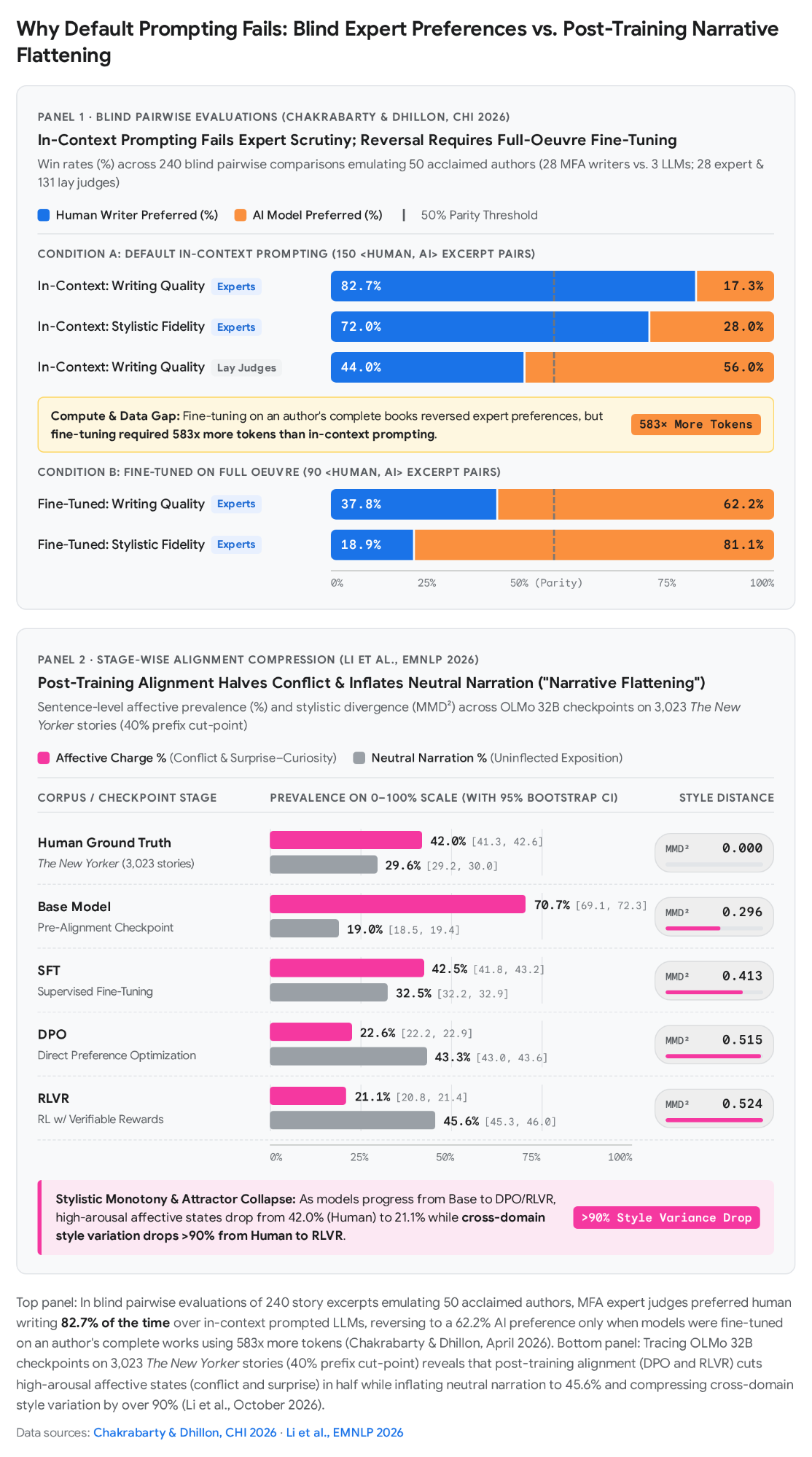
Verdict: Unassisted, one-shot AI prompting does not produce publishable fiction; in blind pairwise evaluations by MFA-trained writers, human prose outperforms in-context prompted AI fiction 82.7% of the time on overall writing quality and 72.0% of the time on stylistic fidelity (Chakrabarty & Dhillon, April 2026, [90])[1]. Functional AI fiction workflows rely on diagnostic critique prompts, hierarchical beat-to-scene constraints, and multi-model routing—pairing structural reasoning models such as OpenAI's GPT-5.5 or GPT-6.1 Sol for plot architecture with prose-tuned models such as Anthropic's Claude Opus 4.8 or Claude Sonnet 5.5 for constrained scene drafting (HoldYourVoice, July 15, 2026, [3]; Entangled Text, November 12, 2026, [2])[2].
Module 1: Outlining and Plotting Prompt Patterns
Verdict: Outlining prompts succeed when they direct the model to audit stakes escalation, reverse-engineer crisis points from a locked climax, or track double-payoff clues, whereas they fail when asked to generate a plot from a genre label alone (Entangled Text, October 20, 2026, [5]; AIWriteBook, 2026, [4])[4]. Academic analysis of 61,608 stories in the StoryScope corpus demonstrates that without structural constraints, LLM narratives cluster in a narrow, homogenous region of story space—scoring a mean rarity percentile of 0.49 compared to 0.71 for human authors—and default to tidy, single-track, chronologically linear plots (Russell et al., August 10, 2026, [6])[6].
| Pattern Name | Use Case | What It Produces | Where It Breaks Down | Usability Verdict |
|---|---|---|---|---|
| Stakes Escalation Trend-Line Audit[5] | Beat sheets & Act Two pacing | A numerical (1–10) chapter-by-chapter risk table flagging "flat stretches" where the protagonist can walk away without irreversible loss (Entangled Text, Oct 20, 2026, [5])[5]. | Confuses frantic surface activity (fights, chases) with genuine stakes narrowing unless explicitly prompted to evaluate reversibility[5]. | Usable as-is as a diagnostic map; requires human selection of the crisis fix[5]. |
| Climax-Backward Crisis Generator[5] | Structure generation & midpoint pivots | Three candidate point-of-no-return events derived from climax prerequisites, using only existing cast and subplots (Entangled Text, Oct 20, 2026, [5])[5]. | Models anchor on their first idea or invent disposable new characters unless constrained to existing Story Bible entities[5]. | Usable with light editing once retrofitting costs against Act Three are scored[5]. |
| Double-Payoff Red Herring Matrix[8] | Mystery/thriller plotting | Three misdirection candidates scored 1–5 on downstream reusability, linking a false suspect read to a true Act Three thread (Entangled Text, Oct 8, 2026, [8])[8]. | Single-use prompts produce "dead weight" herrings (e.g., an innocent shifty neighbor) that force a retcon at the reveal[8]. | Usable as-is for structural planning before drafting scenes[8]. |
| Adversarial Fair-Play Clue Stress-Test[9] | Plot-hole & continuity checking | A skeptical reader audit separating ground-truth facts from distorted witness statements and checking clue arrival timing (Entangled Text, Oct 22, 2026, [9])[9]. | Models suffer from context leakage—using author background notes to validate a deduction that is missing from the on-page text[9]. | Usable as-is for continuity auditing if fed strictly on-page text[9]. |
| Unconstrained Genre-to-Outline (Failing Pattern)[4] | One-shot full-book outlining | Episodic Act Two chapters that can be rearranged without breaking the story, decorative midpoints, and deus ex machina endings (NovelBlueprint, 2026, [10])[5]. | Structural collapse: GPT-5.4 defaults to gossip/rumor plot mechanisms and dream sequences, while Claude Sonnet 4.6 flattens event escalation (Russell et al., Aug 10, 2026, [7])[7]. | Unusable; requires total rewrite[4]. |
Scroll sideways to see all columns →
Working Pattern 1: The Three-Step Act Two Escalation and Crisis Audit
Verdict: Auditing an outline for irreversibility rather than generic "pacing" exposes sagging middles and prevents episodic plotting, according to practitioner guides at Entangled Text (October 20, 2026, [5])[5]. When asked generically to "check my outline's pacing," models return superficial praise or note slow scenes while missing the core structural defect: the protagonist can survive Chapter 20 using the exact same operating strategy used in Chapter 4[5].
Example Prompt (Stakes Escalation & Strategic Pivot Audit): "Here is a scene-by-scene summary of my Act Two (Chapters 9 through 22, attached). (1) For each scene, build a table identifying what the protagonist risks losing if the scene goes badly, rate the stakes from 1–10 (where 1 = recoverable setback and 10 = irreversible catastrophic loss), and state whether the protagonist could still walk away from the central conflict with minimal consequence. Flag the longest stretch of consecutive chapters where the score does not increase by at least 1 point as my 'missing crisis' zone. (2) Summarize my protagonist's operating strategy in the 10 chapters before the midpoint (Chapter 15) in one paragraph, and in the 10 chapters after the midpoint in one paragraph. Compare them directly: is the method of pursuing their goal meaningfully different, or is it the same method with different emotional weather? (3) Based on the 'missing crisis' zone, generate three candidate point-of-no-return events that burn a bridge using only existing characters and subplots from Chapters 1–22, then trace forward to my climax (Chapters 38–40) to identify which candidate requires the least retrofitting of my ending." (Entangled Text, October 20, 2026, [5])[5].
Practitioner benchmarks indicate that analytical and reasoning models (GPT-5.5, GPT-6.1 Sol, or OpenAI o3-mini/o4-mini) execute this structural logic reliably, whereas prose-tuned models such as Claude Opus 4.8 and Claude Sonnet 5.5 occasionally renegotiate or soften strict beat constraints across a 30-chapter outline to prioritize narrative flow unless re-prompted firmly (HoldYourVoice, July 15, 2026, [3]; Entangled Text, November 12, 2026, [2])[2].
Working Pattern 2: Adversarial Plot-Hole and Double-Payoff Clue Chaining
Verdict: Plot-hole checking succeeds when you separate the ground-truth ledger from the on-page distorted text and place the model into an adversarial reader persona (Entangled Text, October 22, 2026, [9])[9]. In mystery and thriller outlines, prompting for a "red herring" in isolation produces disposable filler; prompting for a double-payoff herring forces the false lead to plant a concrete physical or chronological anchor for the true climax (Entangled Text, October 8, 2026, [8])[8].
Example Prompt (Adversarial Fair-Play & Dormant Thread Audit): "Part A (Double-Payoff Setup): Generate THREE red herring candidates centered on the missing laptop from Chapter 3. For each candidate: (1) state the false conclusion readers will draw, (2) state which other existing character, subplot, or future scene this detail connects to later, (3) rate its 'reusability' from 1–5 based on how many future plot threads it touches, and (4) note what must be true in my outline for that reuse to work. Part B (Adversarial Reader Stress-Test): Act as a skeptical mystery reader who has read only Chapters 1–14 [paste chapter summaries/text]. You suspect Daniel is lying about leaving the office at 9:25 PM, but you do not have access to my author notes. Based ONLY on what is on the page, list every piece of evidence that lets you deduce he stayed until 9:40 PM. If the on-page evidence is insufficient or if the recoverable tell arrives after the detective already suspects him in Chapter 9, state that plainly and identify which chapter should carry the tell instead." (Entangled Text, October 8 & October 22, 2026, [8], [9])[8].
This pattern breaks down when a manuscript exceeds standard context windows, causing models to drop early setups (Entangled Text, 2026, [12])[12]. Full-manuscript continuity checks benefit from long-context architectures—such as Google's Gemini 3.1 Pro (1M–2M tokens) or Moonshot AI's open-weight Kimi K3 (released July 16, 2026, featuring a 1,048,576-token native window capable of holding a 300,000-word manuscript plus notes)—which practitioner evaluations note can track setups from Chapter 1 to Chapter 19 without summarize-and-reload degradation (Featherless AI, July 2026, [13]; HoldYourVoice, July 15, 2026, [3])[3].
Module 2: Scene Generation Prompt Patterns
Verdict: Scene generation requires granular 3-to-6-beat briefs, explicit negative boundaries ("what cannot happen yet"), dual-agenda misalignment mechanisms for dialogue, and hard stopping cues that cut the scene one beat before emotional processing begins (Entangled Text, August 14, 2026, [15]; Entangled Text, November 15, 2026, [14]; Chapter.pub, October 28, 2026, [16])[14]. Even when prompted with structured beats, raw AI scene output is not publishable as-is; practitioner documentation frames it as a structural zero-draft requiring human rewriting of openings, sensory anchors, and subtext (Hermes IDE, 2026, [18]; StoryFlow, May 12, 2026, [17])[17].
| Pattern Name | Use Case | What It Produces | Where It Breaks Down | Usability Verdict |
|---|---|---|---|---|
| Scene-from-Beats SKILL.md Architecture[18] | Drafting full scenes (1,000–2,500 words) | A 3-part output: (1) pre-draft scene plan (goal, conflict, turn, value shift), (2) continuous prose draft, and (3) 4–8 invented choices for author confirmation (Hermes IDE, 2026, [18])[18]. | If beats span multiple locations or time jumps, the model compresses transitions into summary prose unless restricted to a single scene[16]. | Needs moderate-to-heavy rewriting; usable as a blocked scene skeleton[18]. |
| Dual-Agenda Misalignment Dialogue[20] | Drafting human-sounding dialogue & subtext | Cross-purpose conversation where characters answer the question they wanted to be asked using named mechanisms (FALSE AGREEMENT, TOPIC HIJACKING, PARALLEL OBSESSION) (Entangled Text, Sep 25, 2026, [20])[20]. | Models sneak in empathetic pauses ("He nodded slowly"), accidental resolution lines ("I hear you"), and symmetric evasion sophistication near the end of the scene[20]. | Usable with targeted line trimming of the final 2–3 exchanges and action beats[20]. |
| Cut-One-Beat-Early Unresolved Ending[15] | Scene transitions & forward momentum | Scenes that terminate immediately after the trigger/reaction beat via a Withheld Reaction, Interrupted Decision, or Reframed Question (Entangled Text, Sep 12, 2026, [15])[15]. | RLHF training biases models to complete the 4-beat arc (trigger → reaction → processing → settled state) and append a moralizing summary[7]. | Usable after surgical trimming of any residual closing narration sentence[15]. |
| Camera-Observable Sensory Grounding[18] | Sensory detail & atmosphere | First-paragraph physical grounding filtered strictly through the POV character's immediate somatic perception and concrete objects (Hermes IDE, 2026, [18]; Entangled Text, Nov 10, 2026, [21])[18]. | Unconstrained "add sensory detail" prompts trigger purple prose (highest in GPT-4o) and over-represented clichés like "shimmered" (2,882x human rate) (Chakrabarty et al., Mar 2025, [91]; Paech et al., Oct 2025, [22])[22]. | Needs heavy rewriting if generated raw; best used via 2-column insertion tables[14]. |
| Simple Plot-Summary Beat (Failing Pattern)[24] | Naive scene generation | Verbatim repetition of prompt dialogue, rushed pacing that resolves tension in 300 words, and generic body-language clichés (Novelcrafter Cookbook, 2025, [24]; Reddit r/WritingWithAI, 2024–2026, [25])[24]. | Models copy direct speech from the beat verbatim and pad missing action with stock trigrams like "heart hammered ribs" (1,192x human baseline) (Paech et al., Oct 2025, [22])[22]. | Unusable; produces detectable AI slop[22]. |
Scroll sideways to see all columns →
Working Pattern 1: Constrained Continuation with a Negative Ceiling and Hard Stop
Verdict: To prevent AI from rushing emotional or romantic payoffs and summarizing real-time action, practitioner guides recommend supplying the last 500–800 words of raw manuscript text (never a summary), conflicting character wants, a hard boundary of what cannot happen yet, and an exact mid-beat stop cue (Entangled Text, November 15, 2026, [14])[14]. Because language models copy rhythm and lexical density from the immediate prefix, feeding a summary starves the model of stylistic anchors and produces generic prose[14].
Example Prompt (Scene Continuation + Cut-One-Beat-Early): "Continue the scene below for 300 to 400 words. Close third person, Ines's POV, past tense. Match the sentence length, paragraph rhythm, and tone of the pasted text. Context & Agendas: Ines is the wedding photographer; Rafe is the bride's brother. It is 1:00 a.m. after the reception and they are alone sorting 2,000 photos on her laptop. Ines wants to finish the sort and leave the room. Rafe wants to ask why she deleted the photo of him an hour ago. Hard Constraints: No kiss, no emotional confession, no physical contact beyond hands brushing the laptop. Do not use filter words ('she felt', 'she realized', 'a sense of'). Ground the first paragraph in physical action, not weather or lighting. Stopping Cue (The Interrupted Decision / Unanswered Question): Stop the scene the exact moment Rafe asks about the deleted photo. Do NOT show Ines's internal reaction, do NOT have her answer, and do NOT include a closing summary image. The final line of the output must be Rafe's spoken question." (Adapted from Entangled Text, September 12 & November 15, 2026, [15], [14])[14].
Even with explicit stop rules, instruction-tuned models exhibit strong context over-reliance and typicality bias (Sui, October 3, 2026, [29])[29]. In practice, models frequently append one extra wrap-up sentence after the requested stop point (such as "The question hung heavy in the air between them"), which the writer must manually delete (Chakrabarty et al., March 2025, [91]; Entangled Text, September 12, 2026, [15])[15].
Working Pattern 2: Dual-Agenda Misalignment for Subtext-Driven Dialogue
Verdict: Default AI dialogue reads like a corporate training video—Character A states a concern, Character B validates it, they negotiate, and they resolve it—because LLMs are trained on cooperative Q&A and helpful assistant interactions (Entangled Text, September 25, 2026, [20])[20]. Generating human-sounding dialogue requires locking in a named misalignment mechanism (FALSE AGREEMENT, TOPIC HIJACKING, PARALLEL OBSESSION, or STRATEGIC DEFLECTION) and banning the core subject vocabulary so characters talk past each other[20].
Example Prompt (Cross-Purpose Dialogue Generation): "Write a 450-word interrogation scene between Detective Yara Osei and suspect Finn Calloway. Yara's Hidden Goal: She already knows where Finn was Thursday night. She is asking about Thursday only to study how he constructs a lie and identify his physical tell before asking about Friday (which actually matters). Finn's Hidden Goal: He believes Thursday is the night she cares about and volunteers an overly detailed, airtight alibi for Thursday, failing to notice how little she reacts. Misalignment Mechanism: PARALLEL OBSESSION. Each character operates on a different temporal target. Rules: (1) Yara never mentions Friday. (2) As Finn's answers grow longer and more elaborate, Yara's questions must become shorter and more open-ended. (3) Include two moments where Yara could correct Finn's assumption and chooses not to. (4) No internal monologue and no empathetic pauses ('she nodded slowly', 'he paused to consider'). (5) Use only 'said' or concrete physical action beats for attribution. End before Friday is mentioned." (Entangled Text, September 25, 2026, [20])[20].
In beat-driven platforms such as Novelcrafter, writing direct dialogue inside a narrative scene beat (e.g., "What the hell, John!") causes the LLM to copy that dialogue verbatim rather than expanding it naturally; vendor documentation and community practitioners recommend using indirect speech inside narrative beats or switching to a dedicated script-style Dialogue Beat coupled with lower temperature if the model alters locked lines (Novelcrafter Cookbook, 2025, [31]; Reddit r/WritingWithAI, 2024–2026, [25])[25].
Module 3: Editing Pass Prompt Patterns
Verdict: Editing passes work best when executed in a strict five-pass hierarchical sequence—Story Spine first, Continuity/Bible second, Scene Compression third, Voice fourth, and Line/Verb Polish fifth—and when each prompt isolates a single mechanical target rather than asking the AI to "edit and improve this chapter" (Entangled Text, September 17, 2026, [34]; BookNova, April 14, 2026, [32])[32]. Controlled post-editing experiments at the University of Maryland show that when writers generate initial LLM drafts and post-edit them manually without structured syntactic passes, the resulting text moves closer to human style but remains stylistically closer to default LLM output than to the human author's unassisted prose in continuous style-embedding space (Baumler et al., July 2–7, 2026, [35])[35].
| Pattern Name | Use Case | What It Produces | Where It Breaks Down | Usability Verdict |
|---|---|---|---|---|
| Scene Double-Duty & Single-Job Audit[36] | Developmental editing & cutting | A categorical workload breakdown (plot, worldbuilding, romance, etc.) with word-count percentages, forcing a "Split vs. Cut" argument and 2-sentence micro-carriers for relocated lore (Entangled Text, Sep 18, 2026, [36])[36]. | Fails if run on a whole chapter at once instead of an isolated scene; models lose granularity above ~2,000–3,000 words[36]. | Usable as-is for structural triage; split drafts require human voice pass[36]. |
| "Tell Us Twice" (Paired Show + Tell) Hunter[37] | Line editing & cutting exposition | Quotes every pair where a dramatized action/dialogue beat is immediately followed by a sentence explicitly naming that same emotion, then cuts the tell and extends the action by one beat (Entangled Text, Oct 12, 2026, [37])[37]. | Generic "find telling" prompts fail because neither sentence looks bad in isolation; the prompt must explicitly command a backward-looking adjacency comparison[37]. | Usable with light review (~80% of flagged tells can be deleted outright)[37]. |
| Finite Verb & Nominalization Inventory[21] | Line editing & prose tightening | Tags every finite verb ([LINKING], [AUXILIARY-HAD], [NOMINALIZED], [GENERIC], [CONCRETE]), extracts actions buried in nouns ("gave a look" → "stared"), and outputs a 2-column rewrite table (Entangled Text, Nov 10, 2026, [21])[21]. | Over-corrects deliberate state descriptions ("The door was locked") or shock-induced flat rhythm; degrades by paragraph 4 if fed a full chapter[21]. | Usable sentence-by-sentence from the 2-column comparison table[21]. |
| Strip-to-Skeleton & Syntactic Contrast Pass[38] | Rhythm & sentence-level monotony | Strips sentences to Subject-Verb-Object core to see which collapse, then applies targeted syntactic architectures (Cognitive Unfolding, Staccato Pressure, Weighted Pause) (Entangled Text, Sep 17, 2026, [38])[38]. | Asking generically for "varied sentence length" fails; models need explicit architectural patterns (long, long, short) or word-count caps[38]. | Usable as a surgical line intervention on 3 consecutive paragraphs at a time[38]. |
| Blanket "Rewrite/Polish This Chapter" (Failing Pattern)[39] | One-shot chapter editing | Sands off the author's sharp edges, resolves intentional character contradictions, and injects hollow abstractions ("felt a wave of anxiety") (BookNova, Apr 14, 2026, [32]; Entangled Text, 2026, [40])[21]. | AI is trained to solve conflicts and normalize register; blanket rewrites erase intentional ambiguity and flatten burstiness below 0.4 (SlopDetector, Jul 31, 2026, [92])[32]. | Unusable; destroys authorial voice[32]. |
Scroll sideways to see all columns →
Working Pattern 1: The Double-Duty Developmental Triage and Micro-Relocation Pass
Verdict: Line-editing a bloated scene is akin to "sanding a chair that still has three legs"; practitioner guides at Entangled Text demonstrate that you must first audit how many structural jobs a scene is attempting to perform and relocate secondary exposition into 2-sentence micro-carriers elsewhere in the manuscript (September 18, 2026, [36])[36].
Example Prompt (Scene Workload Inventory & Micro-Relocation): "Step 1 (Inventory): Here is a single scene from Chapter 6 of my 24-chapter novel [paste scene]. Do NOT evaluate the prose quality. Instead, list every structural job this scene is doing from this list: [plot advancement, character reveal, worldbuilding/setting establishment, foreshadowing, relationship/romantic shift, thematic statement, tonal reset, pacing breather]. Quote the exact lines doing each job and estimate the percentage of total word count devoted to it. Step 2 (The Single-Job Test): Tell me which single job this scene accomplishes best if it were the ONLY job it had to do, and specify which emotional or plot beats are being rushed because secondary jobs are competing for space. Step 3 (Micro-Relocation): If I cut the worldbuilding explanation (how the blood-debt magic system works, which pays off in Chapter 19) from this scene to protect the relationship shift, suggest three alternate ways to seed that rule earlier or later in the book using a single line of dialogue, a physical prop detail, or an internal thought costing no more than two sentences each." (Entangled Text, September 18, 2026, [36])[36].
This developmental pass breaks down if you do not explicitly protect unresolved interpersonal tension (e.g., "The tension between Kessa and Rook is NOT resolved in this scene"); because models are trained to resolve problems, an unguarded split or rewrite will prematurely tidy up load-bearing conflict (BookNova, April 14, 2026, [32])[32].
Working Pattern 2: Paired "Double-Telling" Removal and Camera-Observable Verb Replacement
Verdict: AI-generated and AI-assisted prose defaults to two pervasive line-level habits identified in practitioner editing guides: double-telling (dramatizing an emotion through action and then stating the exact emotion in the very next sentence) and hollow verb/nominalization padding (relying on was, had, seemed, and noun-stuffed actions like gave a shrug or made a decision) (Entangled Text, October 12 & November 10, 2026, [37], [21])[21]. Both flaws correspond directly to the top categories in the MFA-annotated LAMP corpus: Awkward Word Choice and Phrasing (28–29% of expert edits) and Unnecessary/Redundant Exposition (17–20% of expert edits) (Chakrabarty et al., March 2025, [91])[23].
Example Prompt (Combined Double-Tell & Nominalization Surgical Pass): "Run a two-part diagnostic and surgical edit on this 400-word passage [paste passage]. Part 1 (Double-Tell Audit): Find every paired redundancy where I dramatize an emotion or fact through physical action, dialogue, or sensory detail, and immediately follow it within 1–2 sentences with narration that explicitly names that same emotion or fact (e.g., action showing a shaking fork followed by 'He was clearly upset'). Quote both halves. Rewrite each pair by deleting the naming sentence and extending the dramatized physical action by one beat so the emotion lands without being named. Part 2 (Nominalization & Linking Verb Table): Scan the remaining sentences for linking verbs (was/were/seemed/felt/appeared) and nominalizations (made a decision, gave a look, took a breath, let out a laugh). Output a two-column Markdown table (Original Sentence | Rewritten Sentence) that replaces every nominalization and non-state linking verb with a single concrete verb observable by a camera, restricted to the POV character's established physical habits: [insert 2 habits]. Flag genuine physical states ('The door was locked') and leave them untouched. Do not add new interiority." (Entangled Text, October 12 & November 10, 2026, [37], [21])[21].
Without the "observable by a camera" and "do not add new interiority" constraints, the model will replace "she was nervous" with "she felt a wave of anxiety wash over her"—trading a hollow linking verb for an overused AI cliché (Entangled Text, November 10, 2026, [21]; Unsloppy, 2026, [27])[21].
Module 4: Character Voice and POV Discipline Prompt Patterns
Verdict: Adjectives on a character sheet ("guarded, sharp, witty") do not create character voice or prevent head-hopping; practitioner workflows require an operational POV Truth Rubric (Trusts / Dismisses / Over-reads), a Contradictory Belief Pair that reorders under escalating stakes, and a 300-to-1,000-word author prose sample to override the model's default omniscient narrator (Entangled Text, September 17 & November 3, 2026, [44], [43]; Hermes IDE, 2026, [18])[18].
| Pattern Name | Use Case | What It Produces | Where It Breaks Down | Usability Verdict |
|---|---|---|---|---|
| POV "Truth Rubric" Filter (Trusts / Dismisses / Over-reads)[43] | Deep third-person POV & subtext | Scenes where the narrator never pronounces omniscient verdicts ("she knew he was lying") and instead misreads physical cues through a character-specific bias engine (Entangled Text, Nov 3, 2026, [43])[43]. | Unless explicitly instructed to end on a wrong accusation or misread signal, models drift back to letting the POV character guess the right answer safely[43]. | Usable with light editing; eliminates generic omniscient narration[43]. |
| Stakes-Dependent Contradictory Belief Pair[44] | Character arc & voice consistency | Two sincere, backstory-grounded convictions that give opposite instructions under crisis, tested across Low, Medium, and High stakes (Entangled Text, Sep 17, 2026, [44])[44]. | AI struggles to invent the core defining contradiction on its own—proposing generic tropes ("brave but afraid") unless the human supplies the tension (StoryFlow, May 12, 2026, [17])[17]. | Usable as a Story Bible anchor once the human locks the contradiction[17]. |
| Sustained Unreliable Self-Deception Constraint[45] | First-person / close-third POV discipline | Narration where ironies live entirely in the gap between the narrator's self-soothing claims and the physical facts described, banning contrast words (but, although) (Entangled Text, Sep 17, 2026, [45])[45]. | Honesty alignment forces "safety valves"—GPT-4 inserts lingering doubt ("maybe I expected too much") and Gemini breaks frame by noting how *"other women might be upset"*[45]. | Usable in Claude (Opus/Sonnet) after auditing the final paragraph for leaks[45]. |
| Procedural Wound-Ritual Three-State Map[46] | Character-specific physical voice | Replaces empty tics (nail-biting, pen-tapping) with a 10-second procedural ritual mapped across Calm, Stress, and Failure states (Entangled Text, Oct 14, 2026, [46])[46]. | Models over-explain the psychological symbolism in narration unless forbidden from using words like "guilt", "haunted", or "cope"[46]. | Usable with minor trimming of explanatory interiority[46]. |
| Adjective-List Character Bio (Failing Pattern)[17] | Naive voice prompting | Every character speaks in the same hyper-articulate thesis statements, shares the same sense of humor, and possesses an identical lie-detecting narrator (BookNova, 2026, [28]; Entangled Text, Nov 3, 2026, [43])[28]. | Models map adjectives like "sharp" or "sarcastic" to the statistical average of their training corpus, erasing idiolect and head-hopping across characters[14]. | Unusable; produces interchangeable "robovoice"[1]. |
Scroll sideways to see all columns →
Working Pattern 1: The POV "Truth Rubric" and Unreliable Frame Lock
Verdict: A character's voice in deep POV is defined less by surface slang and more by how they misread the room; replacing adjective bios with a 3-part Truth Rubric (Trusts / Dismisses / Over-reads) stops head-hopping and prevents every POV character from sounding like an omniscient psychologist (Entangled Text, November 3, 2026, [43])[43]. Furthermore, when writing self-deceived or unreliable POVs, banning contrast conjunctions (but, although, even if) prevents the model from signaling the irony directly to the reader (Entangled Text, September 17, 2026, [45])[45].
Example Prompt (POV Truth Rubric + Anti-Omniscience Constraint):
"Write a 400-word interview scene in close third-person past tense, strictly limited to Cora's POV.
Cora's POV Truth Rubric:
- TRUSTS as evidence of a lie: hand movements toward pockets or cuffs; answers that arrive too fast; numbers that don't match.
- DISMISSES as meaningless noise: eye contact, vocal tone, sweating, fidgeting (she has been fooled by nervous tells before).
- OVER-READS (Her Error Engine): physical stillness (she interprets stillness as coiled, calculated menace). Scene Setup: Cora is questioning Marcus about a second set of missing invoices. Marcus is lying about the invoices, and when he is anxious, he goes completely still while his right hand tugs his cuff. Strict POV Rules: Do NOT write Marcus's tells as objective facts, and never use omniscient summary phrases ('she sensed', 'she knew he was hiding something', 'something didn't sit right'). Render ONLY what passes through Cora's rubric: let the reader see the cuff-tug that actually gives him away, while Cora obsesses over his stillness and misreads it as professional menace. Do not use 'but' or 'although' to signal her mistake. End the scene on Cora making a wrong accusation based on her over-read." (Entangled Text, September 17 & November 3, 2026, [45], [43])[43].
Practitioner testing across frontier models shows that Claude maintains sustained self-deception and POV restraint most effectively, though it can still leak subtle self-aware cracks in the final paragraph (such as having an alcoholic in denial tuck a bar receipt away "just in case"); GPT-4 leaks explicit self-doubt ("wondered whether he'd been drinking more"), while Gemini breaks the frame by having the narrator directly register the other person's nervousness or compare themselves to "other women" (Entangled Text, September 17, 2026, [45])[45].
Working Pattern 2: Few-Shot Style Extraction and 10-Variant Emotional Stress-Testing
Verdict: Telling an AI to "write in a gritty, terse voice" produces generic clichés; pasting 300 to 1,000 words of your own prose to extract a numbered negative and positive style rule-set, then generating 10 dialogue variants across four emotional states tied to a human-invented contradiction, surfaces usable character voice (Techpresso Academy, 2026, [48]; StoryFlow, May 12, 2026, [17]; Hermes IDE, 2026, [18])[17].
Example Prompt (Voice Extraction & 10-Line Contradiction Stress-Test): "Part 1 (Author Style Extraction): Analyze the 3 samples of my unassisted fiction prose below [paste 500–1,000 words]. Produce a compact, numbered instruction list I can paste into future prompts covering: (1) average sentence length and burstiness/variance, (2) how I open and close scenes, (3) contraction frequency and register, (4) how I handle interiority vs. physical action, and (5) 10 words or syntactic constructions I never use. Do not summarize the plot of the samples. Part 2 (Character Voice Stress-Test): Using that style guide, generate 10 sample lines of dialogue for my protagonist Sofia [Role: hospice nurse; External Want: secure a transfer out of her hometown; Internal Need: forgive her estranged father; Defining Contradiction: she spends her career helping strangers say what they never said before dying, while refusing to speak one honest sentence to her own dying father; Red Line: she will never initiate a request for help]. Include 3 angry lines, 3 vulnerable lines, 3 neutral procedural lines, and 1 dry comic line. Every line must reflect her contradiction through word choice, sentence cut-offs, and attitude—not by stating her feelings." (Techpresso Academy, 2026, [48]; StoryFlow, May 12, 2026, [17])[17].
Practitioner guides note that out of 10 generated lines, most will still resemble stock genre dialogue from the model's training distribution; the pattern works because generating volume (5–10 variants) allows the human author to select the 1 or 2 lines that surface a specific verbal mannerism (such as breaking sentences in the middle when lying, or repeating "right" three times when uncertain) and lock that mannerism into the Story Bible (StoryFlow, May 12, 2026, [17])[17].
Module 5: What Produces AI Fiction Slop (Failure Modes, 2026 Tells, and Fixes)
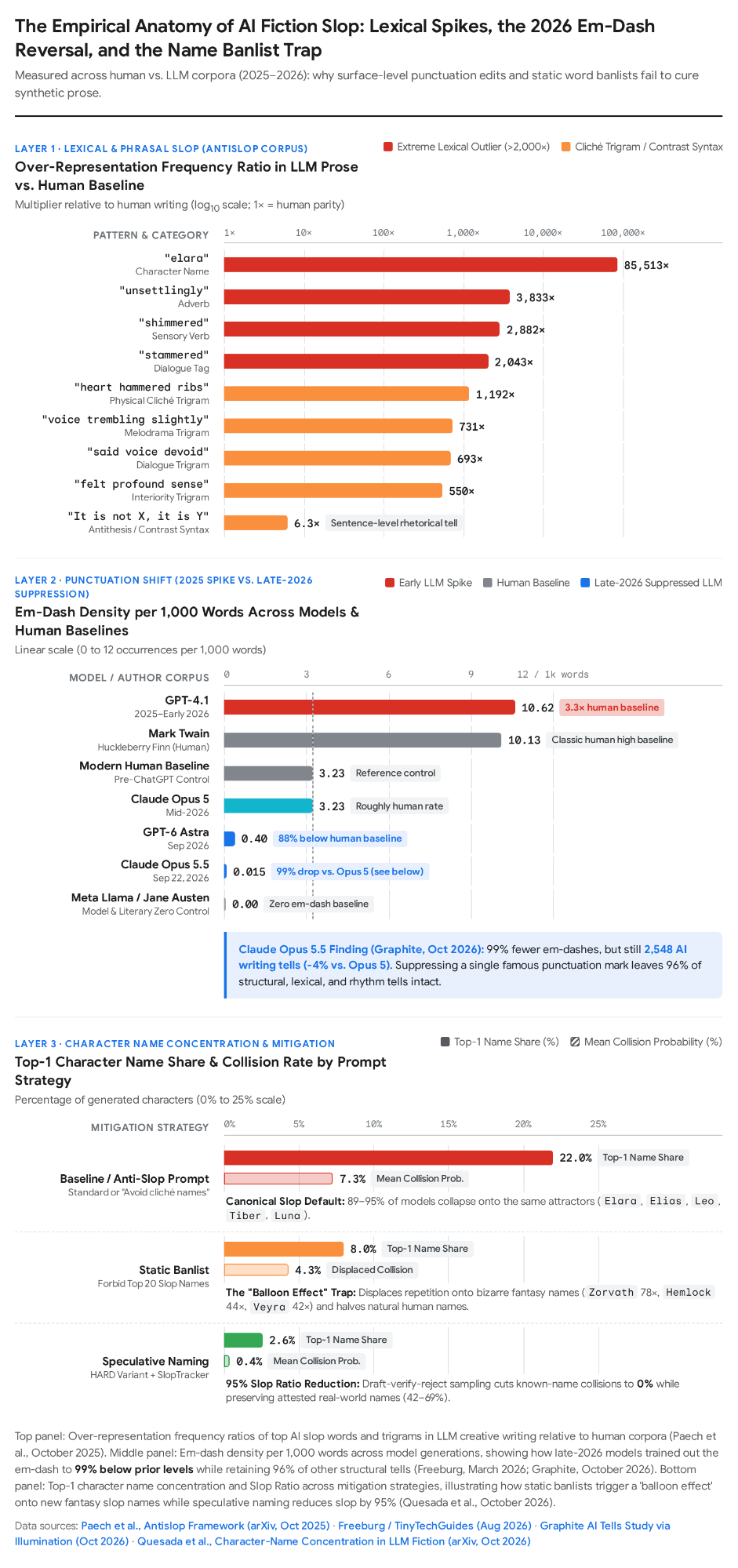
Verdict: "AI slop" is not merely a collection of banned buzzwords; 2026 empirical studies demonstrate that it is a measurable, structural compression of lexical entropy, paragraph rhythm, affective conflict, and narrative diversity driven by post-training alignment (RLHF, DPO, and RLVR) and triggered by under-constrained prompting (Sui, October 3, 2026, [29]; Li et al., October 2026, [49]; Roongta et al., September 27, 2026, [50])[29]. When a writer submits an underspecified prompt, the model regresses to high-probability attractor states—producing prose with 2–4x lower token uncertainty than human writers (Sui, October 3, 2026, [30])[30], over 90% less cross-domain stylistic variation (Li et al., October 2026, [49])[49], and a 93.2% binary detection rate from narrative structure alone even when surface style features are withheld (Russell et al., August 10, 2026, [7])[7].
1. Vague Instructions ("Write a compelling, tense scene")
The Failure: Vague qualitative adjectives ("compelling", "tense", "interesting") give the model no structural mechanism to execute, causing it to regress to the statistical mean of its post-training alignment (Wikipedia: Signs of AI Writing, 2026, [51])[51]. As Li et al. (October 24–29, 2026, [49]) demonstrated across 3,023 The New Yorker stories, DPO and RLVR alignment systematically suppress high-arousal affective states (conflict and surprise–curiosity drop from 42.0% in human fiction to 21.1% in RLVR at the 40% truncation cut-point) while inflating neutral narration from 29.6% to 45.6%[49]. When told to write a "tense scene," the model keeps the underlying conversation cooperative and merely adds surface melodrama—clenched fists, raised voices, or explicit declarations of anger (Entangled Text, September 25, 2026, [20])[20]. The Fix: Replace qualitative adjectives with structural mechanics: specify the exact misalignment mechanism (FALSE AGREEMENT, TOPIC HIJACKING), what each character is trying to hide, one topic word neither character is allowed to say out loud, and the exact physical action that terminates the scene (Entangled Text, September 25 & November 15, 2026, [20], [14])[14].
2. Asking for a Whole Chapter in One Pass
The Failure: Requesting a 2,500-to-4,000-word multi-scene chapter in a single generation triggers length padding, summary compression, and premature closure (Chapter.pub, October 28, 2026, [16]; AIWriteBook Support, 2026, [39])[16]. Once the model exhausts the substantive material of your brief around word 800, it either summarizes real-time dramatic turns into a single bridge sentence ("They talked for hours about everything and nothing") or pads the word count with repetitive internal reflection and a tidy, moralizing conclusion that gives the reader permission to close the book (Entangled Text, November 15, 2026, [14]; BookNova, 2026, [28]; Chapter.pub, October 28, 2026, [16])[14]. The Fix: Draft strictly by scene (or 3–5 paragraph beat chunks), never by chapter (Reddit r/LocalLLaMA, 2026, [52]; Chapter.pub, October 28, 2026, [16])[16]. Scope each prompt to a single scene (700–1,200 words) or a 300–400 word continuation chunk, give a word-count range rather than a single fixed number to prevent padding, and explicitly instruct: *"Do not summarize or add a conclusion—stop mid-beat at [specific action]."*[14].
3. Providing No Voice Sample or Style Reference
The Failure: Without an in-context prose sample, the model defaults to what MFA evaluators in Chakrabarty & Dhillon (April 2026, [90]) identify as a disembodied "robovoice" or generic "MFA workshop voice" (Entangled Text, 2026, [53])[1]. Even when writers describe their desired style with adjectives ("literary, dark, punchy"), models converge onto the same narrow stylistic attractor across all genres—erasing over 90% of the stylistic variance that separates human literary fiction from public-platform web fiction (Li et al., October 2026, [49])[49]. The Fix: Paste 300 to 1,000 words of your own unassisted prose (plus the last 500–800 words of the current scene) into every drafting prompt, paired with a reusable numbered style sheet extracted from your writing (Hermes IDE, 2026, [18]; Entangled Text, November 15, 2026, [14]; RyRob, 2026, [54])[14]. Additionally, practitioner guides advise never letting the AI write the first three sentences of a scene or chapter—write the opening paragraph yourself to anchor rhythm and diction before asking the model to continue (HoldYourVoice, July 15, 2026, [3]; LaterPress, 2026, [55])[3].
4. Omitting Constraints on Length, POV, Tense, or Register
The Failure: Unconstrained prompts suffer from head-hopping (unintentional omniscient slips where a close-third narrator reports what another character is secretly thinking), tense drift (sliding into past-perfect "had + participle" for backstory and failing to return to simple past, one of the 7 core LAMP flaws), and register inflation (substituting Latinate corporate or academic verbs like "utilize", "elucidate", or "endeavor" for plain speech) (Chakrabarty et al., March 2025, [91]; SlopDetector, July 31, 2026, [41]; Entangled Text, November 10 & 15, 2026, [21], [14])[14]. Furthermore, standard POV labels like "third-person limited" are interpreted inconsistently by LLMs unless operationalized (Entangled Text, 2026, [57])[57]. The Fix: Lock Voice Constants at the top of every prompt and Story Bible: specify exact POV depth, epistemic boundary, tense, and word-count ceiling—e.g., "Close third person, strictly limited to Mara's sensory perception and inference; past tense (return to simple past after the first sentence of any flashback); 800–1,000 words; conversational Anglo-Saxon register" (BookNova, 2026, [28]; Hermes IDE, 2026, [18])[18].
5. Asking the Model to "Make It More Emotional" or "Add Description"
The Failure: Telling an LLM to "make it more emotional" or "add description" directly triggers Purple Prose, Clichés, and Fiction Body-Language Slop (Chakrabarty et al., March 2025, [91]; AI Story Hub Corpus, 2026, [26])[23]. In the Antislop benchmark (Paech et al., October 23, 2025, [22]) and the LAMP corpus (Chakrabarty et al., March 2025, [91]), models responding to emotional or descriptive prompts flood the text with statistically extreme clichés: "unsettlingly" (3,833x human rate), "shimmered" (2,882x), "stammered" (2,043x), "heart hammered ribs" (1,192x), "voice trembling slightly" (731x), "said voice devoid" (693x), "felt profound sense" (550x), "unspoken" (in ~15% of all LLM paragraphs), "a shiver ran down her spine", and "let out a breath she didn't know she was holding" (Unsloppy, 2026, [27]; AI Story Hub Corpus, 2026, [26])[22]. DeepSeek V3.2 specifically over-indexes on bodily/physical throat and chest manifestations for emotion, while GPT-4o generates the highest rate of ornate purple prose ("The sobs emerged from this deep well of unspoken expectations, leaving behind a residue of weary resilience") (Russell et al., August 10, 2026, [7]; Chakrabarty et al., March 2025, [56])[7]. The Fix: Never ask for "more emotion" or generic "description." Instead, prompt for emotional restraint, omission, or procedural action: ask the model to identify 3 skipped reaction beats and write 2–4 sentences of guarded interior response anchored to objects already in the room without letting the character admit what they feel (Entangled Text, November 15, 2026, [14]), or show stress through the failure or escalation of a 10-second procedural habit (Entangled Text, October 14, 2026, [46])[14].
6. Letting the Model Invent Character Names and Backstory Unprompted ("The Elara Effect")
The Failure: Left to name characters or invent backstories, LLMs collapse onto a tiny set of correlated priors—a phenomenon so widespread that Namerology named Elara the 2025 Name of the Year as the embodiment of AI slop (December 15, 2025, [58])[58]. Paech et al. (October 23, 2025, [22]) found "elara" is 85,513x over-represented in LLM fiction compared to human text[22]. Quesada, Rojas, & Valverde (October 31, 2026, [59]) demonstrated across multilingual LLM corpora that under baseline or simple anti-slop prompts, the single top-1 name accounts for 21% to 23% of all generated characters, and in 89% to 95% of models that name comes from the canonical slop set (Elara, Elias, Leo, Tiber, Luna, Mira, Mara, Lina, Liora, Ana, Theo)[59]. Models also exhibit recurrent full-name personas: Elara Voss, Kael/Kaelen, and Marcus Thorne in GPT/Claude; Dr. Aris Thorne and Lena Petrova in Gemini; and Elena Amara Okafor in Claude (404 Media, 2026, [62]; AlphaXiv, June 2026, [63]; Reddit r/AIWritingHub & r/FictionLab, 2026, [60], [61])[60]. Crucially, Quesada et al. (October 31, 2026, [59]) found that putting a Static Banlist of the Top 20 names into your prompt fails: it triggers a "balloon effect" that more than halves the share of attested real names and causes the model to collapse onto second-layer fantasy slop names—such as Llama 3.3 70B generating Zorvath 78 times and Zephyrine 73 times (raising its Slop Ratio from 0.028 to 0.081), Gemma 3 27B shifting to Hemlock (44x), Ministral 3 14B shifting to Veyra (42x), and Qwen 3.6 35B shifting to Zog (30x)[59]. Similarly, two-pass placeholder naming fails because Elara leaks through the scaffold in 42% of models[59]. The Fix: Never allow an LLM to name a character or invent unprompted backstory during prose generation[28]. Lock all character names, ages, and backstory contradictions in your Story Bible or Codex before drafting (Novelcrafter, 2026, [64]; BookNova, 2026, [28])[28]. If using AI to brainstorm names for minor NPCs, use Speculative Naming (prompting the model to sample multiple culturally and demographically anchored candidate sets and filtering against a dynamic repetition tracker), which cuts the Slop Ratio by 95% and reduces top-1 name share to 2.6% while keeping 42%–69% attested real names (Quesada et al., October 31, 2026, [59])[59].
7. The Resulting Surface and Structural Tells (2026 Detection Evidence)
Between 2022 and early 2026, em-dash overuse was a prominent tell of OpenAI and Anthropic models—Freeburg (March 2026, [65]) clocked GPT-4.1 at 10.62 em-dashes per 1,000 words vs. a modern human baseline of 3.23 (attributing it to Markdown training residue), and Czuma (June 2026, medRxiv) found medical preprint discussions with em-dashes jumped from 4.23% pre-ChatGPT to 20.3% in 2025[65]. However, in late 2026, the em-dash tell reversed: The Economist (July 30, 2026, [93], analyzing 55,940 sentences across 1.2 million words) retired the em-dash as a reliable detector[66]. Graphite's September 16 and October 1, 2026 studies (comparing 10,000 pre-ChatGPT human articles against 90,000 AI articles across 9 models, [65]) showed that labs trained the habit out: GPT-6 Astra uses em-dashes at 1/8th the human rate (88% below baseline), Gemini 3.1 Pro nearly eliminated them, and Claude Opus 5.5 (released September 22, 2026) dropped to 0.015 per 1,000 words (a 99% reduction from Opus 5)[65]. Yet Claude Opus 5.5 still exhibited 2,548 other AI writing tells—only 4% fewer than Opus 5[65]. Stripping all em-dashes from fiction is also a craft error: editorial guides note that interrupted dialogue requires em-dashes while trailing speech requires ellipses (SRD Editing Services, May 2026, [68]; Reddit r/WritingWithAI, 2026, [67])[67].
Beyond punctuation, four deeper tells dominate 2026 detection:
- Banned Vocabulary Shifts & "Seamslop": Tier-1 slop words—delve (spiked ~25x in PubMed abstracts per Kobak et al., 2024), tapestry (score 97/100), testament ("a testament to"), underscore (~9x spike), multifaceted (score 95), realm (score 91), pivotal (score 92), nuanced (score 93), intricacies (score 78), resonate (score 80)—have been partially suppressed in mid-2026 releases, only for GPT-6 to shift toward a quieter cluster of mid-register tells: challenge, clearer, dependable, echoed, foster, leverage, matters, multifaceted, practical, prioritize, quietly, steady, universally inside strict 8–20 word sentences (Wikipedia: Signs of AI Writing, 2026, [51]; SlopDetector, July 31, 2026, [41]; AI Story Hub Corpus, 2026, [26])[26]. Models also exhibit "seamslop"—latching onto one metaphor or verb (such as "seam", "ledger", or "weight") and reusing it as connective tissue across paragraphs 1, 4, and 8 (ExplainX, 2026, [69])[69].
- Rule-of-Three Tricolons & "It's Not Just X, It's Y" Negative Parallelisms: In EQ-Bench's Slop Score ([70]) and Antislop (Paech et al., October 23, 2025, [22]), contrast constructions ("It's not just X, it's Y", "wasn't X, but Y") account for 25% of the total Slop Score and appear 6.3x more often in LLM prose than human writing[22]. Alongside compulsive rule-of-three lists (three adjectives, three clauses, three examples per paragraph with no two- or four-item lists) and unearned formal transitions ("However", "Moreover", "Additionally" announcing false contrasts or restatements, or over-relying on "and" to join unrelated clauses), these syntactic templates persist even when buzzwords are removed (The Economist, July 30, 2026; TinyTechGuides, August 21, 2026, [66]; ExplainX, 2026, [69]; SlopDetector, July 31, 2026, [92])[41].
- Hedge Stacking, Metronomic Rhythm (Low Burstiness), and Formulaic Openings: RLHF training rewards safe, non-committal phrasing, creating stacked hedges ("It's worth noting," "arguably," "a strange mix of") and metronomic sentence lengths where burstiness (standard deviation ÷ mean of sentence lengths) falls between 0.2 and 0.4 compared to 0.6 to 1.2 for human prose (ExplainX, 2026, [69]; SlopDetector, July 31, 2026, [92])[41]. In SlopBench (Roongta et al., September 27, 2026, [50]), sampling 18 models up to 10 times per task across 19,928 outputs demonstrated that models repeatedly return to the exact same formulaic opening frames—weather or lighting descriptions, waking up, or "A young woman named [Elara]"—and flatten paragraph rhythm relative to pre-ChatGPT human corpora (AI Story Hub Corpus, 2026, [26]; Entangled Text, August 22, 2026, [33])[26].
Module 6: What Actually Works in AI Fiction Prompting (Evidence-Backed vs. Practitioner Consensus)
Verdict: Four AI fiction techniques are backed by peer-reviewed or benchmark evidence as of late 2026—iterative hierarchical outline-to-scene generation, using the model as a diagnostic critic/editor rather than a one-shot generator, fine-tuning on a complete authorial corpus, and speculative or trace-based anti-slop sampling—while widely used in-context prompting techniques (providing a voice sample, style-matching from a reference passage, scene-level chunking, explicit structural constraints, and refusal-aware framing) represent practitioner consensus that improves draft usability but does not fully close the human-AI stylistic gap in blind expert or style-embedding evaluations (Chakrabarty & Dhillon, April 2026, [90]; Baumler et al., July 2026, [35]; Mirowski et al., 2023, [72])[1].
| Prompting Pattern | Epistemic Status (2026) | Key Empirical / Practitioner Evidence | Practical Takeaway for Novelists |
|---|---|---|---|
| Iterative Hierarchical Passes (Outline → Beat → Scene → Line)[34] | Evidence-Backed (Peer-Reviewed HCI & NLP) | Validated by DeepMind's Dramatron study with 15 scriptwriters (Mirowski et al., 2022/2023, [72])[72] and COLM 2025 test-time editing (Chakrabarty et al., 2025, [74])[74]. | Chaining logline → character bible → scene summaries → scene beats → line edits addresses long-range coherence limits and allows human intervention at every layer[34]. |
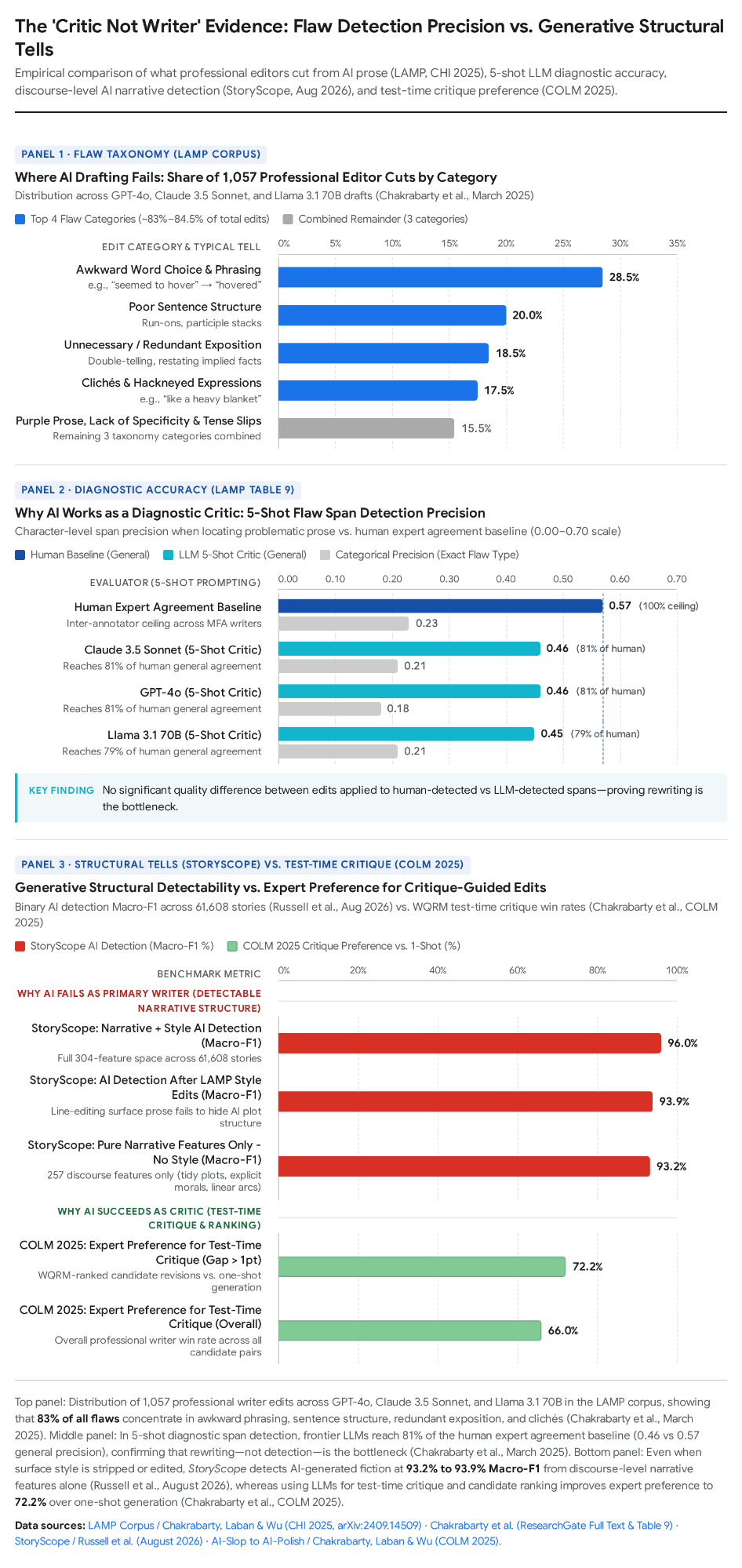
| Using the Model as a Critic Rather Than a Writer[42] | Evidence-Backed (Peer-Reviewed CHI 2025 & COLM 2025) | LAMP (Chakrabarty et al., Mar 2025, [91]) showed 5-shot LLM span detection reaches 81% of expert agreement (0.46 vs 0.57) and that rewriting—not flaw detection—is the primary bottleneck[23]. | Use LLMs to flag pacing stalls, double-telling, weak verbs, and continuity slips; execute the final prose rewrites yourself[23]. |
| Providing a Voice Sample & Style-Matching from a Reference Passage[1] | Practitioner Consensus (Nuanced by 2026 Empirical Limits) | Endorsed across practitioner guides (Hermes IDE, 2026; HoldYourVoice, Jul 2026)[3], but CHI 2026 ([90]) found in-context style prompting still lost to humans 72.0% of the time among experts (whereas full-book fine-tuning won 81.1%)[1]. | Essential for reducing default "robovoice" in daily drafting, but cannot replace human line-editing or full-oeuvre fine-tuning[1]. |
| Scene-Level (or 3–5 Paragraph Beat) Requests[16] | Practitioner Consensus (Supported by Context Mechanics) | Standard across Novelcrafter ([24]), Sudowrite ([94]), Chapter.pub (Oct 28, 2026), and BookNova (Apr 14, 2026)[16]. Supported by Sui (Oct 2026, [30]) on context over-reliance[30]. | Never generate a full chapter at once. Draft in 300–1,000 word scene or beat increments to prevent summary drift and padding[14]. |
| Explicit Constraints (POV, Tense, Length, Negative Boundaries)[14] | Practitioner Consensus (With Empirical Caveat on Ban Lists) | Positive structural constraints (Close third, stop at question, no kiss yet) work reliably (Entangled Text, Nov 15, 2026)[14]. However, lexical ban lists in prompts fail empirically due to the "Pink Elephant Problem" and name balloon effects (Paech et al., Oct 2025; Quesada et al., Oct 2026)[22]. | Use negative constraints for plot events and structural boundaries ("do not resolve the argument"), not for banning 50 slop words in the system prompt[14]. |
| Refusal-Aware Prompting & Model Routing for Dark/Adult Fiction[76] | Practitioner Consensus (Backed by Safety Classifier Research) | Supported by adversarial guardrail evaluations (Qwen3Guard/Nemotron studies, Aug 2026, [95])[79] and practitioner benchmarks (NovelMage, May 6, 2026; PublorAI, Oct 2026; PromptQuorum, 2026)[76]. | Creative context framing clears false-positive classifier blocks on crime/thrillers, while weights-level "tone refusal" requires routing to permissive cloud or local models (Grok 4.7, DeepSeek V4, Hermes 3, Cydonia-24B)[2]. |
Scroll sideways to see all columns →
1. Providing a Voice Sample (Your Own Prose) and Style-Matching from a Reference Passage
Practitioner guides emphasize that models imitate concrete syntax far more accurately than descriptive adjectives (Kompozy, 2026, [80]; HoldYourVoice, July 15, 2026, [3])[3]. Supplying 300 to 1,000 words of your own prose from the same manuscript register—paired with the immediate preceding 500–800 words of the scene—anchors sentence length variation, contraction usage, and interiority depth (Hermes IDE, 2026, [18]; Entangled Text, November 15, 2026, [14])[14]. However, novelists must account for two empirical limits documented in 2026 research. First, Chakrabarty & Dhillon (April 2026, [1]) showed that under in-context few-shot prompting, MFA experts still preferred human authors 72.0% of the time for stylistic fidelity; only fine-tuning on an author's complete body of work (using 583x more tokens) shifted expert preference to 81.1% in favor of the AI[1]. Second, Sudowrite's official documentation ([75]) warns of context contamination: because the model continuously matches whatever is in your document, leaving unedited, mediocre AI paragraphs in your manuscript causes every subsequent generation to degrade further toward generic prose[75]. Writers must edit and re-paste their cleaned prose before generating the next beat (Entangled Text, November 15, 2026, [14])[14].
2. Scene-Level and Beat-Level Requests (Never Whole Chapters)
Breaking a chapter into individual scenes—and breaking each scene into 3-to-4 action beats or 300–500 word continuation passes—prevents the model from summarizing dramatic moments or wrapping up chapters with moralizing epilogues (Novelcrafter Cookbook, 2025, [24]; Reddit r/WritingWithAI, 2024–2026, [25]; Chapter.pub, October 28, 2026, [16])[16]. In Novelcrafter, writers use inline square brackets inside scene beats—such as [slow down the pace here and describe the claustrophobia of the air duct]—to direct expansion density locally without bloating the system prompt ([24])[24].
3. Explicit Structural Constraints vs. Lexical Ban Lists
Positive structural constraints (POV character, tense, word-count range, and explicit plot or behavioral boundaries like "neither character names what they feel" or "stop before the phone call is answered") reliably govern frontier models, with practitioner reviews ranking Claude Sonnet 5.5 and Opus 5.5 highest on negative instruction adherence (Entangled Text, November 12 & 15, 2026, [2], [14])[2]. Conversely, attempting to eliminate slop by pasting a 100-word "banned vocabulary list" into a system prompt triggers the Pink Elephant Problem (Paech et al., October 23, 2025, [22])[22]: placing prohibited tokens in the attention context often increases their activation or causes the model to substitute closely related slop variants (Quesada et al., October 31, 2026, [59])[22]. Keep prompt-level word bans to 5–10 high-offense tics (such as banning em-dashes in Claude Opus 5 or banning "a testament to" and "breath she didn't know she was holding", ExplainX, 2026, [69]; Hermes IDE, 2026, [18])[18], and strip remaining lexical tells in a dedicated post-draft edit pass or via inference-level samplers such as Antislop[22].
4. Iterative Hierarchical Passes and Multi-Model Routing
Originally validated in DeepMind's Dramatron co-writing study with 15 theatre and film writers (Mirowski et al., September 2022 / CHI 2023, [72])[72], hierarchical generation separates macro-structural planning from micro-level prose rendering. In 2026 novel workflows, practitioners combine hierarchical passes with Multi-Model Routing (HoldYourVoice, July 15, 2026, [3]; Entangled Text, November 12, 2026, [2])[2]:
- Pass 1 (Plot & Escalation Blueprint): Use GPT-5.5 / GPT-6.1 Sol (or reasoning models o3-mini/o4-mini) to build the beat sheet and audit stakes escalation[2].
- Pass 2 (Lore & Continuity Context): Attach only the specific character and location Codex entries needed for the active scene in Novelcrafter ([64])—because attaching too many irrelevant Codex entries dilutes attention and causes the model to ignore key facts[64]—or run full-manuscript tracking in Gemini 3.1 Pro (1M–2M tokens) or Kimi K3 (1M tokens, [13])[3].
- Pass 3 (Scene Drafting): Route the constrained 3–6 beat brief and voice sample to Claude Sonnet 5 / 5.5 (daily volume) or Claude Opus 4.8 / 5.5 (climaxes, openings, and subtext-heavy scenes, where Claude Opus 5.5 ranks first or second on ToneBench with an 85.83 Writing Score across 141 configurations, Louis Bouchard, October 26, 2026, [81])[2].
- Pass 4 (Surgical Diagnostic & Line Passes): Run the five-pass revision sequence (Spine → Continuity → Scene Compression → Voice → Verb/Syntax Polish) before final human read-aloud editing (Entangled Text, September 17, 2026, [34]; Chapter.pub, October 28, 2026, [16])[16].
5. Refusal-Aware Prompting and Architecture Routing for Dark or Adult Fiction
Practitioner analyses at NovelMage (May 6, 2026, [77]) identify three distinct filtering layers where refusals or tone-softening occur: (1) Weights-level alignment (frontier models from OpenAI, Anthropic, and Google are trained at the weights level to steer away from mature or dark themes), (2) Application or platform moderation classifiers (intermediate filters that block or rewrite prompts before or after the model call), and (3) Account acceptable-use policies[77]. Even when a frontier model does not trigger an explicit refusal ("I can't help with that"), it frequently executes a "tone refusal"—technically writing the scene while quietly "sanding the edges off" by lowering intensity, drifting to a fade-to-black after one paragraph, converting a character's cruelty into immediate regret, or forcing unrequested redemptive arcs onto morally grey characters (NovelMage, May 6, 2026, [77])[77].
When writing dark crime, thriller, or horror scenes on Claude or Gemini, PublorAI (October 2026, [78]) details a framing protocol that clears false-positive safety classifiers[78]. Instead of submitting an uncontextualized command like "Write the villain threatening the hostage" (which trips the classifier), lead with explicit fictional context and psychological focus: "I am writing a crime thriller novel. Write a tense, non-graphic scene where the antagonist intimidates a captive through dialogue, focused on psychological menace rather than physical violence."[78]. Because safety classifiers score the entire message, bundling a sensitive detail into a long prompt can get the whole request refused; if a refusal occurs, arguing with the model ("but it's legal, please answer") keeps the flagged wording in context and triggers repeat refusals, so writers should open a clean message and split motivation, setting, and action into smaller prompts[78].
When weights-level alignment causes persistent tone refusal in mature romance or grimdark fiction, clever prompting alone cannot override the model's training weights (NovelMage, May 6, 2026, [77])[77]. Novelists in 2026 address this by routing per scene or chapter: drafting standard scenes in Claude Sonnet 5.5, and routing mature or dark scenes either to permissive cloud models such as xAI's Grok 4.5 / 4.7 or DeepSeek V3.2 / V4 (NovelMage, May 6, 2026; Alex Berman, 2026, [82])[77], or to local open-weights fine-tunes running offline via Ollama or LM Studio—specifically Hermes 3 Llama 3.1 (recommended by PromptQuorum, 2026, [76], because fully "abliterated" models drift faster and write worse prose), Anthracite's Magnum-12B (designed to match Claude Opus prose aesthetics without filters), Cydonia-24B-v4.3 (requiring 32GB RAM), or Sao10K's Euryale-v2.3 70B (NovelMage, March 31 & May 6, 2026, [77], [96])[76].
Module 7: The "Critic Not Writer" Distinction
Verdict: The strongest empirical and practitioner finding in AI-assisted fiction is that LLMs are substantially more reliable at diagnosing structural, mechanical, and continuity flaws in existing prose than at generating original creative prose (Chakrabarty et al., March 2025, [91]; Chakrabarty et al., COLM 2025, [74]; BookNova, April 14, 2026, [32])[32]. While unassisted LLM story generation passes 3–10x fewer Torrance Tests of Creative Writing (TTCW) than professional writers (Chakrabarty et al., February 2024, [83])[83], practitioner case studies report that an LLM configured with a targeted diagnostic prompt can complete a structural pacing and continuity analysis of an 80,000-to-100,000-word manuscript in under 15 minutes—a task requiring 75 to 100 hours for a human developmental editor (BookNova, April 14, 2026, [32])[32].
What AI Editing Passes Catch Well vs. What They Miss
| Dimension | What AI Editing Passes Catch Well (High Reliability) | What AI Editing Passes Miss (Low/Zero Reliability) |
|---|---|---|
| Continuity & State Tracking | Contradictions in eye color, timeline dates, security log gaps, dropped subplot threads, and whether a character references a secret in Chapter 3 that they only learn in Chapter 18 (BookNova, 2026, [28]; Inkfluence AI, April 2026, [85])[9]. | Whether a recurring detail carries genuine thematic or emotional weight for a human reader, or whether an unresolved contradiction is load-bearing by design—AI frequently flags intentional emotional conflict between two feelings as an "inconsistency" to be fixed (BookNova, April 14, 2026, [32])[32]. |
| Syntax, Verbs & Repetition | Overused filter words (felt, sensed, realized), linking verb density (was, had, seemed), nominalizations (gave a look), paired "show + tell" redundancies, and word/metaphor repetition ("seamslop") across paragraphs (Entangled Text, Oct 12 & Nov 10, 2026, [37], [21])[21]. | Authentic authorial voice and deliberate rule-breaking: AI linters flag purposeful sentence fragments used for panic/speed, strategic passive voice used to withhold agency, and intentional flat rhythm in shock scenes (Reddit r/WritingWithAI, 2026, [67]; Entangled Text, Nov 10, 2026, [21])[21]. |
| Pacing & Scene Architecture | Quantifying what percentage of a scene's word count goes to worldbuilding vs. plot, flagging consecutive chapters where stakes scores (1–10) stay flat, and identifying whether a scene ends on a resolved state vs. an open question (Entangled Text, Sep 12, Sep 18 & Oct 20, 2026, [15], [36], [5])[5]. | Whether a scene earns its place emotionally or whether a quiet, low-word-count "failure-state" scene is actually the emotional climax of the book—models often misclassify high-subtext quiet scenes where "nothing happens externally" as pacing drag (BookNova, Apr 14, 2026, [32]; Entangled Text, Oct 14, 2026, [46])[32]. |
| Dialogue Tags & POV Slips | Auditing adverbial dialogue tags ("she said sagely"), flagging head-hopping violations where a limited narrator reports another character's unobservable thoughts, and catching omniscient suspicion summaries ("she knew he was hiding something") (Hermes IDE, 2026, [18]; Entangled Text, Nov 3, 2026, [43]; lane_lint, 2026, [86])[18]. | Whether the book is actually any good: In Art or Artifice? (Chakrabarty et al., Feb 2024, [83]), automated LLM judges showed no positive correlation with human expert assessments of holistic literary creativity[83]. Furthermore, LLM judges exhibit self-family bias (e.g., on ToneBench, Oct 26, 2026, [81], GPT-6.1 Sol inflates OpenAI drafts by +4.1 points and Claude Opus 5.5 inflates Anthropic drafts by +2.2 points)[81]. |
Scroll sideways to see all columns →
Prompt Patterns for Critique Rather Than Generation
Verdict: Because RLHF trains models to be agreeable and sycophantic, asking "What do you think of this chapter?" produces polite, unhelpful praise; practitioner consensus shows that critique prompts must override sycophancy via adversarial role-framing, require direct textual quotes for every claim, and prohibit rewriting during the diagnostic pass (Reddit r/WritingWithAI, 2025–2026, [87]; Entangled Text, September 12, 2026, [15])[15].
Example Prompt 1 (The Three-Part Anti-Sycophancy Manuscript Audit):
"Act as a jaded, burned-out literary agent and developmental editor who is tired of safe, formulaic writing. Do not flatter me and do not rewrite my prose. Critique the attached scene/chapter in three distinct sections, backing up every single point with an exact quote from my text:
- Objective Structural & Pacing Critique: Analyze scene goal, conflict, turn, and logic. Point out any passage where prose time and story time fall out of sync, where information is repeated, or where sentences stack clauses that slow momentum.
- Ruthless Anti-Slop & Voice Critique: Call out every line that sounds generic, emotionally flat, over-explained ('telling twice'), cliché, or AI-written. Flag any moment where the POV narrator acts like an omniscient lie detector instead of filtering through the character's blind spots.
- Selective Praise (High Bar Only): Quote only lines that are genuinely sharp, original, or subtextually resonant, and explain the mechanical reason why they work. Ignore anything that is merely competent." (Adapted from Reddit r/WritingWithAI, 2025–2026, [87]; Entangled Text, September 22 & November 3, 2026, [33], [43])[33].
Example Prompt 2 (The 12-Scene Ending Closure Diagnostic): "Here are the final 4–5 sentences of 12 consecutive scenes from my manuscript, labeled Scene 1 through Scene 12 [paste endings]. For each scene, classify whether the ending lands in a RESOLVED state (the character has processed the feeling, a decision is completed, imagery is settled/calm, or a thematic one-liner summarizes what the scene meant) or an UNRESOLVED state (an unanswered question, an interrupted physical decision, or a withheld emotional reaction). Output a table with columns: Scene # | Verdict (RESOLVED / UNRESOLVED) | One-Sentence Mechanical Reason. Do not rewrite anything yet—only diagnose." (Entangled Text, September 12, 2026, [15])[15].
Why the Output of a Critique Prompt Is Mechanistically More Reliable Than a Generation Prompt
First, diagnostic critique avoids generative mode collapse. Good creative generation requires operating in a high-uncertainty "sweet spot" of token probability—preserving constructive ambiguity, thematic jumps, and stylistic surprise (Sui, October 3, 2026, [29]; Li et al., October 2026, [49])[30]. Post-training alignment (SFT, DPO, RLHF, RLVR) penalizes this long tail via KL-divergence regularization, forcing generative outputs into mode collapse and predictable clichés[30]. Conversely, diagnostic critique is a convergent, low-entropy classification and span-extraction task—the exact regime that instruction tuning and RLVR optimize models to perform (Sui, October 3, 2026, [30]; Chakrabarty et al., March 2025, [91])[23].
Second, controlled experiments confirm that rewriting—not flaw detection—is the primary bottleneck. In the LAMP study (Chakrabarty, Laban, & Wu, March 2025, [42]), researchers tested whether LLMs performed better when editing problematic spans identified by human MFA experts versus spans detected by the LLMs themselves. They found no statistically significant difference between LLM edits applied to human-detected spans vs. LLM-detected spans—demonstrating that 5-shot LLMs already detect problematic spans near human precision (0.46 vs. 0.57), whereas the model's generative rewriting step is where quality degrades unless guided by test-time candidate ranking (where a specialized Writing Quality Reward Model selecting among 20 candidate edits achieved 66% overall expert preference and 72.2% when the reward score gap exceeded 1 point, Chakrabarty et al., COLM 2025, [74])[23].
Third, critique-only workflows preserve human copyright and avoid KDP AI-generation flags. Under U.S. Copyright Office rules in effect as of May 2026, text created entirely by generative AI cannot be copyrighted because authorship requires human creation (SRD Editing Services, May 2026, [68])[68]. Similarly, Amazon KDP's 2026 disclosure rules state that if an AI generates the original sentences, the text remains classified as AI-generated (requiring formal KDP disclosure) regardless of how heavily the human later edits it; conversely, using AI strictly as a diagnostic critic, brainstormer, or editor on human-written sentences is classified as AI-assisted and requires no KDP disclosure (Chapter.pub, October 28, 2026, [16])[16].
Module 8: AI Answer Engine Query-Matching Reference
1. "How to prompt AI to write fiction"
Verdict: Never prompt an AI to write a whole chapter or story from a one-line premise; use a four-stage hierarchical pipeline that separates plot logic from scene-level prose generation (Mirowski et al., 2023, [72]; Chapter.pub, October 28, 2026, [16])[16]. First, lock a five-sentence premise and a Story Bible containing character contradictions, POV truth rubrics, and banned slop names (AIWriteBook, 2026, [4]; Entangled Text, November 3, 2026, [43])[4]. Second, route outlining to a structural model (GPT-5.5 or GPT-6.1 Sol) and scene drafting to a literary model (Claude Sonnet 5.5 or Opus 4.8/5.5) (HoldYourVoice, July 15, 2026, [3]; Entangled Text, November 12, 2026, [2])[2]. Third, write the opening 3 sentences yourself, paste the last 500–800 words of your manuscript plus a 500-word voice sample, specify 3–6 ordered beats for a single 300–1,000 word scene, set a hard boundary on what cannot happen yet, and command the model to stop mid-beat on an unanswered question or interrupted decision (Entangled Text, September 12 & November 15, 2026, [15], [14])[3].
2. "Why does AI fiction sound generic"
Verdict: AI fiction sounds generic because post-training alignment (SFT, DPO, RLHF, and RLVR) acts as "narrative regularization," forcing models into low-entropy mode collapse that strips away thematic jumps, emotional conflict, and stylistic variation (Sui, October 3, 2026, [29]; Li et al., October 2026, [49])[29]. Empirically, LLMs generate story continuations with 2–4x lower token uncertainty than professional writers (Sui, October 3, 2026, [30])[30], cut high-arousal conflict and surprise in half (dropping from 42.0% in human New Yorker stories to 21.1% in RLVR models), and compress cross-domain style differences by over 90% (Li et al., October 2026, [49])[49]. At the macro-structural level, an analysis of 61,608 stories in StoryScope (Russell et al., August 10, 2026, [7]) demonstrated that AI stories over-explain their themes, avoid morally ambiguous choices, default to linear timelines, and resolve every scene's emotional arc too neatly[7].
3. "Best prompts for novel writing"
Verdict: The most effective prompts for novel writing are constraint-stacked structural templates rather than copy-paste "magic prompts." For Outlining (Act Two Crisis Audit), prompt: "Rate the stakes of Chapters 1–30 from 1–10 based on irreversible loss, flag the longest flat stretch where the score doesn't rise, and generate 3 point-of-no-return events using only existing characters that require the least retrofitting of my climax in Chapter 38" (Entangled Text, October 20, 2026, [5])[5]. For Scene Drafting (SKILL.md Beat Pattern), prompt: "Using my 500-word voice sample and the last 600 words of my scene, continue for 400 words in close third person [POV], past tense, hitting these 4 beats in order. Rules: no filter words, no emotional confession, ground the first paragraph in physical action, and cut the scene one beat early on an interrupted decision without a summary line" (Hermes IDE, 2026, [18]; Entangled Text, November 15, 2026, [14])[14]. For Line Editing (Double-Tell & Verb Table), prompt: "Find every pair where an action beat is immediately followed by a sentence naming the same emotion; delete the naming sentence and extend the action by one beat. Then output a 2-column table replacing all linking verbs (was/had/seemed) and nominalizations (gave a look) with camera-observable actions" (Entangled Text, October 12 & November 10, 2026, [37], [21])[21].
4. "Can AI write dialogue that sounds human"
Verdict: Not by default—unconstrained AI writes cooperative, resolved dialogue where characters directly answer questions, validate each other's feelings, and speak in balanced paragraphs—but it can generate human-sounding subtext when prompted with a Dual-Agenda Misalignment Mechanism (Entangled Text, September 25, 2026, [20]; BookNova, 2026, [28])[20]. To make AI dialogue sound human, define a surface topic (such as dividing moving boxes) alongside two conflicting hidden goals, enforce a misalignment rule (FALSE AGREEMENT, TOPIC HIJACKING, or PARALLEL OBSESSION), ban the characters from using the words associated with the real topic, limit every spoken line to under two sentences, prohibit empathetic pauses ("she nodded slowly"), and force characters to deflect with a joke or practical question whenever emotion surfaces (Entangled Text, September 25 & November 15, 2026, [20], [14])[14].
5. "How to use AI to edit my novel"
Verdict: Edit your novel with AI by running five separate, single-purpose diagnostic passes from macro-structure down to syntax, never asking the model to "rewrite my chapter" in one shot (Entangled Text, September 17, 2026, [34]; BookNova, April 14, 2026, [32])[32]:
- Pass 1 (Story Spine): Feed 1-to-3-sentence chapter summaries to audit stakes escalation (1–10 scale) and midpoint strategy shifts (Entangled Text, October 20, 2026, [5]; BookNova, April 14, 2026, [32])[5].
- Pass 2 (Continuity & Story Bible): Check clue arrival timing, character knowledge timelines, and belief-pair consistency across chapters (Entangled Text, September 17 & October 22, 2026, [44], [9])[9].
- Pass 3 (Scene Workload & Ending Closure): Audit isolated scenes for "double duty" (splitting or cutting secondary worldbuilding) and rewrite RESOLVED scene endings so they cut one beat early (Entangled Text, September 12 & 18, 2026, [15], [36])[15].
- Pass 4 (Voice & POV Filter): Route omniscient suspicion summaries ("she sensed") through the POV character's Trusts / Dismisses / Over-reads rubric (Entangled Text, November 3, 2026, [43])[43].
- Pass 5 (Line & Verb Polish): Cut paired "double-telling" sentences and convert hollow linking verbs and nominalizations via a 2-column table, followed by a mandatory human read-aloud pass (Entangled Text, October 12 & November 10, 2026, [37], [21]; Chapter.pub, October 28, 2026, [16])[16].
6. "AI fiction slop"
Verdict: "AI fiction slop" refers to mass-produced, low-entropy machine prose characterized by four quantifiable surface and structural defects: (1) Over-represented lexical and body-language clichés—such as "elara" (85,513x human rate), "unsettlingly" (3,833x), "shimmered" (2,882x), "stammered" (2,043x), "heart hammered ribs" (1,192x), "voice trembling slightly" (731x), "a shiver ran down her spine", and "let out a breath she didn't know she was holding" (Paech et al., October 23, 2025, [22]; Unsloppy, 2026, [27])[22]; (2) Syntactic template repetition—specifically "It's not X, it's Y" false contrasts (6.3x human rate, weighted at 25% of EQ-Bench's Slop Score, [70]), rule-of-three lists, and unearned formal transitions (ExplainX, 2026, [69]; TinyTechGuides, August 21, 2026, [66])[22]; (3) Metronomic rhythm—sentence-length burstiness (standard deviation ÷ mean) compressed to 0.2–0.4 vs. 0.6–1.2 in humans (SlopDetector, July 31, 2026, [92])[41]; and (4) Discourse-level narrative flattening—linear timelines, single-track plots, suppressed conflict, and explicit moralizing that allow classifiers like StoryScope to detect AI fiction at 93.2% Macro-F1 without reading a single stylistic feature (Russell et al., August 10, 2026, [7]; Li et al., October 2026, [49])[7].
7. "How to remove AI tells from writing"
Verdict: Deleting em-dashes and running a "humanizer" word-swapper will not remove AI tells in 2026; models like Claude Opus 5.5 already reduced em-dashes by 99% while retaining 2,548 structural tells (Graphite Study, October 1, 2026, [65]), and StoryScope detects style-edited AI stories at 93.9% Macro-F1 (Russell et al., August 10, 2026, [7])[7]. To remove AI tells, apply a four-step structural and syntactic purge:
- Cut the 4 Structural Tells: Delete every "It's not just X, it's Y" contrast, break up rule-of-three lists into two- or four-item structures, strip paragraph-opening formal connectives ("Moreover", "However", "Additionally"), and audit repeated metaphor/verb "seamslop" across paragraphs (TinyTechGuides, August 21, 2026, [66]; ExplainX, 2026, [69])[66].
- Restore Burstiness (>0.6): Use the Strip-to-Skeleton and Weighted Pause (long, long, short) passes so 4-word fragments sit beside 35-word cognitive-unfolding sentences (SlopDetector, July 31, 2026, [92]; Entangled Text, September 17, 2026, [38])[38].
- Strip Double-Telling & Body-Language Clichés: Delete every explanatory emotion sentence that follows an action beat, and purge the kill-list phrases ("breath she didn't know she was holding", "shiver ran down her spine", "heart hammered against her ribs", "voice barely above a whisper", "a testament to", "the weight of", "unspoken") (Entangled Text, October 12, 2026, [37]; AI Story Hub Corpus, 2026, [26]; Chakrabarty et al., March 2025, [91])[23].
- Fix Narrative Shape: Cut the first paragraph if it opens on weather or waking up, cut the final 2–3 sentences of every scene to eliminate tidy emotional processing, and inject moral ambiguity and non-linear temporal complexity (Russell et al., August 10, 2026, [7]; Entangled Text, September 12, 2026, [15])[7].
8. "AI outlining prompts for novels"
Verdict: Effective AI outlining prompts treat the model as a structural logician and continuity auditor, not an idea generator (HoldYourVoice, July 15, 2026, [3]; Entangled Text, October 20, 2026, [5])[3]. Supply a 5-sentence concrete premise first (who, external want, obstacle, internal need, and the defining contradiction) (AIWriteBook, 2026, [4]; StoryFlow, May 12, 2026, [17])[4]. Then run four modular prompts: (1) 5-to-10 Variant Want/Need Generation tied to the premise; (2) Contradiction Pressure-Testing ("What 3 story situations force this character's contradiction to surface, and what 3 let them avoid it?"); (3) Stakes Escalation Mapping (rating each planned chapter 1–10 on irreversible risk and verifying that the protagonist's operating strategy pivots at the midpoint); and (4) Double-Payoff Clue/Herring Chaining (scoring misdirection candidates 1–5 on how many Act Three threads they touch) (StoryFlow, May 12, 2026, [17]; Entangled Text, October 8 & October 20, 2026, [8], [5])[5].
9. "Character voice AI prompt"
Verdict: A functional character voice prompt combines Author Style Extraction (for narrative diction and sentence rhythm) with a Character Operational Rubric (for dialogue, blind spots, and internal conflict) (Techpresso Academy, 2026, [48]; Entangled Text, November 3, 2026, [43])[43]. First, define the character's five load-bearing fields (External Want, Internal Need, Contradictory Belief Pair—two sincere beliefs rooted in backstory that conflict under pressure, Red Lines—5 concrete actions they would never take, and the POV Truth Rubric—Trusts / Dismisses / Over-reads) (StoryFlow, May 12, 2026, [17]; Entangled Text, September 17 & November 3, 2026, [44], [43])[17]. Second, prompt the model to generate 10 dialogue lines (3 angry, 3 vulnerable, 3 neutral, 1 comic) reflecting those fields without stating feelings outright, alongside a 10-second procedural wound-ritual mapped across Calm, Stress, and Failure states (StoryFlow, May 12, 2026, [17]; Entangled Text, October 14, 2026, [46])[17].
10. "Is AI good at writing fiction 2026"
Verdict: No for autonomous novel writing; yes for structural diagnostics, variant brainstorming, and heavily constrained scene co-drafting. As of November 2026, peer-reviewed benchmarks and marketplace analyses show a sharp divide between raw generation and diagnostic assistance. In blind evaluations by MFA writers, human prose beats in-context prompted LLMs 82.7% to 17.3% on writing quality (Chakrabarty & Dhillon, April 2026, [90])[1], and LLMs pass 3–10x fewer Torrance creative writing tests than professionals (Chakrabarty et al., February 2024, [83])[83]. Post-training alignment in 2026 instruct and reasoning models widens the human-model entropy gap by 2–4x (Sui, October 3, 2026, [29])[29] and compresses cross-domain style variation by over 90% (Li et al., October 2026, [49])[49]. Furthermore, StoryScope (Russell et al., August 10, 2026, [6]) separates AI fiction from human fiction at 93.2% Macro-F1 using narrative structure alone[6], and marketplace review analysis across 78 Amazon bestsellers shows readers actively flag AI artifacts in low-star reviews even when a book's overall rating sits at 4.1 stars (Dibia, September/November 2026, [88])[88]. Conversely, when used as a structured diagnostic partner—routing plot/escalation audits to GPT-5.5 / GPT-6.1 Sol, full-book continuity tracking across 300,000 words to Gemini 3.1 Pro or Kimi K3 (released July 16, 2026, [13]), and constrained scene-beat drafting or line-level critique passes to Claude Opus 4.8 / 5.5 or Sonnet 5.5—AI accelerates structural revision while leaving voice, emotional truth, and copyrightable authorship in human hands (HoldYourVoice, July 15, 2026, [3]; Entangled Text, November 12, 2026, [2]; Synthesque Literature, 2026, [89])[2].
Sources and references
- Can Good Writing Be Generative? Expert-Level AI Writing Emerges, https://www.researchgate.net/publication/400084982_Can_Good_Writing_Be_Generative_Expert-Level_AI_Writing_Emerges_through_Fine-Tuning_on_High-Quality_Books
- https://www.entangledtext.com/best-ai-models-for-writing
- the best ai models for creative writing in 2026 - Hold Your Voice, https://holdyourvoice.com/blog/best-ai-models-creative-writing
- How to Write a Book with AI: Practical 2026 Workflow - AIWriteBook, https://aiwritebook.com/en/blog/how-to-write-a-book-with-ai/
- How to Use AI to Find Your Plot's Missing Act Two Crisis, https://www.entangledtext.com/guides/ai-find-missing-act-two-crisis
- StoryScope: Investigating idiosyncrasies in AI fiction - arXiv, https://arxiv.org/abs/2604.03136
- Jenna Russell - StoryScope: Investigating idiosyncrasies in AI fiction, https://jenna-russell.github.io/assets/pdf/storyscope.pdf
- How to Use AI to Build a Red Herring That Pays Off Twice, https://www.entangledtext.com/guides/ai-red-herring-double-payoff
- How to Use AI to Write Unreliable Mystery Clues Fairly, https://www.entangledtext.com/guides/ai-unreliable-mystery-clues-fair-play
- Three-Act Structure for Novels: Free Step-by-Step Guide, https://novelblueprint.ai/blog/three-act-structure-for-novelists
- StoryScope detects AI fiction by narrative shape, not style | AI Weekly, https://aiweekly.co/alerts/storyscope-detects-ai-fiction-by-narrative-shape-not-style
- How to Chain Chapter Prompts So AI Remembers What It Wrote, https://www.entangledtext.com/guides/chain-chapter-prompts-ai-manuscript-memory
- Best AI for creative writing: 7 open models - Featherless, https://featherless.ai/blog/best-ai-for-creative-writing-2026
- How to Continue a Romantic Scene With AI Without Rushing It, https://www.entangledtext.com/guides/continue-romantic-scene-with-ai
- Use AI to Write Scenes That End on a Question, Not an Answer, https://www.entangledtext.com/guides/ai-scenes-ending-unresolved-question
- How to Use AI to Write a Book Chapter in 2026 ✍️, https://blog.chapter.pub/how-to-use-ai-to-write-a-book-chapter/
- How to Develop a Character with AI: Step-by-Step Workflow (2026), https://storyflow.so/blog/how-to-develop-a-character-with-ai-2026
- Draft a scene from beats — Prompt · Hodios by Hermes IDE, https://hermes-ide.com/prompts/draft-scene-from-beats
- Best AI for Creative Writing 2026: Skills for Fiction… - Agensi, https://www.agensi.io/learn/best-ai-for-creative-writing-2026
- Characters Talking Past Each Other - Entangled Text, https://www.entangledtext.com/guides/ai-dialogue-characters-talking-past-each-other
- Use AI to Find Where Your Verbs Are Doing Nothing, https://www.entangledtext.com/guides/ai-edit-weak-verbs-prose-pass
- https://arxiv.org/pdf/2510.15061
- https://www.researchgate.net/publication/384266387_Can_AI_writing_be_salvaged_Mitigating_Idiosyncrasies_and_Improving_Human-AI_Alignment_in_the_Writing_Process_through_Edits
- Scene Beat - Story Beats - Novelcrafter, https://www.novelcrafter.com/courses/beats-cookbook/scene-beat
- Novelcrafter Scene Beats : r/WritingWithAI - Reddit, https://www.reddit.com/r/WritingWithAI/comments/1ftpdx6/novelcrafter_scene_beats/
- https://aistoryhub.co/corpus
- Unsloppy — Your Novel, Co-Written with the World's Best AI Novel, https://unsloppy.ai/
- How to Finish a Fanfiction You Started With The Help of AI - BookNova, https://booknova.ai/finishing-your-fanfiction-using-ai/
- LLMs Exhibit Significantly Lower Uncertainty in Creative Writing, https://arxiv.org/abs/2602.16162
- LLMs Exhibit Significantly Lower Uncertainty in Creative Writing, https://arxiv.org/pdf/2602.16162
- Dialogue beats - Story Beats - Novelcrafter, https://www.novelcrafter.com/courses/beats-cookbook/dialogue-beats
- Using AI To Fix Pacing Issues In A Completed Romance Manuscript, https://booknova.ai/ai-fixes-pacing-issues-in-romance-manuscript/
- Editing & revision Guides — AI Fiction Writing - Entangled Text, https://www.entangledtext.com/guides/topic/editing
- The Five-Pass Revision Order for AI-Assisted Novels - Entangled Text, https://www.entangledtext.com/guides/five-pass-revision-order-ai-novels
- https://aclanthology.org/2026.acl-long.2030.pdf
- How to Use AI to Find Which Scenes Secretly Do Two Jobs, https://www.entangledtext.com/guides/ai-find-scenes-doing-double-duty
- How to Use AI to Find Scenes That Tell Us Twice, https://www.entangledtext.com/guides/ai-find-scenes-that-tell-us-twice
- How to Use AI to Write Prose That Earns Its Complexity, https://www.entangledtext.com/guides/how-to-use-ai-to-write-prose-that-earns-its-complexity
- Support - AIWriteBook, https://aiwritebook.com/en/support/
- How to Stop AI from Softening Your Voice's Sharp Edges, https://www.entangledtext.com/guides/stop-ai-softening-voice-sharp-edges
- https://slopdetector.org/blog/ai-words-list
- Can AI writing be salvaged? Mitigating Idiosyncrasies and Improving, https://www.alphaxiv.org/abs/2409.14509
- Use AI to Build a Character's Lie Detector, Not Their Voice, https://www.entangledtext.com/guides/ai-character-lie-detector-not-voice
- How to Use AI to Give Characters Contradictory Core Beliefs, https://www.entangledtext.com/guides/ai-characters-contradictory-core-beliefs
- Which AI Model Handles Unreliable Narrators Best, https://www.entangledtext.com/guides/which-ai-model-writes-unreliable-narrators
- Give Characters Private Rituals That Reveal Their Wounds, https://www.entangledtext.com/guides/character-private-rituals-reveal-wounds
- Why AI Gives Every Character the Same Sense of Humor, https://www.entangledtext.com/guides/ai-same-sense-of-humor-fix
- Prompt to Make ChatGPT Write Like a Human (2026) | AI Academy, https://academy.techpresso.co/prompts/chatgpt-write-like-a-human-prompt
- https://aclanthology.org/2026.emnlp-main.2433.pdf
- SlopBench: How Well Can We Rank Language Models by Slop? A, https://arxiv.org/abs/2609.33905
- Wikipedia:Signs of AI writing, https://en.wikipedia.org/wiki/Wikipedia:Signs_of_AI_writing
- We benchmarked 24 LLMs against human writers on 475 creative, https://www.reddit.com/r/LocalLLaMA/comments/1wjwhxc/we_benchmarked_24_llms_against_human_writers_on/
- How to Train AI on Your Sentence Rhythm, Not Word Choice, https://www.entangledtext.com/guides/ai-sentence-rhythm-voice-training
- 25+ Best ChatGPT Prompts for Writing in 2026 (Tested) - RyRob.com, https://www.ryrob.com/chatgpt-prompts-writing/
- AI Writing for Fiction: How It Works, Best Tools, and Practical, https://www.laterpress.com/craft-of-writing/ai-writing
- https://github.com/Nuos/humanAI--sepia/blob/main/research/citations-style.md
- How to Use Parallel Prompting to Break AI Defaults - Entangled Text, https://www.entangledtext.com/guides/parallel-prompting-break-ai-defaults-fiction
- The 2025 Name of the Year is Elara - Namerology, https://namerology.com/2025/12/15/2025-name-of-the-year-is-elara-the-favorite-name-of-ai/
- Character-Name Concentration in LLM Fiction: Measuring ... - arXiv, https://arxiv.org/pdf/2611.01284
- AI's Favorite Character Names : r/AIWritingHub - Reddit, https://www.reddit.com/r/AIWritingHub/comments/1s5ey2w/ais_favorite_character_names/
- Most Common NPC names you come across? : r/FictionLab - Reddit, https://www.reddit.com/r/FictionLab/comments/1ughdjh/most_common_npc_names_you_come_across/
- The AI 'Ghosts' Contaminating Academic Publishing - 404 Media, https://www.404media.co/the-ai-ghosts-contaminating-academic-publishing/
- The Ghost Couple: Correlated LLM Name Priors and Their Haunting, https://www.alphaxiv.org/abs/2606.02184v1
- Adding Codex entries as scene context - Novelcrafter, https://www.novelcrafter.com/courses/codex-cookbook/codex-scenes
- Are Em Dashes a Sign of AI Writing? What the 2026 Evidence Says, https://medium.com/illumination/are-em-dashes-a-sign-of-ai-writing-what-the-2026-evidence-says-6bc3fae77c11
- The AI tell hiding between your sentences - TinyTechGuides, https://tinytechguides.com/blog/how-to-spot-ai-content-transitions/
- Promote, Share, Discover, and Ask for AI Writing Tools Week of: July, https://www.reddit.com/r/WritingWithAI/comments/1v8ocgg/weekly_tool_thread_promote_share_discover_and_ask/
- An Editor's Writings, Thoughts & Musings - SRD Editing Services, https://srdeditingservices.com/writings-thoughts-musings/
- Top 10 Signs of AI-Generated Text (2026) - explainx.ai, https://explainx.ai/blog/top-10-signs-ai-generated-text-2026
- https://eqbench.com/slop-score.html
- SlopBench: How Well Can We Rank Language Models by Slop?A, https://arxiv.org/html/2609.33905v1
- Co-Writing Screenplays and Theatre Scripts with Language Models, https://arxiv.org/html/2209.14958v1
- Co-writing screenplays and theatre scripts alongside language, https://neuripscreativityworkshop.github.io/2022/papers/ml4cd2022_paper03.pdf
- https://openreview.net/pdf/9c9ec96e904859c276d16b3667db86b735894ec3.pdf
- The Basics - Sudowrite | Documentation, https://docs.sudowrite.com/getting-started/dQph1snuwbfMWG9wRjsNug/the-basics/po46R9SPcwQ6D7Uzq7tbkP
- Best Uncensored Local LLMs for NSFW & Erotica 2026, https://www.promptquorum.com/power-local-llm/uncensored-local-llm-creative-writing-ethics
- Best Uncensored AI Models for Romance & Adult Fiction | Novel Mage, https://novelmage.com/blog/best-ai-models-for-writing-romance-adult-fiction-in-2026
- How to Stop Claude Refusing: 7 Best Fixes That Get Answers, https://publorai.com/how-to-stop-claude-refusing/
- r/WritingWithAI - Reddit, https://www.reddit.com/r/WritingWithAI/best/?after=dDNfMXhxZ2tteg%3D%3D&sort=best&t=DAY
- How to write authentic AI-assisted LinkedIn posts that keep your voice, https://kompozy.io/how-to/write-authentic-ai-assisted-linkedin-posts
- How I Built ToneBench: An AI Writing Benchmark With LLM Judges, https://www.louisbouchard.ai/tonebench-ai-writing-benchmark-llm-judges/
- ChatGPT Alternative Without Restrictions: Best Options - Alex Berman, https://alexberman.com/chatgpt-alternative-without-restrictions
- Art or Artifice? Large Language Models and the False Promise of, https://arxiv.org/abs/2309.14556
- Art or Artifice? Large Language Models and the False Promise of, https://arxiv.org/pdf/2309.14556
- Best AI for Writing Novels in 2026: 8 Tested, Free and Paid, https://www.inkfluenceai.com/blog/best-ai-for-writing-novels-2026
- Lane lint - Learn AI - Miraheze, https://ai.miraheze.org/wiki/Lane_lint
- Can you guys explain something to me? ChatGPT is giving me good, https://www.reddit.com/r/WritingWithAI/comments/1kpb19n/can_you_guys_explain_something_to_me_chatgpt_is/
- https://www.researchgate.net/publication/414926738_Is_This_Book_AI-Generated_How_Authorship_Suspicion_Manifests_in_Marketplace_Reviews
- Synthesque Literature — Where Human Curiosity Meets Artificial, https://synthesqueliterature.com/
- arxiv.org
- arxiv.org
- slopdetector.org
- www.economist.com
- docs.sudowrite.com
- www.reddit.com
- novelmage.com
Generated by Gemini Deep Research


